3D Printing and Laser Tech Drive Personalized Jewelry Innovation in 2026
Forget name necklaces: personalized jewelry in 2026 is being rebuilt from scratch using 3D printing and laser tech that can render sound waves, fingerprints, and fractal geometries in gold.
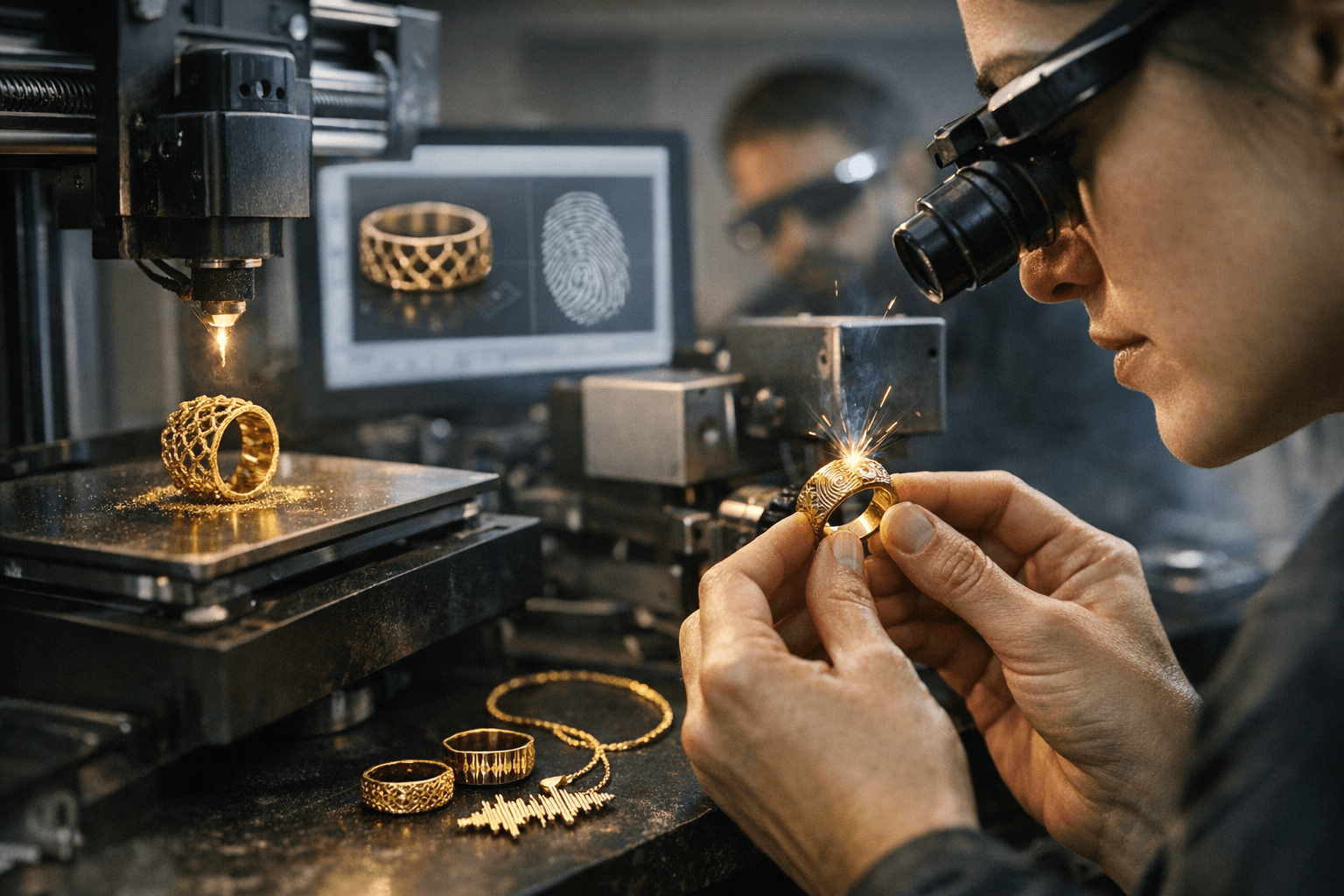
You already know what you want. A ring that maps the exact contour of your finger. A pendant that converts a loved one's voice into a wearable sound wave. A band engineered with internal lattice geometry no human hand could carve. The technology to make all of it exists today, and it is reshaping personalized jewelry at a speed the industry has not seen before.
The scale of what's happening
The global 3D printed jewelry market was valued at USD 10.64 billion in 2024 and is expected to reach USD 29.32 billion by 2032, growing at a CAGR of 13.50%, driven by something specific: the convergence of design freedom and consumer demand for pieces that could not exist any other way. Annual revenues from 3D printing hardware, materials, services, and software used in the jewelry industry are expected to top $900 million in 2026 alone. The acceleration is real, and it is not abstract. Major luxury brands are taking notice, with established jewelers from Tiffany & Co. to Bulgari investing in the technology, either developing in-house capabilities or partnering with specialized 3D printing services.
The technologies doing the work
Not all 3D printing is the same, and in fine jewelry the differences matter considerably. The Stereolithography (SLA) segment accounts for the largest market revenue share, owing to its ability to produce high-resolution and highly detailed prototypes. SLA works by curing liquid photopolymer resin with a UV laser, layer by microscopic layer, producing wax or resin patterns precise enough to feed directly into lost-wax casting. Selective Laser Sintering (SLS) is projected to witness the fastest growth rate through 2032 due to its ability to handle complex geometries and work with a wide range of materials, and it supports functional part manufacturing in high-volume runs, offering scalability, speed, and design freedom that makes it increasingly valuable for mid-to-large jewelry manufacturers.
For pieces in actual precious metal, the process is more demanding. The most common method for direct gold printing uses Direct Metal Laser Sintering (DMLS) or Selective Laser Melting (SLM), techniques that employ high-powered lasers to selectively melt and fuse gold powder particles together, building intricate structures one microscopic layer at a time. Designer Amelia Diggle of Human Interface Jewellery uses two methods in tandem: material jetting for gold and silver pieces, printing them in wax then casting in metal, while DMLS handles titanium and some silver pieces, especially for kinetic jewelry with gaps for movable parts. Her toggle rings and scroll bar necklaces, with their moving parts locked in place by controlled laser gaps, represent the kind of thing that was simply not manufacturable five years ago.
Picosecond and femtosecond lasers enable cold processing with virtually no heat-affected zones, making them ideal for precision microfabrication in fine jewelry settings where the thermal sensitivity of stones or delicate metalwork cannot tolerate the heat of conventional tools. Lasers provide a level of accuracy that traditional methods cannot match, allowing jewelers to cut metals like gold, silver, and platinum with unparalleled precision, reducing material waste and ensuring a perfect fit for gemstones.
What this means for design
This technological capability has spawned entirely new aesthetic directions. Mathematically-derived structures like Möbius strips, fractal patterns, and biomimetic forms inspired by nature can be rendered with perfect precision, while hollow, lightweight structures that maintain strength while reducing material costs have become signatures of 3D-printed jewelry.
Much of the personal jewelry produced until now has been name necklaces and birthstone rings, but personalization is getting considerably more specific in 2026: consumers want jewelry that symbolizes important memories and emotion, such as custom engravings, fingerprint jewelry, and sound waves. Consumers can now collaborate directly with designers to create truly personalized pieces, from rings that perfectly match the contours of one's finger to necklaces that incorporate personal symbols or even sound waves of a loved one's voice translated into 3D form.
On the manufacturing side, 3D printing and advanced CAD modeling allows jewelers to produce intricate details that weren't previously possible by hand, even stone cutting is advancing with new faceting styles emerging that maximize brilliance, and AI-assisted design is becoming readily accessible, helping jewelers discover different structural possibilities that broaden creativity.
The craft question: technology versus the bench
The arrival of these tools does not eliminate the bench jeweler; it changes what the bench jeweler does. The newest trend in 3D printed jewelry is to combine manual labor with cutting-edge technology, with designers fusing traditional and digital approaches by adding handcrafted elements and textures to 3D printed objects. Skilled jewelers still pour their expertise into every piece, from refining digital designs to hand-setting stones, and brands like Charles Krypell and Roberto Coin are blending 3D printing with traditional craftsmanship to create heirlooms that are both innovative and timeless.
There are real limitations worth knowing before commissioning a piece. Surface finishing often requires traditional handcrafting skills, as printed items typically need polishing and post-processing to achieve the smooth, lustrous finish expected of fine jewelry. While 14K and 18K gold alloys print reliably, achieving consistent results with higher purity gold remains challenging due to the metal's properties. These are not disqualifying constraints, but they are honest ones. Understanding the post-production handwork involved helps you ask better questions when working with a jeweler, and it explains why digitally fabricated pieces still carry skilled labor costs.
Sustainability: where the claims hold up and where they don't
The pairing of additive manufacturing with sustainability is not simply marketing language. The market growth is largely fueled by increasing adoption of digital fabrication techniques and advancements in additive manufacturing technology, enabling high-precision, customizable jewelry production at reduced lead times and lower material waste. The technology is well-suited for using recycled gold, further reducing its environmental footprint. Because DMLS and SLM build structures layer by layer from powder rather than carving from a solid block, excess material can often be recaptured and reused in a way lost-wax casting cannot match.
Within metals, recycled gold, silver, and platinum will dominate 2026 assortments because they match the performance and beauty of newly mined metals while conserving resources. The certifications to look for are specific: Fairmined and Fairtrade certifications continue to expand responsible extraction options where recycling alone is not enough, and the Institute for Responsible Mining Assurance (IRMA) gives additional mine-level assurance. The Responsible Jewellery Council remains the leading multi-stakeholder standard for traceability and fair practices, and RJC membership has grown to around 1,700 organizations in 71 countries.
On stones, the picture is similar. Lab-grown diamonds made by HPHT or CVD methods are chemically and optically identical to mined diamonds, with typical retail price advantages on similarly graded stones, and the evident advantages include predictable quality, ethical assurances independent of mining, and access to larger sizes within a given budget. But the sustainability caveat is real: buyers should ask for facility-level energy mixes and any third-party carbon accounting, as some analysts question whether every lab-grown supplier is truly low-carbon. A brand that uses DMLS with recycled 18K gold and CVD-grown sapphires from a renewable-energy facility is genuinely cleaner. A brand that pairs 3D printing with conventionally mined stones and vague "eco-friendly" language is not.
What to ask before you commission
The personalization market in 2026 has enough genuine innovation that a discerning buyer can hold makers to high standards on both craft and provenance. Before commissioning a digitally fabricated piece, the right questions are specific:
- What printing method is used, and does it output directly in metal or via a wax/resin intermediate for casting?
- Is the brand transparent about sourcing? Brands that openly share sourcing practices and material origins build trust, and information on recycling, ethical certification, and traceability allows buyers to make informed choices.
- What post-processing is required, and will that work be done in-house by trained bench jewelers or outsourced?
- For stones, does the seller offer third-party grading reports and, for lab-grown options, documentation of the facility's energy sources?
In 2026, sustainability is not a differentiator; it is the default expectation. The technology that makes it possible to print a ring around the topography of your knuckle is the same technology that, used responsibly, allows a goldsmith to work with reclaimed metal powder and near-zero casting waste. The most compelling personalized jewelry of this moment earns both descriptions: technically extraordinary and provably clean. Those two qualities are no longer in tension; the best makers have made them inseparable.
This article was produced by Prism’s automated news system from verified source data, official records, and press releases, then run through automated quality and moderation checks before publishing. The system is built and supervised by the people who set the standards it runs under. Read our full AI policy.
Did this article answer your question?