3D Printing Is Reshaping Platinum Jewelry, Unlocking New Personalization Frontiers
Additive manufacturing is moving platinum from the casting bench to the print bed, enabling personalization impossible with traditional tools. Here's how to buy smart.
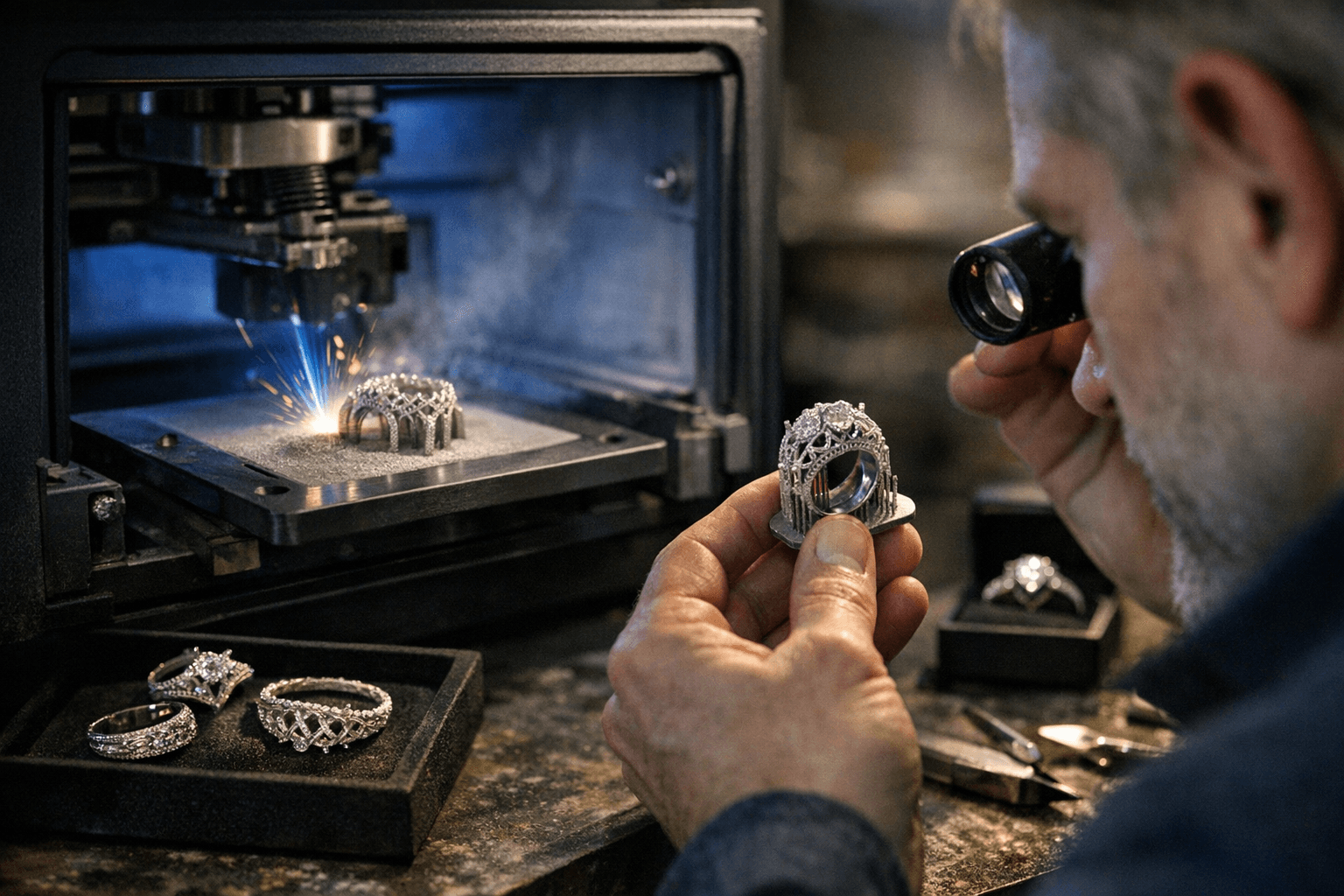
Platinum has always demanded patience. The metal's extreme melting point, roughly 400 degrees hotter than gold, made it the exclusive province of master craftspeople working with specialized equipment. Now that same intractability is becoming a design asset: the laser beds of direct metal printing systems fuse platinum powder layer by layer, at thicknesses as fine as 16 micrometers, producing forms that no hand-tool or traditional mold could replicate. The global 3D printed jewelry market is projected to grow from approximately $980 million in 2026 to more than $3 billion by 2034, at a compound annual growth rate exceeding 15%. Platinum, historically sidelined in earlier additive manufacturing experiments because of its technical difficulty, is now central to that expansion.
Why Additive Manufacturing Changes the Personalization Calculus
Traditional jewelry fabrication excels at repetition. A master carver produces a wax model; it gets cast, refined, and replicated by the hundreds. Personalization in that system means adding an engraving after the fact, swapping a stone, or adjusting a ring size. The geometry of the piece itself remains fixed.
Direct metal printing collapses that constraint. Because the piece is built from a digital file, the geometry is entirely malleable until the moment the file is sent to print. Paired with CAD tools, the process supports a consumer shift toward bespoke pieces that reflect personal identity and meaning. A monogram can be woven through the interior of a ring shank, invisible from the outside but structurally permanent. A message in Braille can become the surface texture of a bangle. A hollow torc can be engineered to achieve a precise target weight. None of this requires a new mold; it requires only a revised file.
Rapid iteration is the other transformational benefit. In traditional bespoke work, moving from sketch to wax model to cast sample to revision can take weeks. A digital workflow compresses that to days: a jeweler can send three-dimensional renderings, adjust proportions in real time, and move to a print run in a fraction of the traditional timeline.
When to Choose 3D Printing for Your Custom Piece
Additive manufacturing is the right call when the design brief demands something casting cannot deliver:
- Complex internal geometry: Hollow structures, lattice interiors, and interlocking elements that cannot be demolded require the layer-by-layer build that only printing provides. Additive manufacturing enables complex and organic forms, lightweight hollow structures, and intricate interlocking elements that are virtually impossible to achieve with traditional casting.
- Organic and sculptural forms: Designs that mimic natural structures can be modeled with complete fidelity to the digital source, without the simplifications traditional casting imposes.
- Precision fit for unusual proportions: A knuckle ring that must clear a joint before settling into place, or a stacking set designed to nest at specific angles, benefits from the dimensional exactitude that direct metal printing delivers.
- Micro-personalization at the fabrication stage: Hidden messages, embedded dates, interior inscriptions that run the full circumference of a shank are built into the print file and carry no additional production cost compared to a blank surface. 3D printing enables unprecedented levels of customization, including on-demand adjustments to sizing, integration of personalized design elements, and the creation of unique bespoke pieces at scale.
- Rapid iteration on bespoke commissions: Multiple design reviews without the tooling cost of multiple wax models.
When Traditional Fabrication Still Wins
3D printing is not the universal answer. For simpler forms, a classic solitaire setting, a plain band, a collet-set pendant, traditional casting is faster, less expensive to finish, and produces a surface that requires less post-processing labor.
The finishing question is critical. Post-processing requirements mean that 3D-printed jewelry may require additional finishing touches like polishing or stone setting, depending on the chosen material and design complexity, and these steps can add time and cost to the production process. If a client expects the uniformly brilliant surface of a traditionally cast and hand-finished platinum ring, the finishing labor will close much of the cost gap between methods.
Repairability is a related consideration. A traditionally cast platinum band can be sized, soldered, and refinished by any competent bench jeweler. A direct-metal-printed piece with a complex hollow interior may require the original maker for significant repair, since conventional bench tools cannot replicate its internal geometry. For an heirloom piece intended to last generations and be resized over a lifetime, that distinction matters.
The Tùsaire Collection: What Commercial Reality Looks Like
The clearest current evidence of where the technology stands is the Tùsaire Collection, designed by Scottish-American jeweler Maeve Gillies in collaboration with Platinum Guild International, with printing executed by ProGold in Italy. "Tùsaire" means "pioneer" in Scottish Gaelic, and the collection represents the world's first commercially launched platinum-focused line using direct metal 3D printing, transitioning 3D-printed platinum jewelry from experimental novelty to commercial reality.
The collection spans 30 statement pieces ranging from $800 to $35,000 and debuted at the Inhorgenta show in Munich. The pieces are ultralight and hollow, with platinum and titanium that swirls and coils into bold modern silhouettes. The centerpiece, "Torc of the King of the Mountains," features platinum and titanium set with a Scottish Renfrewshire quartz, priced at $28,500. Portions of the design are deliberately left unpolished while others are high-polished, showcasing the range of surface qualities the 3D printing technology can produce.
Tai Wong, global director of innovation at PGI, described the project's intent: "We really wanted to put 3D printing of platinum to the test, to identify advantages and challenges, in hope to expediate the technology's application in jewelry to create novel designs and experience. There is no doubt additive manufacturing will be very important for the future of jewelry, as it unlocks many new possibilities."
Pandora's Platinum Pivot: A Commercial Signal
At the mass-market end of the spectrum, Pandora's move into platinum-plated jewelry offers a different but equally instructive data point. In Q1 2026, the world's largest jewelry brand by volume launched platinum-plated versions of best-selling bracelets across 30 stores and online in Northern Europe, using an optimized version of its proprietary PANDORA EVERSHINE metal-alloy core, a technique it has refined since 2015 for gold-plated products. A global rollout, including additional bracelets and charms, is planned for the second half of 2026.
The motivation is partly defensive: rising silver and gold costs have pressured industry cost structures, and platinum plating offers a way to diversify commodity exposure while maintaining price accessibility for consumers. But the consumer data Pandora cites is striking in its own right. A July 2025 survey of 23,000 participants found that 78% recognized platinum as a precious metal, compared to 69% for sterling silver. That perception gap has direct implications for anyone commissioning a custom piece: platinum's prestige is increasingly legible to buyers who do not consider themselves collectors.
Pandora has also committed to shifting its platinum sourcing to recycled material over time, consistent with its existing practice of using 100% recycled silver and gold since 2024. For buyers who care about provenance, asking where a jeweler sources platinum powder or alloy and whether it carries recycled-metal certification is now a reasonable and answerable question.
Before You Commission: Questions to Ask Your Jeweler
Any bespoke commission involves trust, but a 3D-printed platinum piece introduces technical variables that a traditionally fabricated piece does not. Before approving a custom order, press your jeweler on these:
- What platinum alloy is being used? Pt950 (95% platinum, typically alloyed with ruthenium or iridium) is the fine jewelry standard. New platinum alloys and qualified powders for additive processes are improving manufacturability and expanding design possibilities, but alloy composition affects hardness, surface color, and hallmarking eligibility.
- How is porosity addressed? Metal binder-jetted parts can show relatively large and inconsistent porosity, affecting the density of the final part. Ask whether the jeweler uses Hot Isostatic Pressing (HIP) or a verified densification protocol for their specific printing method.
- What does the finishing process include? A high-polish platinum finish requires significant hand labor after printing. Confirm whether the quoted price covers full finishing or whether additional fees apply.
- What will the finished piece weigh? Hollow printed platinum pieces can weigh significantly less than their cast equivalents, which affects both the wearing experience and the intrinsic metal value.
- Will it carry official hallmarks? In markets with hallmarking requirements, confirm that the piece will be submitted for assay certification before delivery.
- Who can repair it? If the piece has hollow internal structures, ask explicitly whether a standard bench jeweler can resize or repair it, or whether it must return to the original maker.
- What is the realistic lead time? 3D printing compresses the iteration phase, but post-print finishing, stone setting, and quality checks still take time. A realistic bespoke timeline is typically four to eight weeks from an approved CAD file to finished piece, depending on complexity.
Cost, Comfort, and Durability: The Trade-Off at a Glance
| Factor | 3D-Printed Platinum | Traditional Cast Platinum |
|---|---|---|
| Design complexity | Unlimited: hollow, lattice, organic forms | Constrained by mold geometry |
| Personalization depth | Embedded at fabrication; no add-on cost | Post-fabrication only (engraving, sizing) |
| Surface finish | Requires hand-finishing after print | Ready for polishing post-casting |
| Weight | Lighter (hollow structures possible) | Heavier (solid forms standard) |
| Durability | High; porosity management is the key variable | Very high; established long-term benchmark |
| Repairability | Complex pieces may need original maker | Standard bench repair widely available |
| Lead time | Faster iteration; similar overall timeline | Slower prototyping; faster production runs |
| Cost vs. complexity | Cost scales with finishing, not geometry | Cost scales with design complexity |
The table captures a truth that is easy to miss: with 3D-printed platinum, you pay for finishing, not for complexity. A mirror-polished band with an intricate interior monogram costs the same to print as a blank band. With traditional casting, every additional design element adds bench time and therefore cost. For buyers who want genuine personalization built into the architecture of a piece rather than applied to its surface, additive manufacturing is, structurally, the more economical choice.
What Comes Next
The projected growth from $980 million to more than $3 billion by 2034 is driven by increasing consumer demand for customizable, intricate, and digitally enabled designs, and platinum is positioned to benefit from every one of those tailwinds. Maeve Gillies producing 30 commercially available pieces in direct-printed platinum, and Pandora running a platinum-plated pilot with the infrastructure to go global by year's end, signal that the technology has cleared the proof-of-concept stage. What remains are finishing standards, alloy certification, repair networks, and hallmarking protocols: the infrastructure of a mature craft. That infrastructure is being built now, and the questions in this guide are the ones that will determine whether the piece you commission today wears as beautifully in twenty years as it does the day it leaves the bench.
This article was produced by Prism’s automated news system from verified source data, official records, and press releases, then run through automated quality and moderation checks before publishing. The system is built and supervised by the people who set the standards it runs under. Read our full AI policy.
Did this article answer your question?