AI Is Revolutionizing Jewelry Design, Personalization, and Custom Creation
Before AI, changing a single engraving meant a brand-new sketch. Now it takes seconds — and that shift is remaking every stage of jewelry design.
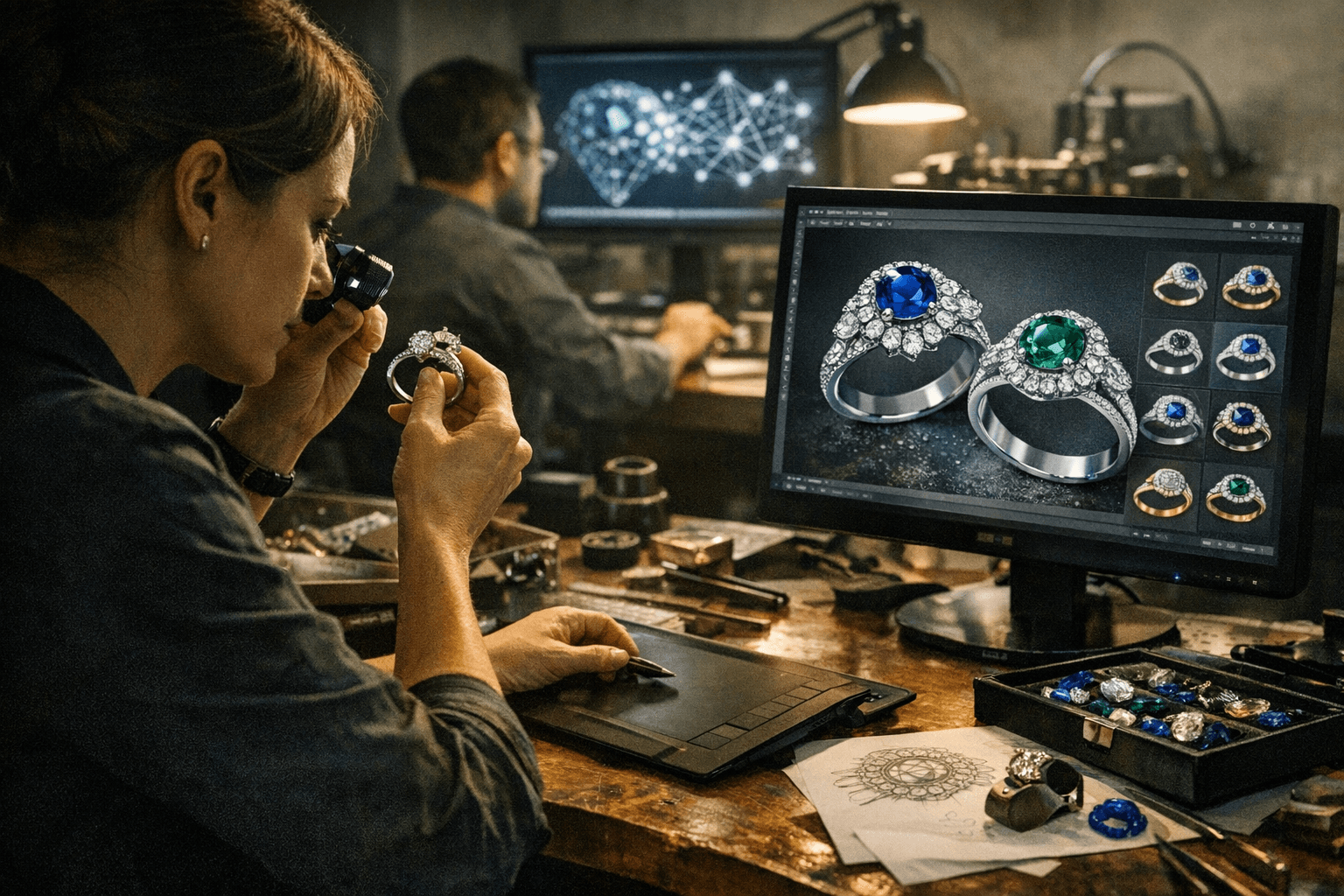
The design appointment used to follow a familiar script: a customer sits across from a jeweler, describes a vague vision, and leaves with a promise that sketches will arrive in a few days. What comes back rarely matches the image in their head. Today, that same appointment can unfold in real time — metal colors swapped, gemstone shapes compared side by side, proportions adjusted on screen before anyone has committed to a single millimeter of gold. AI has become, as one jewelry design platform puts it, "a quiet partner in modern jewelry design studios, offering new capabilities, streamlining workflows, and expanding creative possibilities."
That transformation is no longer a pilot program or a luxury-brand experiment. It is reshaping how jewelry is imagined, customized, prototyped, and worn — from engagement rings to birthstone pendants to branded corporate commissions.
How AI Generates Designs
At its core, AI jewelry design works by analyzing large datasets of existing designs, current trends, and aggregated customer preferences to generate new concepts. The technology uses algorithms to produce detailed variations of specific components — chains, charms, beads, clasps — based on either text prompts or initial hand-drawn sketches. A designer can describe a piece in words, upload a rough drawing, and receive multiple fully rendered variations within the same conversation.
This capability compresses what used to be a multi-day iterative process. The time between initial concept and workable prototype shrinks substantially because the system can surface a wider range of styles faster than any single designer could sketch by hand. AI also allows adjustment of materials, shapes, and patterns in real time, which improves efficiency across both the design studio and the manufacturing floor.
What Changes for the Customer
The most immediate customer-facing shift is visibility. Previously, buying a custom piece required an act of faith: trust the jeweler's sketch, approve a wax model, and wait. AI removes much of that uncertainty by letting customers compare metal colors, gemstone shapes, and stone sizes instantly, on screen. Real-time rendered visualizations of rings, necklaces, and bracelets make abstract decisions — rose gold versus platinum, oval versus cushion cut — concrete and comparative rather than hypothetical. As Markschneiderdesign observes, "This reduces uncertainty and increases confidence, especially for customers who can't see the piece in person."
The design appointment itself changes character. Rather than the customer describing and the designer interpreting, both parties are working together on a live visual. It becomes, as Markschneiderdesign describes it, "a more interactive and personalized experience for the customer and designer." The customer is no longer selecting from a catalog; they are authoring the piece.
AI and Personalization
Personalization has always been jewelry's emotional core — the engraved date inside a wedding band, the birthstone set in a pendant for a child's first birthday. What AI changes is the cost and speed of delivering that meaning. "Personalization is one of the biggest shifts in modern jewelry design, and AI has amplified it," notes Markschneiderdesign. "Customers want pieces with meaning — birthstones, symbols, initials, or engravings. Before AI, customizing even small details meant creating a completely new sketch, but now AI makes those adjustments within seconds."
The technology goes further than simply executing a customer's stated request. Once AI interprets what the customer wants, it can suggest complementary designs, proportions, or themes — functioning less like a drafting tool and more like a knowledgeable collaborator. That collaborative quality carries particular weight for milestone pieces. "This is especially powerful for engagement rings and other milestone jewelry pieces because it adds another emotional element to the process," Markschneiderdesign notes. Instead of approving a pre-designed setting, the customer becomes, in a meaningful sense, a co-designer.
Component-Level Personalization
AI's personalization capabilities extend below the level of the whole piece to the individual components that make it. Beyond choosing an overall silhouette, customers can now influence the granular details: unique patterns generated for individual beads, optimized shapes for charms, chain styles suggested to complement the final design. AI analyzes user input — style preferences, occasion, material choice — and generates designs that align with personal aesthetics, then allows interactive adjustment of size, shape, and pattern. Designers can also receive recommendations based on a customer's past selections or trending styles, reducing the number of manual iterations before arriving at a piece that genuinely matches the wearer's personality.
The Designer's Experience
For the working jeweler, the fear that AI replaces artisanship misreads what the technology actually does. Every source in this space makes the same point: AI augments rather than substitutes. "AI doesn't replace human touch, it just opens up creative possibilities," as Markschneiderdesign puts it directly. The craftsperson still makes the piece; AI accelerates the creative phase that precedes the bench work.
In practical terms, AI offers designers a greater range of possibilities to explore within a single session, and faster adjustments when a client changes direction. The result is that designers can produce more unique work more quickly without compromising the quality of execution. The handmaking, the stone setting, the finishing — those remain human acts. What changes is the volume and variety of ideas a designer can bring to a client before a single piece of metal is touched.
Business Benefits: Speed, Precision, and Reach
The business case for AI in jewelry rests on three concrete advantages. First, speed and precision: faster design turnarounds with fewer revision cycles mean less time spent on each commission and more capacity overall. Second, personalization at scale: every detail, from gemstone placement to engraving depth, can be made unique without the overhead that once made true customization prohibitively expensive for anyone but the highest-budget clients. Third, accessibility: high-quality custom designs are now within reach for more customers globally, not only those who can walk into an atelier in a major city and spend unlimited time with a senior designer. J&M Jewelry, which launched an AI Jewelry Designer tool, frames these advantages plainly: "This technology saves time, reduces guesswork, and brings greater confidence to the customization process."
AI and Sustainable Practice
One of the less obvious benefits of AI-driven design is its environmental implication. Digital prototyping allows a customer to arrive at their final approved design entirely on screen, without producing physical samples or wax models of every variation explored along the way. By simulating designs digitally, jewelers can reduce material waste and only produce what customers have already confirmed they want. This shift aligns naturally with a broader industry trend: the rise of lab-grown diamonds and gemstones, which carry more traceable, lower-impact sourcing credentials than their mined equivalents. The combination of AI-optimized production and ethically sourced stones addresses two of the most persistent concerns in modern fine jewelry simultaneously.
A Cultural Shift, Not a Software Update
It would be easy to frame AI in jewelry as a technology upgrade — a faster computer, a better rendering engine. The more accurate frame is cultural. The relationship between a customer and a jewelry piece has historically been passive: you walk into a store, you choose from what exists, and you take it home. AI inverts that dynamic. The customer brings their own aesthetic preferences, occasion context, and material choices; the system interprets and responds; and what emerges is genuinely theirs in a way that catalog selection never was.
"This shift isn't a short-lived tech trend," Markschneiderdesign argues. "It represents a huge cultural change in how consumers, designers, and brands interact with jewelry." The finished piece has always carried emotional weight. What AI adds is the possibility that the process of making it carries that weight too — that the hours spent choosing, adjusting, and refining become part of what the piece ultimately means to the person who wears it.
This article was produced by Prism’s automated news system from verified source data, official records, and press releases, then run through automated quality and moderation checks before publishing. The system is built and supervised by the people who set the standards it runs under. Read our full AI policy.
Did this article answer your question?