AI Tools, AR Try-On, and Social Commerce Reshape Jewelry Marketing in 2026
AR try-on users are 65% more likely to complete a jewelry purchase, and social commerce is crossing $100 billion in U.S. sales this year. Here's what that means for personalized jewelry brands.
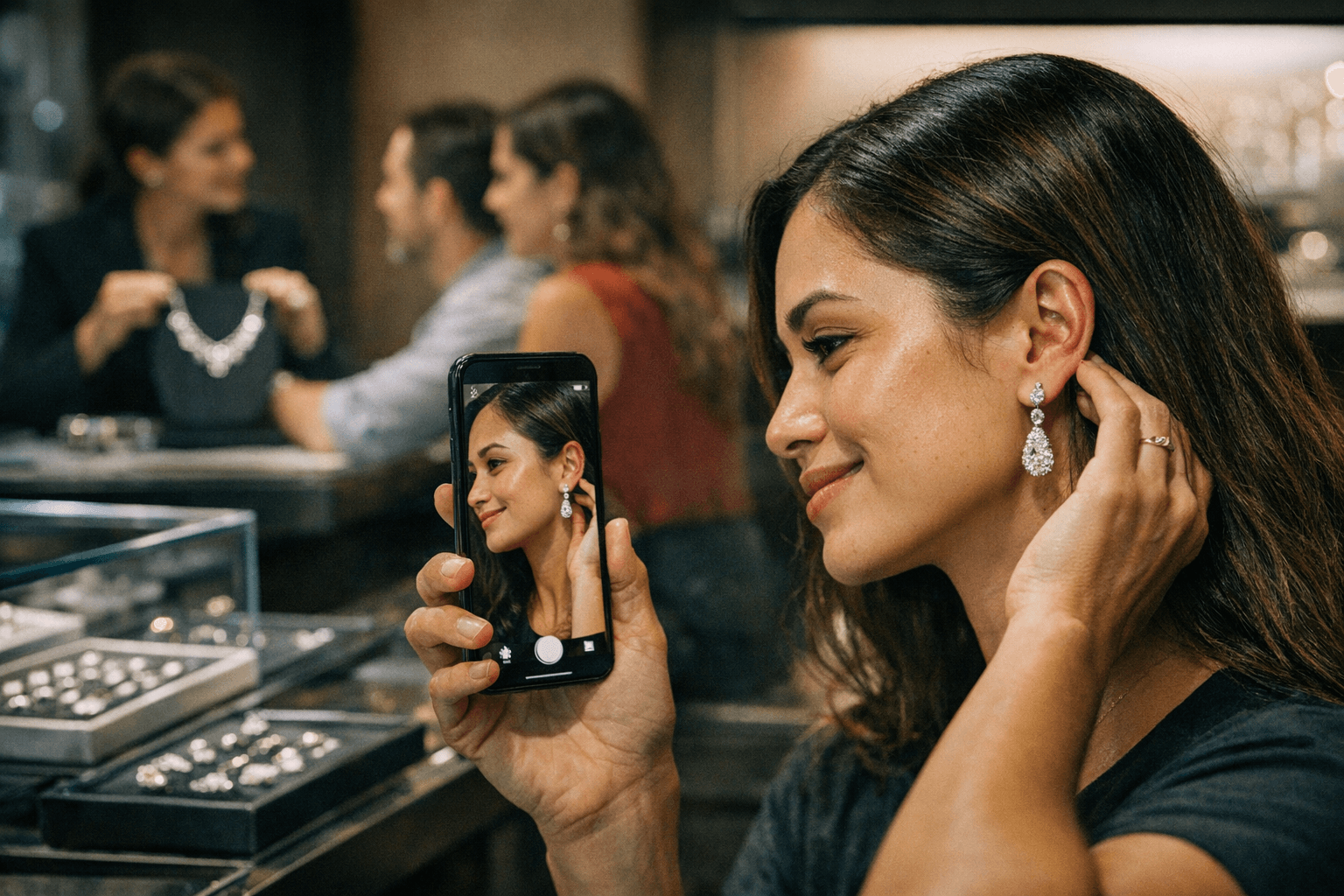
There is a number that should stop every jewelry brand in its tracks: customers who use AR features are 65% more likely to complete their purchase. That single figure reframes the entire conversation about how personalized jewelry is marketed, discovered, and sold in 2026. The tools reshaping this industry are not novelties layered on top of traditional retail; they are fundamentally altering who buys, how they decide, and where the transaction actually happens. Four forces are driving this shift: AI-powered personalization, augmented reality try-on, social commerce, and educational content. Understanding each one, and how they work together, is no longer optional for serious jewelry brands.
AI-Powered Personalization: From Intuition to Intelligence
The in-store sales associate who remembered your preference for pavé settings and yellow gold is not extinct; she has simply been scaled. By analyzing a customer's browsing history, purchase patterns, social media activity, and expressed preferences during online interactions, AI algorithms can identify the types of jewelry most likely to appeal to them, presenting a curated selection that saves time while increasing the likelihood of a successful sale. That curation, once the province of a gifted salesperson on a slow afternoon, now operates continuously across an entire catalog.
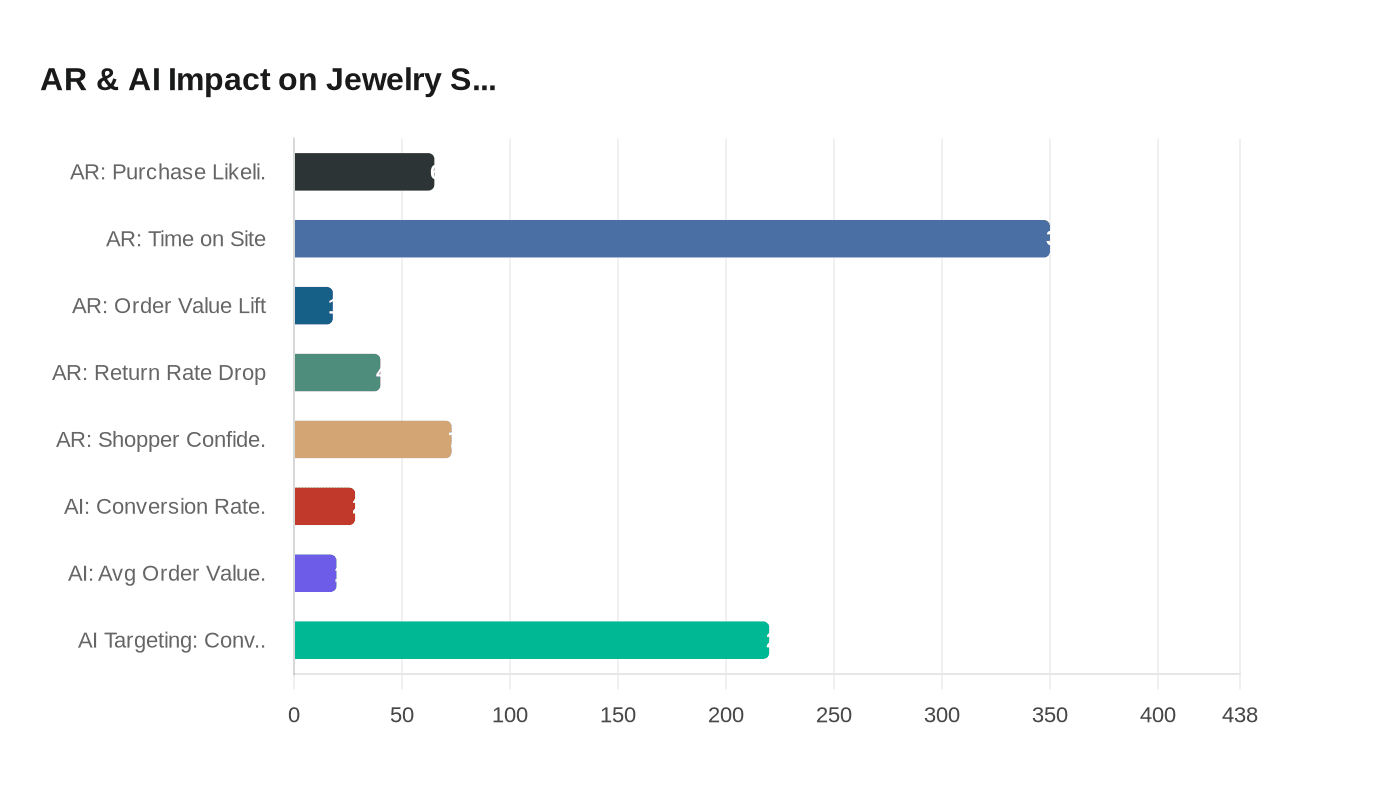
The practical results are measurable. Brands using data-driven targeting and AI-powered personalization are generating up to 3.2x higher jewelry ecommerce conversion rates than traditional campaigns. Even more specifically, a McKinsey study found that 67.4% of jewelry buyers aged 18 to 44 now expect some form of product customization at the point of purchase, and brands offering AI-driven design configurators reported a 28.3% higher conversion rate and a 19.7% increase in average order value compared to retailers without personalization tools.
Hyper-personalization takes this further: AI can predict an anniversary or birthday and serve a personalized ad featuring the exact style of jewelry the customer previously viewed. The difference between a relevant ad and an intrusive one is timing and context, and AI is increasingly getting both right. AI is being used to personalize marketing campaigns, so instead of sending generic emails or advertisements, brands can now target customers with messages relevant to their individual interests, showcasing new arrivals that align with their style, offering exclusive discounts on items they've previously viewed, or inviting them to participate in personalized events.
AR Virtual Try-On: The Fitting Room Comes Home
Buying a ring, a pair of drop earrings, or a layered necklace has always been a tactile act. The weight of the metal, the way a stone catches light, the proportion of a pendant against the collarbone: these are things photographs cannot communicate. Augmented reality is not a perfect substitute, but the data makes a compelling case that it is the next best thing.
Research shows specific changes in how consumers behave when shopping for jewelry online: users spend 4.5 times longer on websites with AR features, 73% of shoppers feel more certain about their choices, and average order values go up by 18% when AR is used. Return rates, the persistent cost center of online jewelry retail, respond directly: retailers using virtual try-on solutions have seen a 40% decrease in return rates, especially for expensive items like engagement rings.
The technology behind these experiences has matured significantly. Advanced AI algorithms accurately track facial features and hand movements, ensuring that virtual jewelry pieces are displayed in a realistic and natural way. Platforms can now render a diamond solitaire on a specific finger, adjusting for scale, lighting, and angle as the user moves their hand. Tiffany & Co. saw online revenue climb roughly 30% after embedding an AI-augmented try-on tool in its app, a lift echoed across the sector. According to Deloitte, retailers using similar AI-powered try-on experiences for jewelry websites enjoy conversion rates about 40% higher than peers without the feature, alongside a 20% bump in average order value.
The physical retail dimension is also expanding. Augmented reality technology is playing a significant role in adding flexibility to modern stores, integrated into smart mirrors or kiosks, allowing shoppers to virtually try on jewelry without the help of a salesperson or physically handling it in real time. The AR market itself reflects the scale of investment behind these capabilities: the global AR market size was valued at $18.4 billion in 2020 and is likely to reach $95.4 billion in 2026.
Brands implementing "social try-on" features allow users to share virtual try-on experiences with friends, creating a collaborative shopping environment. That sharing behavior is not incidental; it is a marketing channel in its own right, extending the brand's reach organically at precisely the moment of highest engagement.
Social Commerce: The Storefront Is Now the Feed
The purchase funnel that once ran from a magazine advertisement to a boutique visit to a point-of-sale transaction has been compressed into a single scroll. Social commerce is the integration of ecommerce functionality into social media platforms, enabling consumers to browse, discover, and purchase products directly within apps like TikTok, Instagram, and Facebook. Unlike traditional ecommerce where shoppers arrive with purchase intent, social commerce thrives on discovery, inspiration, and impulse; users encounter products through creator content, algorithm-driven feeds, and livestream shopping, then complete transactions without switching to a retailer's website.
The numbers behind this shift are not modest. In 2026, social commerce sales will grow another 18.0%, surpassing $100 billion in the U.S. for the first time. TikTok Shop alone is projected to reach $23.41 billion in U.S. ecommerce sales in 2026, a 48% increase year-over-year, giving it a larger U.S. ecommerce business than Target, Costco, Best Buy, or Kroger.
For jewelry specifically, 28% of jewelry discovery among Gen Z happens via social platforms, and Instagram, TikTok, and live shopping have become direct sales channels. Instagram Shopping allows brands to tag products in posts, stories, and Reels, and Reels video views for luxury brands grew 234% in Q2 2025, as some brands shift content distribution from TikTok.
Live shopping is a particular growth vector. TikTok livestreams drove 84% year-over-year sales growth for participating brands during Black Friday/Cyber Monday 2025, validating the format as a serious conversion channel rather than a novelty. Live shopping allows for real-time Q&A, which builds the trust needed to close high-ticket sales. For jewelry, where an engagement ring or a tennis bracelet represents a significant emotional and financial commitment, that trust component is not secondary. It is the entire transaction.
Trust, however, is not guaranteed. Consumer trust remains a significant barrier to social commerce adoption, and 26% of consumers don't trust influencer marketing, more than double the 11% who distrust advertising overall. Brands that treat social commerce as a broadcast channel rather than a conversation will find the numbers less forgiving. Influencer marketing is evolving towards authenticity and niche relevance, with brands increasingly partnering with micro and nano influencers who have highly engaged and loyal audiences rather than chasing celebrity reach at a premium price.
Educational Content: The Gemologist's Advantage
Jewelry is one of the few retail categories where knowledge genuinely sells. A customer who understands the difference between a bezel and a prong setting, who knows why a VS1 clarity grade matters for a three-stone ring, or who can recognize the difference between 14- and 18-karat gold in terms of both durability and warmth, is a more confident buyer. Confidence converts. Jewelry is a considered purchase that often requires trust before a customer commits to buying. Email gives brands a direct channel to educate customers about craftsmanship, materials, and brand values, all of which contribute to building the perceived value that justifies the price point. Subscribers who trust a brand are significantly more likely to convert and return.
The educational imperative has taken on a new dimension with the rise of AI search. The rise of Generative Engine Optimization, or GEO, is about showing up in AI search results. Jewelers being rewarded with GEO are the ones answering real questions and educating customers via their online content. This doesn't favor the biggest budgets; it favors the most helpful jewelry websites. A well-written website page that answers questions and explains jewelry in depth will often outperform a heavily promoted site that says very little.
In 2026, audiences are more skeptical and selective about what they consume. Generic promotional content is losing effectiveness, while authentic, informative, and emotionally engaging content is gaining traction. Storytelling has become a powerful tool for brands to connect with their audience on a deeper level. A jeweler explaining why they selected a particular stone typically outperforms a polished, high-budget ad — a finding that reframes the value of gemological expertise as a marketing asset, not just a technical qualification.
Educational content, behind-the-scenes insights, and user-generated content are particularly effective in building credibility and trust. For a jeweler, "behind the scenes" might mean showing the lost-wax casting process for a custom signet ring, explaining why a particular sapphire was selected for its saturation rather than its weight, or demonstrating how prong tips are retipped during a restoration. This is content that no algorithm can fabricate and no mass-market retailer can easily replicate.
The Convergence
What makes 2026 different from previous digital marketing moments is that these four levers are no longer operating in isolation. Social commerce integration allows direct purchases through platforms like Instagram and TikTok, personalization features enable custom jewelry design through AR interfaces, and virtual showrooms create immersive brand experiences. A customer might discover a piece through a TikTok creator, immediately try it on via an integrated AR filter, read an educational post about the stone's provenance, and complete a purchase without ever leaving the app. That seamless path is where serious jewelry brands are now competing, and the ones building fluency in all four disciplines are the ones compounding their advantage.
The median online jewelry order size has risen to $374 in 2026, with customized and engraved pieces commanding a median order value 41% higher at $527, reflecting how personalization features are directly elevating average transaction values across ecommerce platforms. The margin in personalization is not just psychological; it is arithmetical.
This article was produced by Prism’s automated news system from verified source data, official records, and press releases, then run through automated quality and moderation checks before publishing. The system is built and supervised by the people who set the standards it runs under. Read our full AI policy.
Did this article answer your question?