Art Jewelry Forum spotlights collectible personalized pieces in June roundup
Art Jewelry Forum’s June roundup makes personalization feel sculptural, pairing etched surfaces, oxidized silver, and editioned forms with pieces collectors can actually wear.
Art jewelry becomes most intriguing when it feels intimate without losing its edge, and Art Jewelry Forum’s June On Offer roundup leans into that tension beautifully. The selection gathers one-of-a-kind and editioned works chosen by member galleries, turning personalization into something more sophisticated than initials or birthstones: a field of small-scale objects with strong ideas, distinctive materials, and the kind of handwork that reveals itself up close.
A roundup built for collectors, not just browsers
On Offer is part of Art Jewelry Forum’s bi-monthly format, a standing invitation for its international gallery supporters to present extraordinary pieces they have personally selected to tempt and inspire readers. That matters because AJF, founded in 1997 as a 501(c)(3) nonprofit, has long treated contemporary jewelry as both an exhibitionary medium and a market in motion. The June edition fits that mission neatly: it does not simply show objects, it frames them as purchaseable works of art with lives beyond the vitrine.
This is where the appeal of personalized jewelry sharpens. The strongest pieces in the roundup do not rely on overt sentimentality. Instead, they offer something more lasting: a trace of the maker’s hand, a deliberate material contrast, or a motif that feels loaded with private meaning. That is the territory where bespoke jewelry becomes compelling, because the best commissions borrow an artist’s point of view, not just a customer’s name.
Kelly Jean Conroy and the power of the etched surface
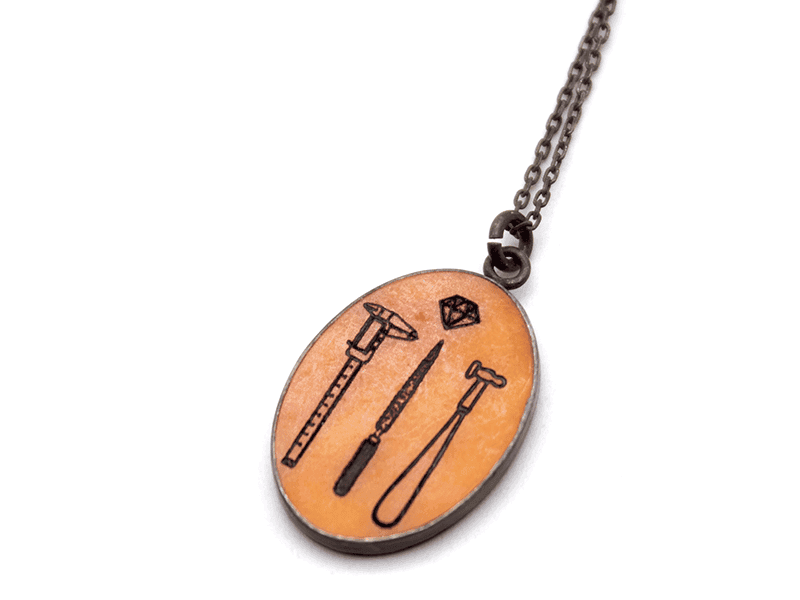
Kelly Jean Conroy’s Orange Tool Pendant, dated 2024, is the kind of piece that rewards attention. Listed in the June roundup as a necklace in sterling silver and etched stone, it measures ½ x ¾ x ¹⁄ inches, or 13 x 19 x 2 mm, and is priced at US$80 through Baltimore Jewelry Center in Baltimore, Maryland. Its small scale is part of its force: the pendant reads as a tiny, concentrated composition rather than a decorative afterthought.
Conroy’s work is especially useful as a reference point for anyone considering a custom piece with personal resonance. AJF’s January coverage described her statement necklaces as built from etched mother-of-pearl, with each unique element etched by hand and then prong set in oxidized sterling silver. That combination is worth borrowing: prongs leave the edges visible, which preserves the object-like quality of the material, while oxidized silver brings out the brightness of the etched surface instead of competing with it. For a bespoke commission, the lesson is clear. A personal piece does not have to be literal to feel intimate. It can carry meaning through surface, texture, and the discipline of hand-finished detail.
A separate AJF object feature identifies another Conroy necklace, Lapis with Moth, made from laser-etched lapis and oxidized sterling silver. The motif suggests how a commission can become narrative without becoming precious. A moth, a tool, a fragment of stone: these are not generic luxury cues, but symbols with texture and character. If you want a piece that feels artistic rather than mass-market, ask for a material that can be etched, cut, or oxidized in a way that preserves the evidence of process.

Sofia Björkman’s sculptural language in wearable form
If Conroy’s work draws power from surface, Sofia Björkman’s objects make their case through volume and silhouette. AJF’s object features show her working across brooches and necklaces in PLA, acrylic paint, steel, silver, and stainless steel, with pieces titled Yellow Wing, Butterfly, Field, and Landscape. Those titles are telling. They suggest a practice that moves between nature and abstraction, treating jewelry as a compact sculpture rather than a miniature object that merely decorates the body.
Yellow Wing, a 2024 brooch, is listed as a substantial form, measuring 15 ¾ x 10 x 4 inches and weighing 70 grams, in polylactic acid, acrylic paint, and steel. That scale changes the conversation entirely. In a custom context, it argues for jewelry that is intentionally dimensional, even slightly architectural, especially when the wearer wants a piece to read from across a room. Brooches in particular invite this kind of design thinking because they can behave almost like portable artworks pinned to fabric, visible from afar and legible up close.
Björkman’s own biography adds useful context to that artistic range. She is a Stockholm-based jewellery artist and curator, and after graduating from Konstfack University of Arts and Crafts in 1998, she founded Platina, a gallery and studio for art jewellery. That dual role, maker and curator, helps explain why her work feels so considered: it sits at the intersection of display, wearability, and the politics of looking. For readers commissioning a personalized piece, her example suggests that the most memorable jewelry often begins with a strong formal idea, then finds its place on the body.
Why editioned work still feels personal
The roundup also includes Walid Akkad’s editioned bracelet, a reminder that collectibility in art jewelry is not reserved only for one-off objects. Editioned work offers a different kind of intimacy: the design can circulate, but the experience of wearing it still feels individual. In a market saturated with supposedly unique gifts, that balance can be surprisingly attractive. It allows a buyer to participate in an artist’s language without flattening the work into mass production.
That distinction matters for anyone thinking about a bespoke commission. One route is absolute singularity, a piece that exists only once. Another is a controlled edition, where the design is repeatable but still carries the authority of a maker’s hand and a clearly defined artistic logic. Both approaches appear in AJF’s June roundup, and both push against the flatness of commercial personalization.
What to borrow for a custom commission
The most compelling details in this roundup are not decorative flourishes, but structural choices. They give a clear blueprint for jewelry that feels personal and artful at once.
- Use etched surfaces to hold memory in texture rather than in text.
- Choose oxidized sterling silver when you want contrast, shadow, and a more sculptural outline.
- Consider prong settings when the point is to keep each element visibly separate, not hidden inside a heavy mount.
- Borrow from brooch-making when scale matters: a larger form can turn a necklace or pin into a tiny wearable sculpture.
- Look to motifs such as moths, wings, fields, and tools when you want symbolism that feels precise rather than sentimental.
The June On Offer roundup works because it treats personalized jewelry as a serious design language. Whether the piece is a modest US$80 pendant or a brooch with real sculptural presence, the same principle applies: the most desirable custom work is rarely the loudest. It is the piece where material, setting, and form align so completely that the object feels inevitable.
This article was produced by Prism’s automated news system from verified source data, official records, and press releases, then run through automated quality and moderation checks before publishing. The system is built and supervised by the people who set the standards it runs under. Read our full AI policy.
Did this article answer your question?