Best Name Necklaces Ranked by Material, Durability, and Value
Not all name necklaces age the same: the gap between a $30 plated pendant and a $120 gold-filled piece can be measured in years of daily wear.

After mapping every material tier from budget stainless steel to solid gold, one finding cuts through the noise: a name necklace lives and dies by its base metal, not its price tag label. Shoppers consistently overpay for gold-plated pieces with microscopically thin coatings and underpay attention to the construction details that determine whether a necklace survives a year of daily wear or a decade of it. Here, ranked from most durable to most budget-accessible, are the name necklace materials worth your consideration, along with the criteria that separate a lasting keepsake from a disappointing fadeout.
1. Solid gold nameplate necklaces
Solid gold can be worn every day without worry of tarnishing or fading; it will always stay gold, whereas the gold layer will eventually wear off of plated, vermeil, and gold-filled jewelry. For a name necklace meant to last generations, solid gold (10k, 14k, or 18k) is the only material that never asks you to change your habits around it. It is also the only option that retains its value well over time and can be easily polished to restore its original shine if it gets scratched or dull. The trade-off is straightforward: cost. A 14k solid gold nameplate will run significantly more than any plated alternative, but it is also the one you hand down.
2. Gold-filled name necklaces
Gold-filled jewelry has a thick layer of solid gold that is heat- and pressure-bonded to the sterling silver core, making it far more durable than gold-plated, vermeil, or other plated alternatives. The bonding process means the gold layer is not merely sitting on the surface; it becomes mechanically fused to the base, which is why gold-filled pieces can handle daily wear, sweat, and moisture in ways that plated jewelry cannot. For everyday staples, gold-filled investment is warranted for exceptional longevity, while fashion pieces that rotate through a collection can do fine at lower tiers. If you want a name necklace you can forget to take off, gold-filled is the most practical non-solid-gold answer.
3. Gold vermeil name necklaces
Gold vermeil (pronounced ver-may) is 2.5 microns of gold plating on top of sterling silver; US standards require at least 2.5 microns, and it is hypoallergenic, so people with metal allergies can wear it safely. The sterling silver base matters enormously here: when the gold plating does wear down on vermeil, there is sterling silver underneath, making it more hypoallergenic than gold-filled or gold-plated jewelry, which use copper or brass as a core. Quality vermeil can last three to five or more years looking beautiful, but that range narrows sharply with daily wear and widens considerably if the piece is reserved for occasions. Critically, if a vermeil necklace only has the minimum layer of gold, it is likely to start wearing away soon after purchase and will need replating periodically. Always ask the seller for the micron thickness: anything below 2.5 microns is not technically vermeil by U.S. Federal Trade Commission standards, regardless of how it is labeled.
4. Sterling silver (.925) nameplate necklaces
Silver is a soft metal, which is why many jewelers opt for sterling silver; sterling silver mixes copper in with silver, resulting in a more durable piece of jewelry, and silver jewelry is graded based on the percentage of silver in a piece. The .925 stamp means 92.5% pure silver, with the remainder typically copper for structural integrity. Sterling silver tarnishes with exposure to air and moisture, but unlike plated options, it can be polished back to a bright finish indefinitely without fear of exposing a cheaper base metal. Dainty chains and delicate necklaces can be difficult to clean once they tarnish, so pieces requiring minimal upkeep are recommended. For name necklaces, sterling silver hits a genuine sweet spot: it is durable enough for everyday wear, hypoallergenic for most skin types, and priced accessibly compared to gold options.
5. Stainless steel (316L grade) name necklaces
Because many people want stainless steel jewelry for the beach or gym, they run into unexpected rust, and the grade determines the lifespan of the accessory: 316L is the gold standard for wearable stainless. Unlike standard steel, 316L contains molybdenum, which provides genuine resistance to the salt and sweat that destroy lesser grades within a single summer season. For a name necklace worn during workouts or beach trips, 316L stainless steel is the most reliably waterproof base material available at any price. If you swim regularly, stainless steel is one of the most reliably water-resistant options without any coating degradation to worry about. The styling limitation is that stainless steel carries a cooler, more industrial feel; bold sans-serif block fonts read best on this material and tend to hold their legibility better than ornate scripts.
6. Budget gold-plated over stainless steel or brass
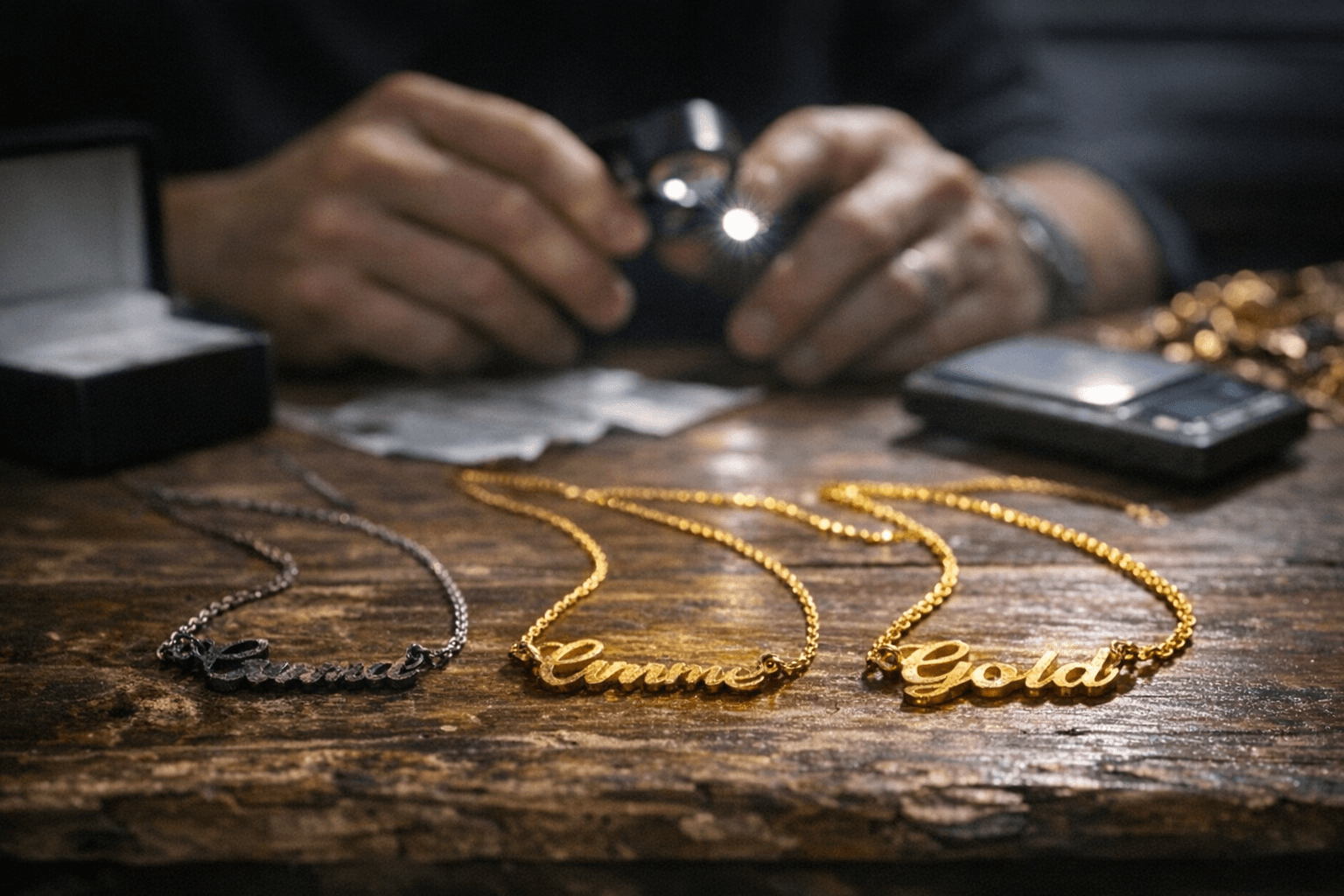
Gold plating has no minimum karat or thickness requirement; a manufacturer can apply a microscopically thin layer of low-karat gold over any metal and call it gold-plated. This is the category where the most misleading marketing lives. A gold-plated name necklace may look identical to a vermeil piece in a product photo and cost a fraction of the price, but the durability gap is substantial. These pieces work well as trend-driven or occasional-wear purchases, but should not be treated as heirlooms or daily drivers. PVD (physical vapor deposition) plating, a newer process in which titanium nitride is bonded to the base metal, offers meaningfully better durability than traditional electroplating and is worth seeking out within the budget tier.
Font legibility: the detail most buyers overlook
Before choosing a material tier, the font decision shapes whether anyone can actually read your name. Legibility is particularly important for a nameplate necklace, and key factors include character spacing: a font with good spacing between characters makes it easier to distinguish individual letters, and uncluttered letter shapes are easier to read than more ornate or complex shapes. Block-style fonts are the most legible, using capital letters and thick lines without the flowing connections of cursive. Script fonts, while elegant, can collapse into illegibility at small pendant sizes. For metal type, bold fonts read best on stainless steel, while serif styles like Garamond or Baskerville pair naturally with gold and silver nameplate work. Always use the brand's online preview tool before confirming: what reads clearly at screen size can lose definition once cut in metal.
Spelling proof verification: non-negotiable before production
Some name necklace makers will send a proof by email, begin manufacturing only once the proof is approved, and note that a hyphen counts as a character, which can affect maximum character limits. Reputable sellers limit customization to 15 characters or fewer to maintain structural integrity and readability; anything beyond that should prompt scrutiny of how the pendant is sized. When possible, review a preview to ensure the engraving reads the way you intend, considering exact spelling, capitalization, and any special characters including numbers or symbols for meaningful dates and initials. Skipping the proof step is the single most common source of buyer regret in personalized jewelry. No return policy covers a correctly manufactured misspelling.
Chain strength and construction
The pendant earns all the attention, but chain failure is a far more common point of loss. Evaluate chain weight relative to pendant size: a heavy nameplate on a delicate 1mm cable chain is a structural mismatch. Box chains and figaro chains generally offer more durability for heavier nameplate designs, while rolo or snake chains suit lighter script pendants. Regardless of material tier, the chain clasp should operate with the same ease and firmness on day one and year three. If a brand offers chain upgrades at checkout, that option is worth the cost for a piece you intend to wear daily.
The most durable name necklace is not necessarily the most expensive one; it is the one made with a material matched to how you actually live. A 316L stainless steel nameplate on an active swimmer outlasts a poorly maintained gold vermeil piece worn in the pool. Knowing the material hierarchy, asking for micron thickness disclosures, and demanding a spelling proof before production are the three habits that separate buyers who are still wearing their name necklaces in five years from those who are not.
This article was produced by Prism’s automated news system from verified source data, official records, and press releases, then run through automated quality and moderation checks before publishing. The system is built and supervised by the people who set the standards it runs under. Read our full AI policy.
Did this article answer your question?