Common Era turns Paris family memories into relic-inspired gold jewelry
Common Era’s Fragments turns a Paris family trip into gold pendants shaped by museum relics, where memory, loss, and survival become wearable form.
A collection built from what survives
Common Era’s Fragments collection begins with a family trip, but it ends somewhere much older, and stranger, in the language of relics. Torie Tilley took the Paris journey with her infant son, her husband, and a stroller, and what she brought back was not a souvenir in the usual sense but a design vocabulary built from broken museum fragments. The collection is explicitly framed by Common Era as “a collection about what survives,” and that idea gives the jewelry its force: these are pieces that do not try to smooth over fracture, but honor it.
The emotional center of the story is remarkably specific. Tilley and her husband used airline miles to get to Paris with their baby boy, landed just before what she described as the biggest snowstorm Paris had ever had, and walked more than 20,000 steps through the Louvre with their son. The child was 8 months old, and at one point he reached toward a Three Graces fragment behind glass. That image, a baby reaching for a classical fragment he could not touch, explains the collection better than any slogan could. It is about proximity to history, and the ache of being separated from it.
Fragments that read like relics
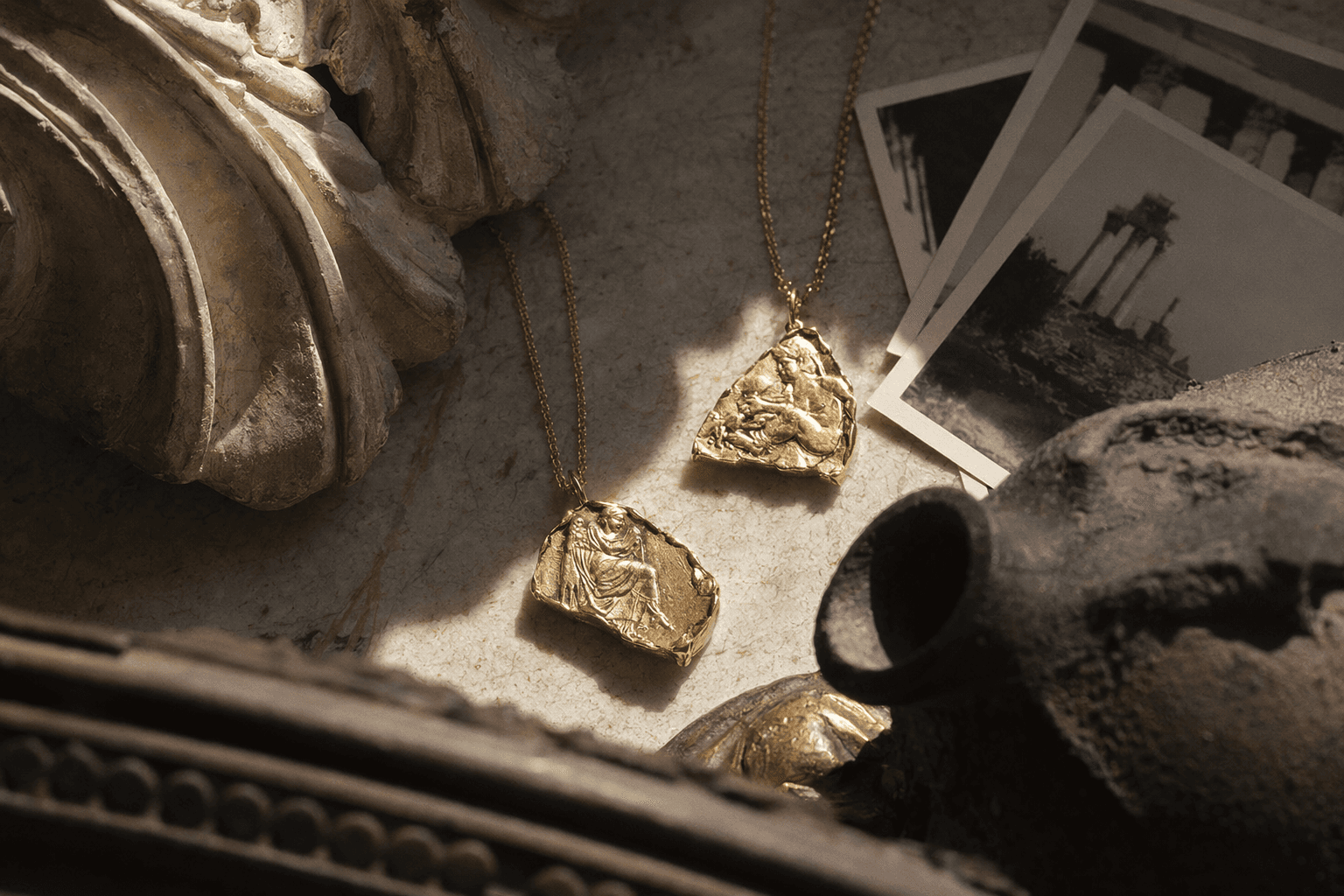
The first five Fragments pieces are modeled on historic works displayed in the Louvre and other museums: the Three Graces, a Broken Column inspired by an Ionic column, the Lovers, a hound funerary relief, and an inscribed Orphic tablet. Common Era says the line is derived from documented sources including ancient manuscripts, archaeological records, and mythological texts, which matters because the collection does not borrow ancient imagery loosely. It translates specific artifacts into solid gold pendants with a collector’s seriousness.
Each motif carries its own emotional charge. The Orphic tablet is a ritual object associated with the afterlife, which gives it a hushed, almost talismanic gravity. The hound motif, drawn from ancient Greek and Roman funeral reliefs, symbolizes fidelity and memory, making it one of the collection’s most poignant emblems. The Broken Column, meanwhile, captures the poetry of incompletion, while the Lovers and Three Graces soften the harder edges of the set with intimacy, grace, and human attachment.
What makes these forms feel especially contemporary is that they are not pristine reconstructions. They are fragments, and fragments imply time, loss, and survival all at once. In a market crowded with neat personalization, initials, and birthstones that can sometimes feel overly polished, Common Era’s approach is more layered. These pieces suggest that meaning does not always arrive intact; sometimes it comes to life through what has chipped away.
Gold with texture, history, and weight
The Fragments pieces are cast in 14k and 18k recycled gold, and that material choice is essential to the collection’s tone. Gold gives the relic forms warmth and permanence, but recycled gold also keeps the line aligned with Common Era’s broader ethics. The solid gold pieces are made by hand in the brand’s New York City studio using 100% recycled gold, with production in RJC-certified facilities, a detail that places the collection within a more disciplined jewelry framework than the casual language of “sustainable” often implies.
Because these are solid gold pendants rather than delicate, gemstone-led ornaments, the design reads almost like portable sculpture. The surfaces carry the quiet heft of objects meant to be kept, not simply worn for a season. That gives the collection a different emotional register from standard milestone jewelry, which can lean sentimental in a predictable way. Here, the sentiment is more intimate and less literal: a piece can hold motherhood, travel, grief, awe, or change without spelling any of it out.
That distinction matters. A name necklace declares identity in a straightforward line. A fragment pendant leaves room for memory to remain imperfect, which often feels truer to real life. The appeal is not in presenting a finished story, but in wearing a piece that recognizes how memory actually works, partial, tactile, and shaped by what time does to objects and to people.
Why the collection feels personal rather than decorative
Tilley has said she noticed the emotional power of “broken things,” and that phrase sits at the heart of Fragments. The collection is not sentimental in the sugary sense. It is closer to a private relic cabinet, where an object becomes precious because it carries evidence of a life event, a journey, or a transformation that cannot be repeated.
That is why the collection resonates so strongly around motherhood and travel. The Paris trip was not a polished, aspirational escape. It was a practical family journey, funded with airline miles, complicated by weather, and experienced through the physical strain of walking a museum with a baby in tow. The resulting jewelry does not erase that messiness. It holds onto it, and in doing so it offers an alternative to the glossy grammar of milestone gifts.
The pieces also feel timely because they invite a more complicated kind of self-portrait. A buyer marking a new child, a move, a loss, or a personal reset may be drawn less to perfection than to a form that acknowledges interruption. Fragments does that with unusual discipline. It turns museum history into a wearable language of memory, and it does so without flattening the emotions that make memory worth keeping.
A brand built for long accumulation
Common Era launched in 2019, and Tilley has said her approach is to release collections when something truly moves her rather than on a fixed quarterly schedule. That rhythm suits Fragments perfectly. The collection feels less like a trend cycle and more like the opening of a permanent cabinet, something the brand could expand over time in the manner of a museum collection.
The company’s broader identity reinforces that sense of intent. Common Era is woman-owned and independent, funded by sales rather than investors, and it presents sustainability as part of its structure rather than as a marketing flourish. It also donates 3% of profits to the Animal Welfare Institute. Together, those choices position Fragments as more than a sentimental jewelry story. They frame the collection as a study in how ethics, memory, and craftsmanship can coexist in the same object.
In the end, Common Era has made relic-inspired jewelry feel newly personal by refusing to sand away the cracks. Fragments understands that the pieces people keep closest are often the ones that carry a little loss inside them, and that is exactly why they endure.
Know something we missed? Have a correction or additional information?
Submit a Tip