Designers Embrace 10k Gold for Affordable, Wearable Personalized Jewelry
10k gold's hardness and lower price make it the practical choice for personalized jewelry you actually wear daily — if you know its trade-offs.
Why Designers Are Reaching for 10k Gold
Record-high gold prices have a way of clarifying priorities. When the cost of pure gold climbs, every karat decision becomes a design decision, and a growing cohort of jewelry makers is landing on 10k not as a budget compromise, but as a deliberate material choice for pieces people actually wear every day. The logic is straightforward: 41.7% pure gold, hardened by a higher proportion of alloy metals, produces a metal that resists scratching, holds fine engraving, and keeps price points accessible for the customized nameplates, signets, and engraved keepsakes that define today's personalized jewelry market.
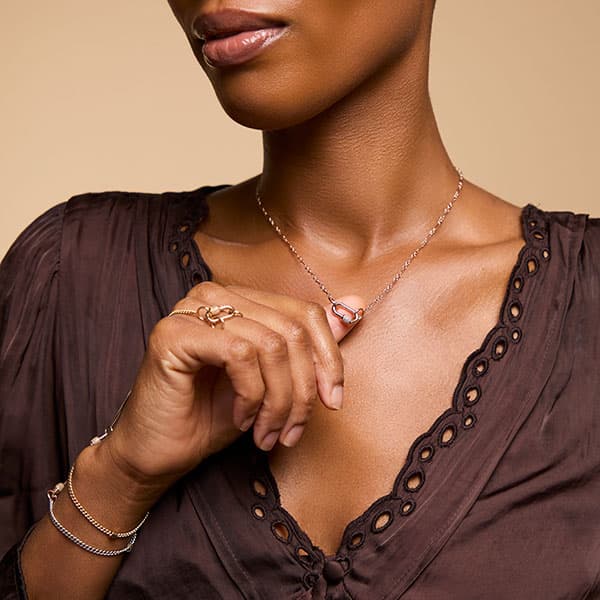
Marla Aaron, whose New York-based brand is known for its modular, mix-and-match hardware pieces, made the case plainly when she debuted the Micro Babylock, her first 10k piece, priced at $595. "The primary reason for using 10k was its hardness," she told JCK. "I've long been fascinated by Victorian-era mechanical jewelry, not just because it's beautiful, but because it was driven by both curiosity and functionality. It was a period of tremendous creativity, often involving gold alloys in the 9 to 15k range because of their strength and adaptability. That's why we chose 10k." The Micro Babylock itself, cast in a warm rosy 10k gold, was inspired by pieces from Aaron's own Victorian-era personal collection: a piece that wears its material history as part of its identity.
The financial context sharpens the argument. Aaron put it directly: "In a moment like this, when material costs are what they are, every decision matters more. You have to be smart, intentional, and creative in ways that don't compromise the integrity of the object."
What 10k Actually Feels Like to Wear
The practical differences between 10k, 14k, and 18k gold are more tactile than theoretical. 10k gold holds up slightly better under stress due to its higher alloy content, making it very difficult to scratch, scuff, or bend. For a nameplate necklace worn daily, tucked under a collar, taken off and on repeatedly, that resilience is not a minor consideration. The raised letters of an engraved signet or the fine detailing on a custom band are better preserved in a harder metal.
18k gold, by contrast, is softer and scratches more easily with daily wear, sometimes developing visible wear marks over time for someone who wears their jewelry constantly. That softness is the price of its 75% gold purity and its richer, more saturated color.
14k gold hits a middle ground: durable enough to handle daily life without showing excessive wear, yet retaining enough gold content to feel genuine and display a warm, classic color. It remains the industry's most popular all-purpose karat for good reason.
The Karat Comparison: What the Numbers Mean
The table below captures the core trade-offs at a glance.
| 10k Gold | 14k Gold | 18k Gold | |
|---|---|---|---|
| Gold purity | 41.7% | 58.3% | 75% |
| Relative price per gram | Lowest | Mid | Highest |
| Scratch resistance | Highest | High | Moderate |
| Color warmth | Pale/subtle | Warm classic | Rich, buttery |
| Allergy risk | Higher (more alloys) | Moderate | Lower |
| Best for | Daily wear, engraving, active lifestyles | All-purpose, everyday fine jewelry | Occasional wear, sensitive skin, heirloom pieces |
| Maintenance | Minimal; wipe clean | Minimal to moderate | Requires more careful handling |
18k gold appears more buttery and saturated in color, and for those with sensitive skin or nickel allergies, it is less likely to cause reactions. That is the clearest argument for choosing up when budget allows. 10k gold carries a higher chance of causing skin irritation for people with metal allergies, since it contains more alloy metals like nickel. If you have a known nickel sensitivity, 10k is worth approaching carefully before committing to a piece worn directly against skin.
How Designers Compensate for Lower Karat
The critique of 10k has always circled around color: it reads slightly cooler and paler than 14k or 18k, a visible consequence of its higher alloy content. Skilled designers have found ways to turn this into an asset rather than an apology. Rose gold alloys, like the one Aaron chose for the Micro Babylock, lean into warmth from copper content rather than relying on gold purity alone. Textured finishes, hammered surfaces, and architectural forms draw the eye to design rather than raw material richness.
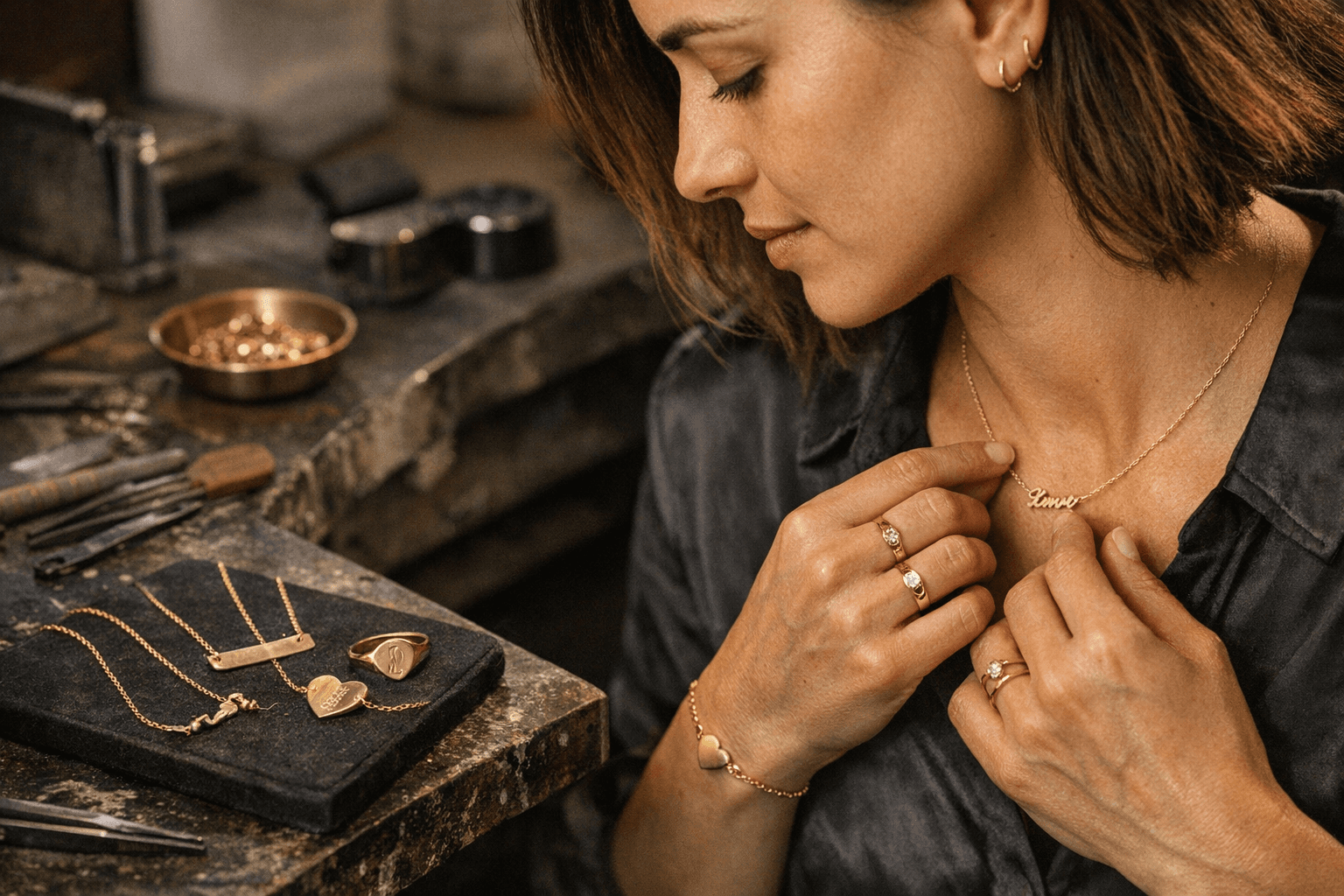
Aaron's description of the Micro Babylock captures this philosophy precisely: "Truly, this tiny Lock feels like just the beginning of a whole new sandbox for how we play with jewelry, on a macro-to-micro level. Micro Babylock is peak functional maximalism in micro form, a small object doing a surprising amount of work. We are offering it in 10k because we've always believed in playing at every end of the spectrum, for you, and for ourselves."
The personalized jewelry category in particular rewards this thinking. A nameplate necklace is already a statement defined by its text and form; the buyer's name, a child's birthdate, a set of initials rendered in a chosen font. The karat choice recedes behind the meaning of the object. The same logic applies to signet rings, where the engraved crest or monogram carries the piece's visual weight, and to custom bands, where proportions and surface treatment do more work than metal purity alone.
Best Use Cases for 10k Gold
10k is the practical choice in several specific scenarios:
- Everyday nameplates and pendants. If you plan to wear a piece daily without removing it, 10k's hardness protects raised lettering and fine detailing through the rigors of a real life.
- Signets and engraved rings. Deep engraving reads crisply in harder metals and holds its definition longer. A family signet meant to be worn, not stored, benefits from 10k's resistance to wear.
- Custom bands worn as stackers. Rings that knock against other rings, countertops, and keyboards are better served by a harder metal. The lower price also makes it easier to invest in multiple pieces.
- First fine jewelry purchases. 10k retains a hallmark of genuine precious metal while lowering the entry price for buyers who want something real but not at 18k cost.
- Gifts for active wearers. A personalized piece for someone who works with their hands, exercises regularly, or simply doesn't take their jewelry off deserves the durability that higher alloy content provides.
Who Should Avoid 10k
10k is not the right answer for every buyer or every piece. For those with sensitive skin or nickel allergies, 18k is less likely to cause reactions, and a daily-wear piece that irritates skin is no piece at all. If you know you react to nickel, zinc, or copper, testing any alloy metal against your skin before committing to a custom piece is worth the extra step.
The color difference between 14k and 18k gold is noticeable; 18k appears more buttery and saturated. Buyers who prioritize that depth of color, especially in yellow gold, will find 14k a more satisfying compromise and 18k the clear winner in richness. For heirloom-intent pieces meant to be passed down rather than worn daily, the higher gold content of 18k carries both material and sentimental weight that 10k doesn't replicate.
The designers embracing 10k are not retreating from quality. They are matching material to purpose. For the buyer who wants a gold nameplate she'll wear every day for a decade, not store in a velvet box, that alignment between material and life is exactly the right kind of craftsmanship.
This article was produced by Prism’s automated news system from verified source data, official records, and press releases, then run through automated quality and moderation checks before publishing. The system is built and supervised by the people who set the standards it runs under. Read our full AI policy.
Did this article answer your question?