GIA Education Guides Personalized Jewelry Buyers on Grading and Certificates
GIA's grading education fills a critical gap for personalized jewelry buyers navigating certificates, stone quality, and what reports actually verify.
Personalized jewelry occupies a singular space in the market: it is commissioned with intention, often commemorating something irreplaceable, and it demands a level of informed decision-making that a standard retail purchase does not. When you are asking a jeweler to set your birthstone into a custom ring or engrave coordinates into a pendant, the emotional stakes are high. But so are the material ones. Understanding what you are actually buying, down to the quality grades and the paperwork that accompanies a stone, is not pedantry. It is protection.
This is precisely where the Gemological Institute of America's consumer-facing educational resources become essential reading. GIA has long served as the global authority on gemstone grading, and its guidance addresses the exact questions that arise when commissioning personalized pieces: How is a diamond graded? What does a gemstone certificate actually tell you, and what does it not? These are not abstract questions for collectors. They are practical ones for anyone investing in something made to last.
Understanding How Diamond and Gemstone Grading Works
Grading is the process by which a gemstone's quality characteristics are evaluated and documented by trained gemologists using standardized criteria. For diamonds, GIA developed the now-universal 4Cs framework: cut, color, clarity, and carat weight. Each criterion is assessed independently under controlled laboratory conditions. Cut quality, for example, evaluates not just shape but the precision of a diamond's facet proportions, symmetry, and polish, all of which determine how light moves through the stone. A diamond graded Excellent in cut by GIA will exhibit measurably different light performance than one graded Good, even if both appear similar in a photograph.
Color grading for diamonds runs on a D-to-Z scale, where D represents colorless and Z indicates a light yellow or brown tint. This is an objective measurement conducted in a standardized light environment against master comparison stones. Clarity, meanwhile, assesses internal characteristics called inclusions and surface features called blemishes, ranging from Flawless to I3. For personalized jewelry, where a stone may be the emotional centerpiece of a piece made for a specific person, understanding these grades allows you to make deliberate trade-offs: perhaps a slightly lower clarity grade in favor of a larger carat weight, or a premium cut grade because brilliance matters more than size.
Colored gemstones, which feature prominently in personalized pieces tied to birthstones or symbolic meaning, follow a different but equally rigorous approach. GIA evaluates color, clarity, and other quality factors for stones like sapphires, rubies, and emeralds, though the grading vocabulary and methodology differ from diamond grading. Knowing these distinctions matters when discussing a commission with your jeweler.
What a Grading Report Does and Does Not Verify
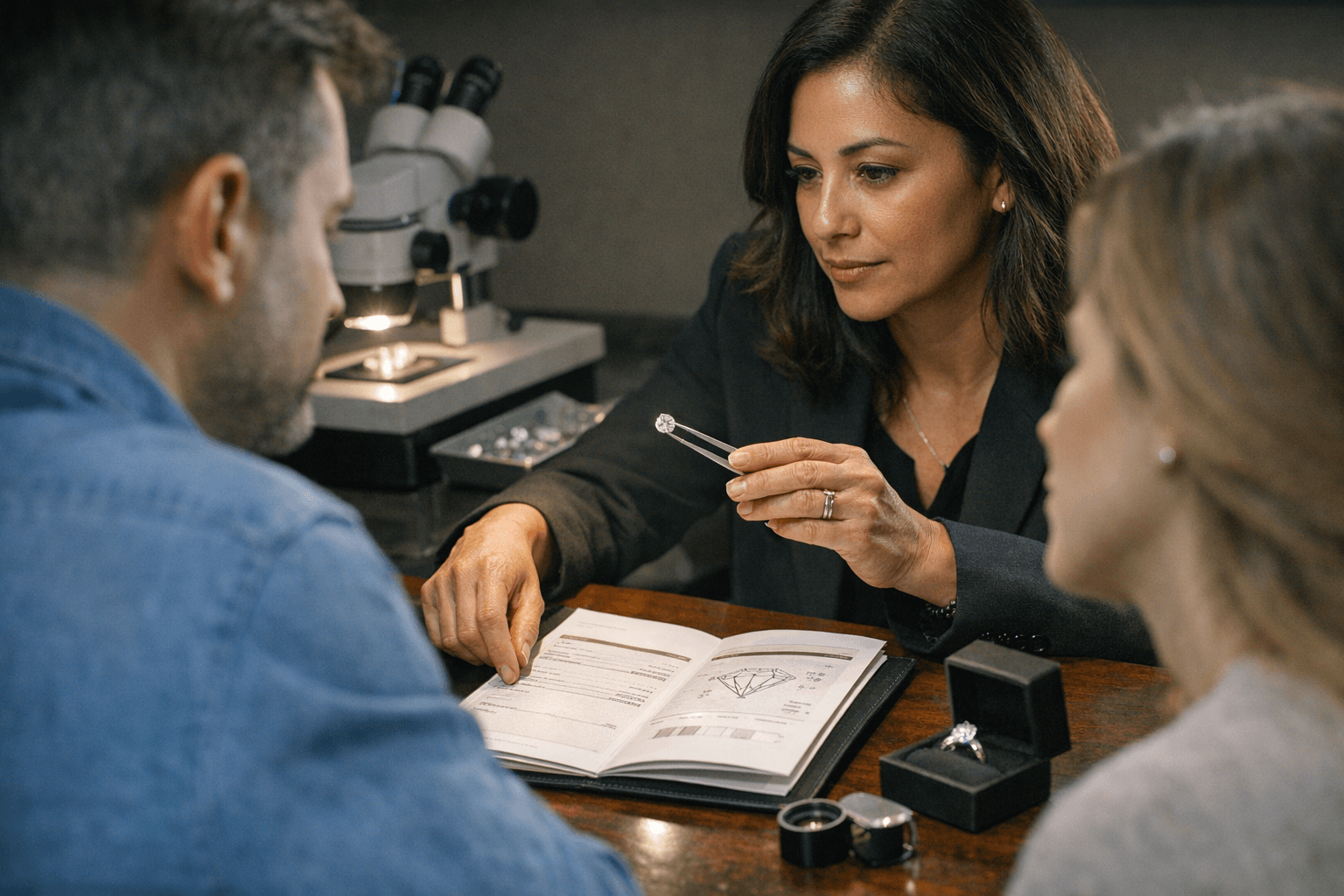
A GIA grading report is one of the most trusted documents in the jewelry industry, but it is frequently misunderstood. What a report confirms: the quality characteristics of a specific stone at the time it was examined in GIA's laboratory. It documents the 4Cs for a diamond, or the relevant quality factors for a colored stone, along with a unique report number that allows the stone to be verified in GIA's online database.
What a report does not confirm is equally important to understand. A grading certificate does not establish provenance in the ethical sourcing sense, meaning it does not independently verify where a stone was mined or under what conditions. It does not guarantee that the stone described in the report is the stone currently in your setting, unless additional measures have been taken. And it does not assess the quality of the jewelry setting itself, only the loose stone evaluated in the laboratory.
For buyers of personalized jewelry, this last point carries particular weight. When a stone is set into a custom piece, the report you receive speaks to the stone before it was mounted. The quality of the metalwork, the security of the prongs or bezel, the finishing of the shank: none of these fall within the scope of a gemological grading report. This is why working with a skilled and reputable jeweler matters as much as having the right paperwork.
Laser Inscription and Stone Identification
One of the most practical tools in connecting a physical stone to its grading report is laser inscription. GIA offers a laser inscription service in which the unique report number is inscribed on the girdle of a diamond, the thin edge that separates the crown from the pavilion. This inscription is microscopic and requires magnification to read, but it creates an indelible link between the stone and its documentation.
For personalized jewelry, laser inscription provides meaningful reassurance. If a piece is resized, repaired, or the stone is temporarily removed for any reason, the inscription allows the stone to be matched back to its certificate. It also serves as a deterrent against stone switching, a practice where an unscrupulous repair shop replaces a customer's original stone with an inferior one. Knowing that your diamond carries its GIA report number on its girdle gives you a point of verification that transcends memory or assumption.
Some personalized pieces also incorporate intentional laser engraving on the metal itself, a date, initials, or a short phrase on the interior of a band. This is distinct from gemological laser inscription and speaks to the personal rather than the technical dimension of the piece. Both serve the same underlying purpose, though: making something identifiably, verifiably yours.
Putting Grading Knowledge to Work in a Custom Commission
When you approach a jeweler for a personalized piece, arriving with a working understanding of GIA grading puts you in a fundamentally stronger position. You can ask to review the grading report before a stone is set, verify the report number against GIA's online database, and request that any GIA-graded stone you provide or purchase comes with current documentation.
You can also make more nuanced decisions. Knowing that a VS2 clarity diamond will appear eye-clean in most settings, for example, allows you to allocate budget toward a higher cut grade or a more intricate hand-engraved setting. Understanding that a padparadscha sapphire, that rare pinkish-orange variety, carries no standardized grading scale in the way a diamond does helps you set realistic expectations and ask the right questions about origin and treatment disclosure.
Personalized jewelry is, by its nature, a highly individual transaction. The piece you commission will carry the weight of a specific moment, relationship, or milestone. Grounding that transaction in gemological literacy does not diminish the romance of the piece. It ensures that what you receive reflects what you were promised, and that the stone at its heart is exactly what its certificate says it is.
This article was produced by Prism’s automated news system from verified source data, official records, and press releases, then run through automated quality and moderation checks before publishing. The system is built and supervised by the people who set the standards it runs under. Read our full AI policy.
Did this article answer your question?