Haute Couture’s Next Frontier: Personalized Jewelry Redefines Luxury
Major luxury houses now invite clients into the design room itself, from CAD renders to rare stone selection. Here is what true bespoke costs, takes, and demands.
After tracking the personalized jewelry movement across dozens of luxury consultations, industry analyses, and ateliers operating from Paris to New York, the clearest signal emerging from the market is this: younger affluent buyers have fundamentally redefined what the word "luxury" means inside a jeweler's showroom. According to Jewelers of America's 2024 research, 63% of Millennials and Gen Z consumers prefer brands offering bespoke or customization options. Meanwhile, according to Bain & Company's 2024 report, Millennials and Gen Z now drive over 70% of global luxury sales growth. The catalog, it turns out, is no longer enough.
Beyond Engraving: What True Bespoke Actually Means
There is a meaningful difference between personalization and bespoke, and confusing the two is an expensive mistake. A monogram lasered onto the clasp of a ready-made bracelet is not bespoke. Neither is selecting a birthstone from a dropdown menu on a brand's e-commerce page. True bespoke begins with a blank page and ends with a piece that has never existed before, built around the client's specific anatomy, aesthetic, and intention.
At the level practiced by houses like Harry Winston, Van Cleef & Arpels, and Chopard, the bespoke experience is closer to architectural commissioning than retail shopping. Harry Winston offers clients a process of working hand in hand with designers to create extraordinary masterpieces, while Van Cleef & Arpels creates custom designs that draw most often from nature and art, with individual attention to each client. De Beers customizes diamond jewelry for the significant events in clients' lives, making the service one of the most revered in the sector. The shared thread across these houses is not simply craft; it is co-authorship.
The Bespoke Journey: Consultation to Finished Setting
Understanding the sequence demystifies both the timeline and the cost. The process has five distinct phases, and each one involves meaningful client participation.
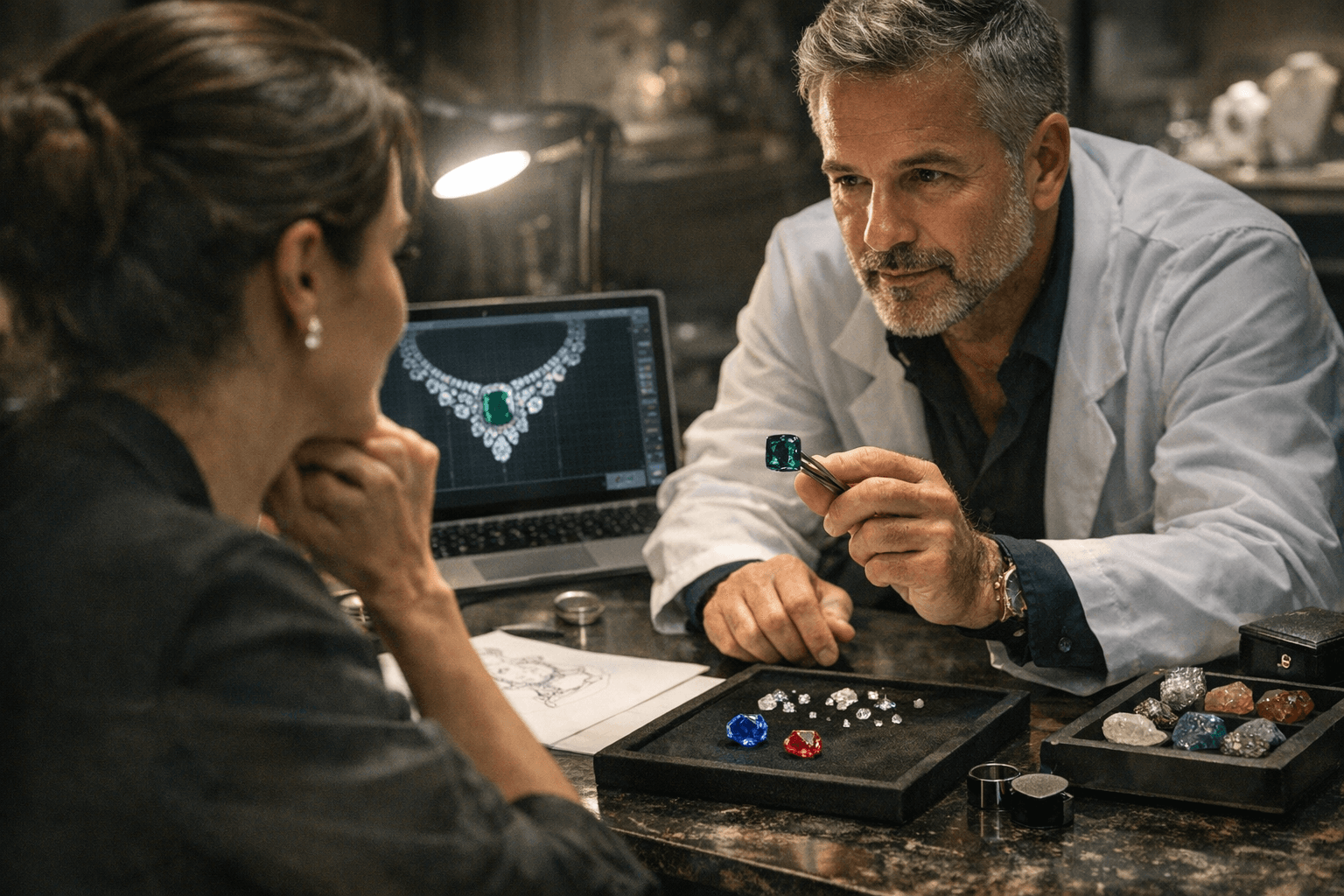
1. Initial Consultation. The first step in designing a piece of bespoke jewelry is the initial consultation, which can last between one and two hours and largely consists of you and the designer sussing each other out.
Some studios structure this as two 45-minute meetings, which can be conducted via Zoom or in person at a private studio. This is the moment to articulate not just the visual aesthetic but the context: the occasion, the wardrobe it will live alongside, and the budget ceiling. A skilled concierge will discuss wardrobe needs, personal values, signature style, and investment considerations.
2. Concept Development and CAD Rendering. Once the brief is established, designers move from hand-drawn sketches to computer-aided design.
The design team draws from multiple sources of inspiration while keeping the piece uniquely yours, staying current with fine jewelry trends while recognizing that custom pieces should transcend fleeting fashion. Once hand-drawn sketches capture the essence of the vision, the design process is elevated through CAD. The rendered file produces photorealistic 3D visuals of the piece before a single gram of metal is cast, allowing for precise adjustments to proportions, setting geometry, and stone placement.
3. 3D Prototyping. Before committing to precious materials, most serious ateliers produce a physical prototype using 3D-printed resin or wax.
This is the stage where a prong configuration that looks elegant on screen might reveal itself to be impractical on the hand, where a bezel's depth can be tested for wearability, and where the client can assess scale in real life rather than on a monitor. The prototype phase is where money is saved and disappointment is avoided.
4. Stone Sourcing. For any piece anchored by a significant gemstone, this phase deserves its own timeline.
Sourcing a Kashmir sapphire with documented provenance, a Colombian emerald with a particular tone of bluish-green, or a fancy intense yellow diamond of precise saturation requires access to dealer networks and, in some cases, auction relationships. The consultation process aims to provide a "personalized shopping list" of specific stones and metals chosen for the piece, ensuring full transparency and allowing clients to track progress from initial discussion to the final showing.
5. Production and Delivery. Most high-end custom rings move from a finalized 3D CAD design to a finished piece in as little as 7 to 14 days at production-focused workshops; at a major house where hand-engraving, pavé-setting, and multiple quality stages are involved, the timeline extends to eight, twelve, or even sixteen weeks.
This is not delay; it is due process.
What Drives the Price
The cost of bespoke jewelry is not easy to pin down, but understanding how the costs of metal, gemstones, and labour work will clarify the final price. Metal type carries enormous weight: 18-karat yellow gold is one benchmark, but platinum, which is denser and harder to work, commands a fabrication premium that can add 20 to 40 percent over an equivalent gold piece. Gemstone pricing is its own discipline entirely, driven by the 4Cs for diamonds and by origin, treatment history, and rarity for colored stones. Labour, often the least-discussed variable, reflects the hours a master setter or engraver invests, particularly in complex pavé or guilloché work. Custom jewelry typically uses higher-quality materials and craftsmanship, making it more durable over time and reducing the frequency of repair; it also tends to hold value better than mass-produced pieces, which lose value quickly because they are easily available and not unique.
Personalization vs. "Personalization": The Gap You Need to Know
The luxury industry's embrace of personalization has produced two very different products wearing the same name. Off-the-shelf personalization, the kind offered by most brands' online configurators, lets a buyer select a metal color, a stone type from a pre-approved list, and perhaps a font for engraving. The design itself is fixed. The proportions, the setting style, the silhouette: all predetermined, all catalog. What changes is the surface.
True bespoke inverts this entirely. The design is the variable; the client's vision is the constant. Today's luxury buyers value storytelling over status, and jewelry must be bold and meaningful, with designers now crafting pieces that break conventional silhouettes to make every detail part of the wearer's message. The practical implication is that the two categories are not substitutes. Choosing an engraved bracelet from a luxury house's existing collection is a legitimate, beautiful purchase. But it is not bespoke, and the two should not carry the same price expectation or the same emotional expectation.
The Questions Every Client Should Ask Before Commissioning
Commissioning a bespoke piece is a legal transaction as much as a creative one. Before signing anything, clarity on the following points is non-negotiable:
- Design IP and ownership: Does the final CAD file belong to the client or to the house? If the design is exceptionally original, can the house reproduce it for other clients? Some ateliers retain rights to their CAD files even after delivery.
- Revision rounds: How many rounds of CAD revisions are included in the quoted fee? Changes requested after fabrication begins carry significant cost, and the number of included pre-production revisions should be stated in writing.
- Stone sourcing transparency: Can the client see lab reports, certificates, and origin documentation for any significant stone before it is set? A GIA grading report for diamonds and, for colored stones, a Gübelin or AGL origin report are reasonable standards.
- Timeline commitments: Is the delivery date a guarantee or an estimate? What happens if sourcing a specified stone takes longer than projected?
- Aftercare and repair pathways: Does the house offer cleaning, re-plating, or prong re-tipping as part of a post-purchase relationship? Who is responsible for the piece if a stone is lost within the first year?
The Long-Term Client Relationship
The smartest luxury houses understand that a bespoke commission is not a transaction; it is the beginning of a client relationship that should span decades. Post-delivery service, including private viewings of new collections, access to rare stones as they become available, and dedicated repair channels, is the infrastructure that converts a first-time commissioner into a collector. Iconic brands like Cartier and Tiffany still set the standard for craftsmanship and elegance, but today's buyers are looking for pieces that tell their own story. The houses that will win the next generation of collectors are those that recognize aftercare as an act of editorial curation, not just customer service.
A remarkable 48% of Gen Z luxury buyers prioritize self-expression over brand recognition, which means the prestige of a maison's name alone is no longer sufficient collateral. The work must be genuinely theirs: conceived together, built with accountability, and cared for with the same seriousness brought to the original commission. In that sense, bespoke jewelry in 2026 is less about wearing a house's signature and more about wearing your own.
This article was produced by Prism’s automated news system from verified source data, official records, and press releases, then run through automated quality and moderation checks before publishing. The system is built and supervised by the people who set the standards it runs under. Read our full AI policy.
Did this article answer your question?