Hip-hop jewelry embraces customization as lab-grown diamonds go mainstream
Lab-grown diamonds are widening hip-hop jewelry’s creative range, but the real status symbol still lies in custom design, symbolism, and precision craftsmanship.
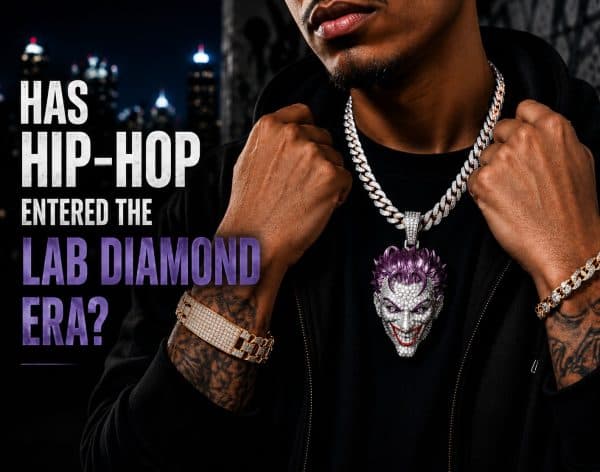
Thick gold rope chains announced hip-hop in the 1980s. Today’s custom pendants, iced-out watches, and oversized statement pieces still serve as a visual language of success, identity, and authorship. Lab-grown diamonds are making that language more accessible, but they are not rewriting its grammar.
The culture’s strongest signal is still personalization
Vikki Tobak’s 2022 book, *Ice Cold: A Hip-Hop Jewelry History*, and the American Museum of Natural History’s 2024 exhibition, *Ice Cold: An Exhibition of Hip-Hop Jewelry*, trace the form from the 1980s to the present. Jewelry in this culture evolved from scale and gleam into something more specific, where the piece can carry a name, a symbol, or a private reference only the wearer fully understands.
That evolution is visible in the way rap-inspired jewelry is described now: diamond necklaces, custom pendants, oversized watches, and men’s jewelry collections built around the codes of rap culture. The material may shift from solid gold to pavé diamonds, from natural stones to lab-grown, but the central ambition remains a name, a symbol, or a private reference only the wearer fully understands.
Why custom jewelry keeps its power
The market around diamonds has changed in ways that strengthen, rather than dilute, that instinct for self-definition. De Beers said in June 2026 that non-bridal occasions account for three-quarters of overall U.S. diamond demand. In its 2026 U.S. Diamond Report, the company also identified Gen Z as the second-largest generation buying diamonds, a generation that tends to treat jewelry less as inherited formality and more as a tool for self-styling.
That shift pairs naturally with hip-hop’s customization culture. De Beers’ findings showed gifting made up 44% of sales in 2025 and self-purchases 31%. A nameplate for a birthday, a pendant for a first major contract, or a symbolic motif for a milestone fits that pattern.

What lab-grown diamonds change, and what they do not
Lab-grown diamonds have made large, highly individualized pieces easier to build. BriteCo’s 2025 data put more than 45% of U.S. engagement ring purchases in lab-grown stones, and put the average 1-carat lab-grown diamond at $1,000 or less, compared with about $4,200 for a natural 1-carat diamond. That price gap matters because customization often depends on size, volume, and repetition of stones, especially in fully iced pendants, script nameplates, and heavy-link bracelets.
BriteCo said the average engagement ring price fell from $6,000 in 2021 to $5,200 by 2024, while Tenoris data in a 2025 industry update showed lab-grown diamond jewelry unit sales rose 43% in 2024 and sales rose 31%, though the pace was slowing from 2023. One survey put the main reasons people buy lab-grown diamonds at lower price, more size for the money, ethical reasons, and perceived environmental benefits, at 37%, 25%, 20%, and 18% respectively.
Lower prices make it easier to specify a larger center stone, repeat stones across a wider surface, or commission a more elaborate one-off piece without forcing the entire budget into the diamond alone. Lab-grown diamonds widen access without erasing aspiration.
Still, the category carries real tension. Wholesale prices have fallen steeply since 2020, putting pressure on the perceived luxury value of lab-grown stones. De Beers’ 2026 U.S. research also emphasized continued demand for natural diamonds. In hip-hop jewelry, that tension is visible in the pieces themselves: lab-grown diamonds can increase the scale and intricacy of a custom design.
How to judge a personalized piece
A custom hip-hop piece should be evaluated like a small piece of architecture. The setting, the weight, the way the chain supports the pendant, and the visibility of the back matter as much as the front-facing flash. A bezel setting, which wraps metal around the edge of a stone, offers a cleaner, more protective profile for daily wear; prong settings lift a stone higher and allow more light to enter, which can increase sparkle in a piece meant to throw off maximum brilliance.
- Nameplates should have enough thickness to survive actual wear, not just photographs.
- Pendants need secure bails and balanced proportions so the piece hangs straight instead of twisting.
- Pavé surfaces should be tight and even, because gaps or uneven seats become obvious once the light hits them.
- Symbolic motifs, whether religious, familial, or tied to a stage persona, work best when the silhouette is legible from a distance.
Lab-grown diamonds make the most interesting difference by letting the buyer think less narrowly about carat budget and more expansively about execution. They make room for a larger center stone, more repeated stones across a wider surface, or a more elaborate one-off piece.
This article was produced by Prism’s automated news system from verified source data, official records, and press releases, then run through automated quality and moderation checks before publishing. The system is built and supervised by the people who set the standards it runs under. Read our full AI policy.
Did this article answer your question?