How to Layer Personalized Jewelry for a Curated Personal Narrative
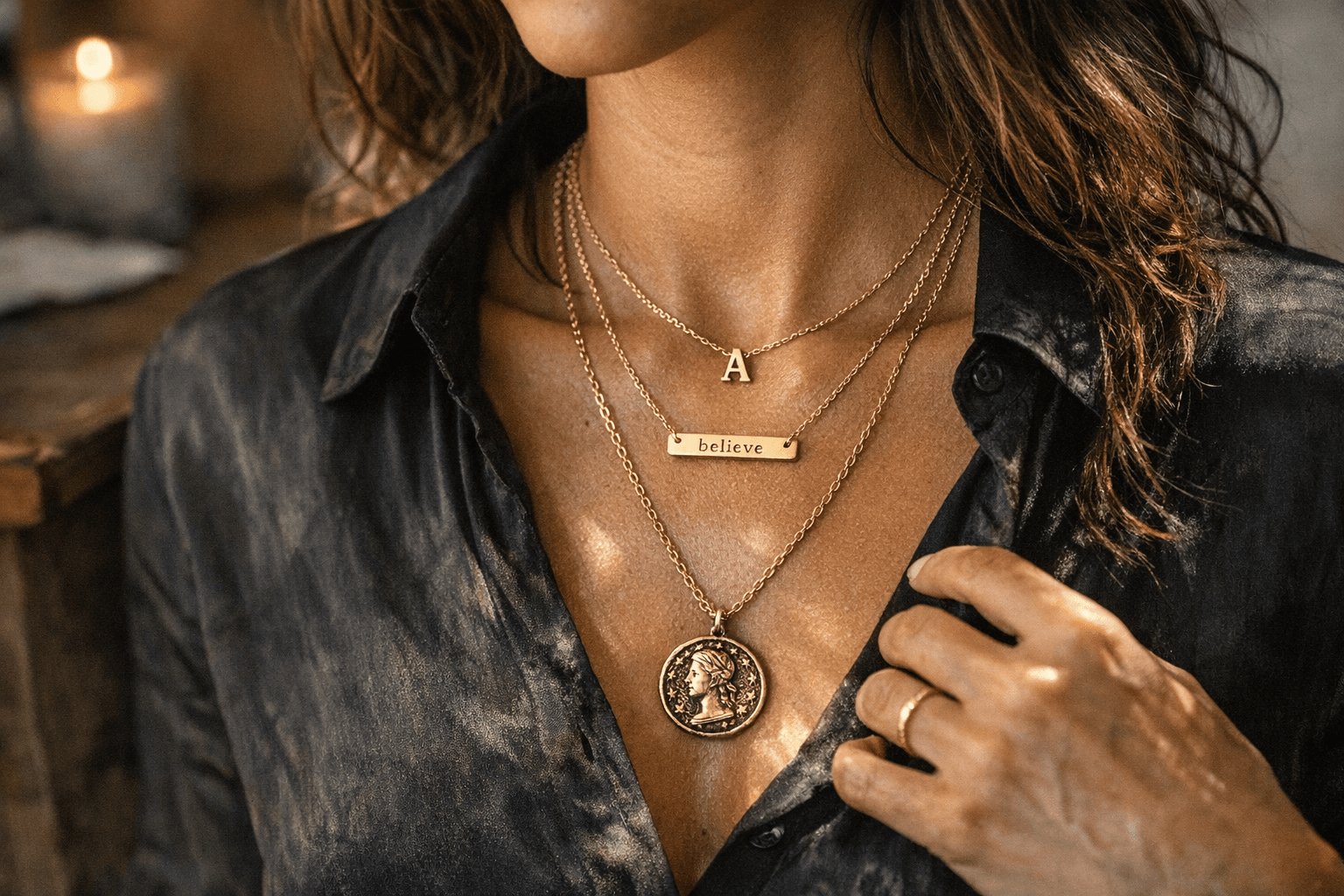
Layer an initial pendant, a short engraved bar, and a talisman coin across staggered chain lengths to build a readable, intimate story at the throat.
1. Begin with an anchor: the initial pendant
An initial pendant functions as the visual thesis of a layered necklace, simple, legible, and often set in a bezel or delicate prong to read clearly at a glance. Choose a size roughly 8–14 mm for a single letter so it remains distinct without overpowering other pieces; bezel settings give a clean silhouette and protect edges, while a slender prong setting allows more light if the letter is openwork or inset with a tiny diamond. Use the initial as the shortest or middle layer so it reads as a name or identity marker amid other narrative elements.
2. Add a short engraved bar for specificity
A short engraved bar carries dates, coordinates, or a single word and reads horizontally across the chest, offering a compact line of meaning that complements the initial. Select a bar 20–35 mm long for concise text, anything longer breaks visual harmony, and request deep, crisp engraving so the characters maintain legibility over time. Place the bar on a short chain (often 14–16 inches) so its horizontal orientation anchors the upper field of the layering composition.
3. Introduce a talisman coin as the storyteller
A talisman coin, solid, often textured, and slightly larger than an initial, adds narrative weight and visual contrast to the stack. Look for diameters in the 15–25 mm range; the coin’s edge, whether milgrain, hammered, or beaded, becomes part of the story as much as its face engraving or relief. Wear the coin at the longest length in your set so it sits lower on the sternum, pulling the eye down and creating a three-point line between the initial, bar, and coin.
4. Vary length: use 14", 16", 18" increments to create readable tiers
Layering succeeds when each element has its own breathing room; staggered chain lengths of roughly 14, 16, and 18 inches are a reliable starting point to prevent overlap and allow each piece to be read on its own. Start with the shortest at the throat, often the initial or a choker-style bar, then step down in two-inch increments so the coin or pendant falls lower. If you need additional layers, add a 20" or 24" chain, but maintain at least 1–2 inches between focal points so pendants do not crowd each other.
5. Match metal tone and finish for coherence
A curated narrative reads as intentional when metals and finishes are coherent: warm golds pair with warm tones, cool whites with cooler palettes. Mixing metals can be expressive, but do it with purpose, use one dominant metal and introduce a contrasting tone as an accent on a single piece (for example, a silver talisman with a small gold vermeil initial). Texture matters: a high-polish engraved bar will reflect light differently than a matte, hammered coin, so consider whether you want contrast or a unified sheen across the stack.
6. Consider scale and proportion across pieces
Scale is how the eye measures importance. An initial should be smaller than a talisman coin; an engraved bar should be narrow enough to sit unobtrusively but long enough for clear lettering. If the coin is 20 mm, keep the initial around 8–12 mm and the bar 20–25 mm long; these proportions create a hierarchy that feels deliberate rather than accidental. Also calibrate chain thickness: a 0.8–1.2 mm fine cable works for initial pendants, while a 1.5–2 mm chain provides the support and visual weight for a coin.
7. Use settings and stone choices to add nuance
Settings convey both protection and personality. Bezel settings encase a stone or motif and read as modern and secure; prong settings allow more brilliance and a lighter profile. If you inset stones, opt for single accent diamonds or colored sapphires, 1–3 point melee diamonds or 0.02–0.05 ct colored gems, so the stones act as punctuation rather than the headline. Consider a pavé edge on a coin for sparkle or a solitary bezel-set sapphire on an initial for a private pop of color.
8. Typeface, engraving depth, and legibility
Typeface transforms a name into mood: a clean sans-serif engraving reads contemporary, while a delicate script feels intimate. Specify engraving depth, deeper cuts (0.5 mm or more where possible) withstand polishing and daily wear better than superficial etching. Think about negative space: short bars and coin faces need letter spacing that breathes; a professional engraver will recommend point sizes and kerning appropriate to the surface.
9. Rhythm and repetition: create motifs that repeat
Introduce a repeating motif to unify disparate elements, a tiny star stamped on both the bar and coin, or a consistent edge treatment like milgrain. Repetition builds rhythm: a motif repeated on two of three pieces reads as intentional design rather than an accidental mix. Keep repetition minimal, one recurring detail is often enough to knit the set together.
10. Practical construction: clasps, jump rings, and connectors
Functionality keeps your narrative wearable. Use lobster or spring-ring clasps sized to the chain’s weight; lightweight chains benefit from small lobster clasps for security. Ensure jump rings are soldered on focal pieces to avoid deformation; unsoldered rings can open under stress and break the story. If you want interchangeable pieces, use a small connector ring or a converter clasp that lets you remove the bar or coin without unfastening the entire stack.
11. Wear and care: longevity of personalized pieces
Personalization is meant to be worn. Choose durable metals, 14k or 18k gold, gold vermeil with thick plating, or 925 sterling silver with rhodium plating for white tones, to resist daily wear. Clean engraved areas gently with a soft brush to remove debris from letter cuttings, and polish settings carefully to preserve sharp engraving. Store layered sets flat or on a multi-chain board to prevent tangling and preserve the deliberate spacing you curated.
12. Narrative curation: what each piece says together
Think of each element as a sentence; together they form a paragraph. The initial names, the bar specifies, and the talisman contextualizes, collectively, they create a curated personal narrative rather than a single stamped monogram. Arrange pieces by meaning as well as by length: if a date on the bar is the emotional center, let the coin and initial play supporting roles visually so the date remains legible and central.
- Start on a neutral neckline: a crewneck or simple V lets you test spacing before wearing the set with patterned tops.
- Photograph the stack in daylight to check legibility and spacing, digital images reveal overlaps harder to see in a mirror.
- Build slowly: begin with two pieces, live with them, then add the third. This keeps the story evolving rather than forced.
Tips for composition
A layered approach to personalization is not about excess; it is the practiced hand of selection. When an initial pendant, a short engraved bar, and a talisman coin are chosen with attention to length, scale, finish, and setting, the result reads as a single, composed statement, an intimate narrative you wear and refine over years.
This article was produced by Prism’s automated news system from verified source data, official records, and press releases, then run through automated quality and moderation checks before publishing. The system is built and supervised by the people who set the standards it runs under. Read our full AI policy.
Did this article answer your question?