June's three birthstones offer personalized jewelry options for every budget
June’s trio of pearl, moonstone, and alexandrite gives personalized jewelry shoppers a rare range of mood, meaning, and price. The best choice depends on how you want the piece to read on the body.
Why June gives you more room to personalize
June is unusual in jewelry: it is one of only two months with three birthstones, which means the month’s story is not fixed to a single look. Pearl, moonstone, and alexandrite span a striking range of color, rarity, and price, from the soft sheen of cultured pearl to the milky glow of moonstone to the dramatic color shift of alexandrite. For personalized jewelry, that variety is the point. It lets a name necklace feel airy and classic, a locket feel sentimental and private, or a charm piece feel a little more expressive and unexpected.
The modern June list reflects both history and merchandising. The official U.S. birthstone list dates to 1912, when it was established by the American National Retail Jewelers Association, now Jewelers of America. Alexandrite was added in 1952, and not every trade group uses the same June trio today: some include moonstone, while others do not. For a shopper, though, the design question is more useful than the taxonomy. Which stone best suits the person, the story, and the way the piece will actually be worn?
Pearl: the softest, most intimate choice
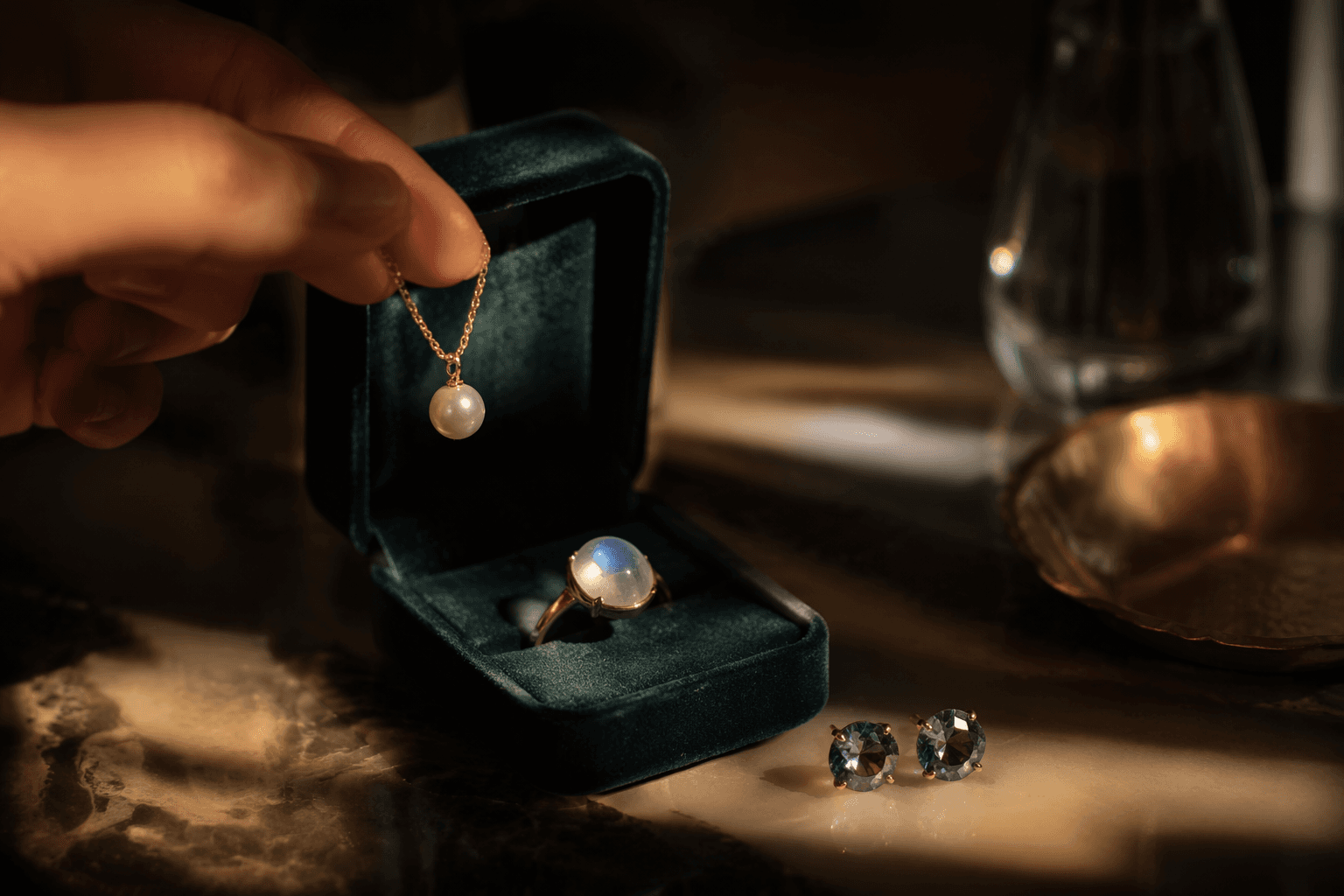
Pearl remains the traditional June birthstone, and it carries a kind of quiet authority that makes it especially effective in personalized gifts. It is also the only gemstone made by a living creature, which gives it a natural romance that no lab-grown material can quite mimic. Pearls are associated with the third and thirtieth wedding anniversaries, so they work beautifully when a name, date, or monogram is meant to mark a relationship rather than simply a birthday.
Cultured pearls became far more accessible after Kokichi Mikimoto developed pearl culturing in 1893, which is why pearl remains one of the most approachable options in fine jewelry. That matters for personalized pieces, where the budget often has to stretch across a setting, engraving, and chain or clasp details. Pearls suit engraved pendants, delicate lockets, and charm bracelets especially well, because their glow reads as decorative rather than showy. In a name necklace, pearl softens the typography and gives the whole piece a more romantic, less trend-driven finish.
Pearl is also the most delicate of the three June stones, so it rewards protective settings and careful wear. A bezel-set pearl pendant or a charm that does not bang against other metal pieces will preserve its luster far better than an exposed design. If the gift is meant for everyday wear but still wants to feel feminine and classic, pearl is the safest emotional bet.
Moonstone: luminous, modern, and quietly expressive
Moonstone is the June stone for someone who wants atmosphere more than sparkle. Its signature glow, called adularescence, is what makes it appear to move from within, giving it a pale, almost lunar shimmer that feels especially elegant in personalized jewelry. The stone has been used in jewelry for thousands of years and found renewed popularity in the Art Nouveau period, when designers favored nature-inspired forms and stones with an almost dreamlike quality.
That history makes moonstone an ideal match for pieces that are meant to feel a little secretive or symbolic. It works beautifully in lockets, where the stone can act as a private marker on the outside of a piece that already carries personal meaning inside. It also suits charm jewelry, especially when paired with initials, zodiac motifs, or small engraved tags, because moonstone adds color without competing with the personal detail.
Moonstone’s mood is more ethereal than pearl’s. Pearl looks polished and composed; moonstone looks fluid and slightly mysterious. That makes it a strong choice for a gift that is meant to feel personal without being literal. In a name necklace, moonstone is best when used as a small accent stone rather than a large center gem, since its pale body color can disappear if the design becomes too busy. If you want the jewelry to feel subtle, sentimental, and a little romantic, moonstone is the most poetic of the three.
Alexandrite: the rarest, most dramatic option
Alexandrite is the stone for a gift that needs presence. Discovered in the Ural Mountains of Russia in the 1830s, it was named in 1834 in honor of the future Czar Alexander II, and by the 1950s it had become the modern alternative to pearl for June. Its appeal lies in rarity and transformation: alexandrite is prized for its unusual color change, a phenomenon tied to an extraordinary geological coincidence involving beryllium and chromium. The original source was nearly exhausted after only a few decades of mining, which is why fine alexandrite remains one of the more serious investment stones in birthstone jewelry.
For personalization, alexandrite is the most elegant choice when you want the center of gravity to stay on craftsmanship. It shines in engraved gifts that use the stone as a focal point, especially pendants or rings with clean metal lines. It also elevates a name necklace in a way the other two stones cannot, because even a small alexandrite accent gives the piece a sense of rarity and intention. If pearl whispers and moonstone glows, alexandrite changes the conversation.
This is the stone for someone who already owns the obvious options and wants something a little more singular. It can justify a higher budget because the cost reflects both scarcity and visual complexity. In a personalized piece, that rarity becomes part of the story: the jewelry feels less like a conventional birthstone gift and more like a deliberate design object.
How to choose the right June stone for the right format
The smartest way to shop June birthstones is to match the stone’s character to the format of the jewelry.
- Name necklaces: Alexandrite is the most striking choice if you want the name itself to feel elevated. Pearl brings a classic, bridal softness. Moonstone works best as a quiet accent that keeps the piece from feeling too literal.
- Lockets: Moonstone is especially strong here because its glow adds mood without overwhelming the sentimental architecture of the locket. Pearl suits a more traditional look. Alexandrite is best when the locket is designed as a true keepsake object.
- Charm pieces: Pearl and moonstone both work well in charm form because their scale can stay small without losing personality. Alexandrite charms are more precious-feeling and best used sparingly, where their rarity can be appreciated.
- Engraved gifts: Alexandrite makes engraving feel more luxurious, especially in clean, minimal metalwork. Pearl is ideal when the engraving is about memory or family. Moonstone creates a gentler, more lyrical effect.
Budget, wearability, and the final design choice
Because June’s birthstones occupy such different price points, the best one is not always the rarest. Pearl offers the broadest accessibility, thanks in part to cultured pearl production, and it remains a handsome choice for shoppers who want a meaningful piece without pushing into investment territory. Moonstone usually sits in the middle, offering visual romance at a relatively approachable level. Alexandrite stands apart at the top end, where rarity and color change justify the cost for buyers who want a truly distinctive stone.
Wearability matters just as much as budget. Pearl and moonstone are softer stones, so they feel most at home in protective settings and pieces that will not be knocked around every day. Alexandrite is the strongest day-to-day option of the three and can handle more ambitious settings. That practical difference is often what turns a nice gift into the right one.
June’s birthstones are less a single story than three different design languages. Pearl is for memory, moonstone for mood, and alexandrite for transformation. In personalized jewelry, that range is a luxury in itself, because it lets the piece say exactly what the buyer means, in the stone that says it best.
This article was produced by Prism’s automated news system from verified source data, official records, and press releases, then run through automated quality and moderation checks before publishing. The system is built and supervised by the people who set the standards it runs under. Read our full AI policy.
Know something we missed? Have a correction or additional information?
Submit a Tip