Kris Averi’s Prism Thorn ring turns queer pride into wearable armor
Prism Thorn turns Pride into a made-to-order heirloom, with angel-cut rainbow sapphires and a silhouette that wears like armor. Kris Averi ties every stone to identity, not novelty.
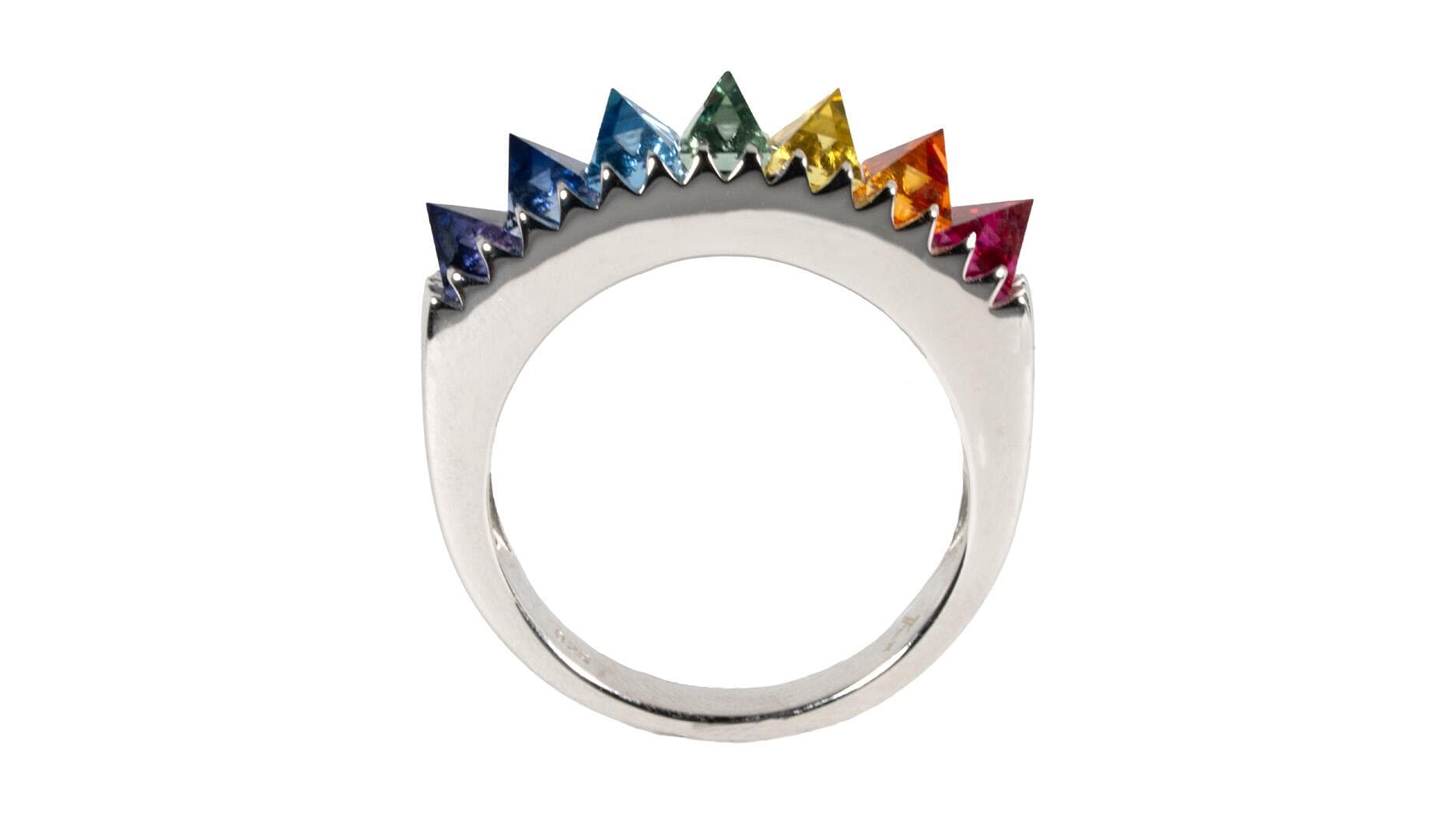
Kris Averi’s Prism Thorn ring reads like a rebuke to disposable Pride merchandise. Instead of leaning on logo-heavy rainbows or one-month novelty, the design uses custom-cut sapphire geometry, a protective silhouette, and a made-to-order format that turns identity into something meant to be kept, worn, and handed down.
A ring built as protection, not decoration
The rainbow version of Prism Thorn was conceived as “a little piece of armor,” and that idea shapes every visual choice. The ring draws from prisms, pyramids, and the protective force of thorns, then translates those references into a crown-like form that feels sharpened rather than soft-edged. In Kris Harvey’s hands, the symbolism is not abstract: it is meant to sit on the hand as a visible defense, the way punk spikes can signal both resistance and style.
That protective impulse matters because it gives Pride jewelry a different emotional register. This is not a seasonal accessory that lives or dies by June’s calendar; it is closer to an identity marker, one that carries the wearer’s sense of resilience in a form sturdy enough to become part of an everyday jewelry rotation.
Why the gemstone cutting changes everything
The most striking part of Prism Thorn is the stonework. Harvey worked with lapidarist Oke Millett, who custom-cut the gemstones in Thailand into calibrated true octahedrons, a shape far removed from the familiar round, oval, or cushion cuts that dominate fine jewelry. The rainbow version uses angel-cut, reverse-set, lab-grown flame-fusion sapphires in a ROYGBIV palette, so the color story is literal without feeling cartoonish.
Angel-cut stones are set face down and point up, which gives the ring a more architectural profile than a conventional prong-set gemstone. Harvey said the octahedron cut preserves the pavilion and pointed underside, creating greater depth of color, and described the stones as “compressed light until the sun finds them.” That is exactly what the setting seems to pursue: a geometry that catches light from multiple angles and returns it as flashes of saturated color rather than a flat rainbow stripe.
The technical challenge is part of the allure. Cutting an octahedron precisely enough to fit the setting demands a level of calibration that standard commercial production rarely attempts, and that precision is what makes the ring feel bespoke rather than branded. The result is a piece that looks engineered, not merely embellished.

Made-to-order jewelry, with customization at the center
Prism Thorn also reflects a larger shift in personalized jewelry toward pieces that are tailored in more than one dimension. Kris Averi says the ring is made-to-order and can be customized by request, including stone, shape, size, cut, clarity, and metal alloy. That level of flexibility moves the design beyond the single-stock model that governs so much Pride retail and into the more intimate language of private commission.
The pricing reinforces that point. The rainbow version is priced at $395 in sterling silver, with 14-karat yellow gold and 14-karat white gold versions also available. Sterling silver keeps the entry point relatively accessible, while the gold options push the design into heirloom territory, especially for buyers who want a ring that can live beyond a single season or occasion.
Kris Averi’s wider brand identity makes that strategy feel coherent rather than opportunistic. The company describes itself as making one-of-a-kind engagement rings and heirloom fine jewelry for all love stories, crafted to honor identity, devotion, and legacy, and it identifies as an LGBTQ+ jeweler and a queer-led business. Made in NYC, that positioning fits a piece like Prism Thorn especially well, because the ring is not asking Pride to look generic. It is asking it to look personal.
The rainbow code is intentional
There is another reason the ring stands out in the current jewelry landscape: its rainbow is coded, not casual. The ROYGBIV palette gives Prism Thorn a clear Pride connection, but the use of sapphires, the octahedral cut, and the reverse-setting keep the color story from becoming literal merchandise. The black spinel version, which Kris Averi also offers, sharpens that distinction further by leaning into a more subdued language of protection and power, while the rainbow edition emphasizes joy, visibility, and celebration.
That contrast between black spinel and rainbow sapphire is telling. It suggests that queer identity jewelry does not need to choose between softness and strength, or between celebration and self-possession. The same design family can hold both moods, which is part of why personalized fine jewelry is increasingly resonant: it can express a layered identity without flattening it into a slogan.
A Pride piece with a direct community tie
Harvey is donating 25 percent of the profits from both versions of the ring to Heritage of Pride through June 30, 2026. That nonprofit is behind NYC Pride, and the timing sits squarely beside New York City’s Pride March and PrideFest, which were scheduled for Sunday, June 28, 2026. The donation gives the ring a clear civic connection, but the piece does not rely on charity language to justify itself; its strongest argument remains its design language and its custom craftsmanship.
There is also a useful distinction here between charity merchandise and collectible jewelry. A donation window can give a piece urgency, but the ring’s longevity comes from the fact that its symbolism is embedded in the construction itself. The sapphire geometry, the protective framing, and the made-to-order structure make it feel designed for long wear, not just a calendar moment.
Why this points to the next chapter in identity jewelry
Kris Averi’s Prism Thorn ring captures where personalized jewelry is heading: less mass-market affirmation, more intimate symbolism; less seasonal branding, more bespoke meaning. When a ring can be ordered in different metals, adjusted by cut and clarity, and built around a stone shape that was custom-cut to preserve its internal light, personalization stops being a finishing touch and becomes the entire premise.
That is why Prism Thorn lands as more than a Pride ring. It is a small, precise object with the language of protection built into its silhouette, and that makes it feel closer to a personal emblem than a campaign item. In a market crowded with declarative rainbow pieces, this one chooses a subtler and more durable form of visibility.
This article was produced by Prism’s automated news system from verified source data, official records, and press releases, then run through automated quality and moderation checks before publishing. The system is built and supervised by the people who set the standards it runs under. Read our full AI policy.
Did this article answer your question?