Matilda Bardet's Bubbly Quartz Marquise Ring Feels Perfectly In Step With the Moment
Matilda Bardet's one-of-a-kind marquise quartz ring earns its moment not by chasing trends, but by solving a single design problem with rare precision.
There is a particular kind of jewelry that arrives at exactly the right cultural moment without having been designed for it. Matilda Bardet's custom "Bubble" ring is that piece. Elongated stones and enamel have dominated conversations in fine jewelry recently, yet this ring wasn't engineered to ride those waves. It simply exists on its own terms, and the timing feels serendipitous.
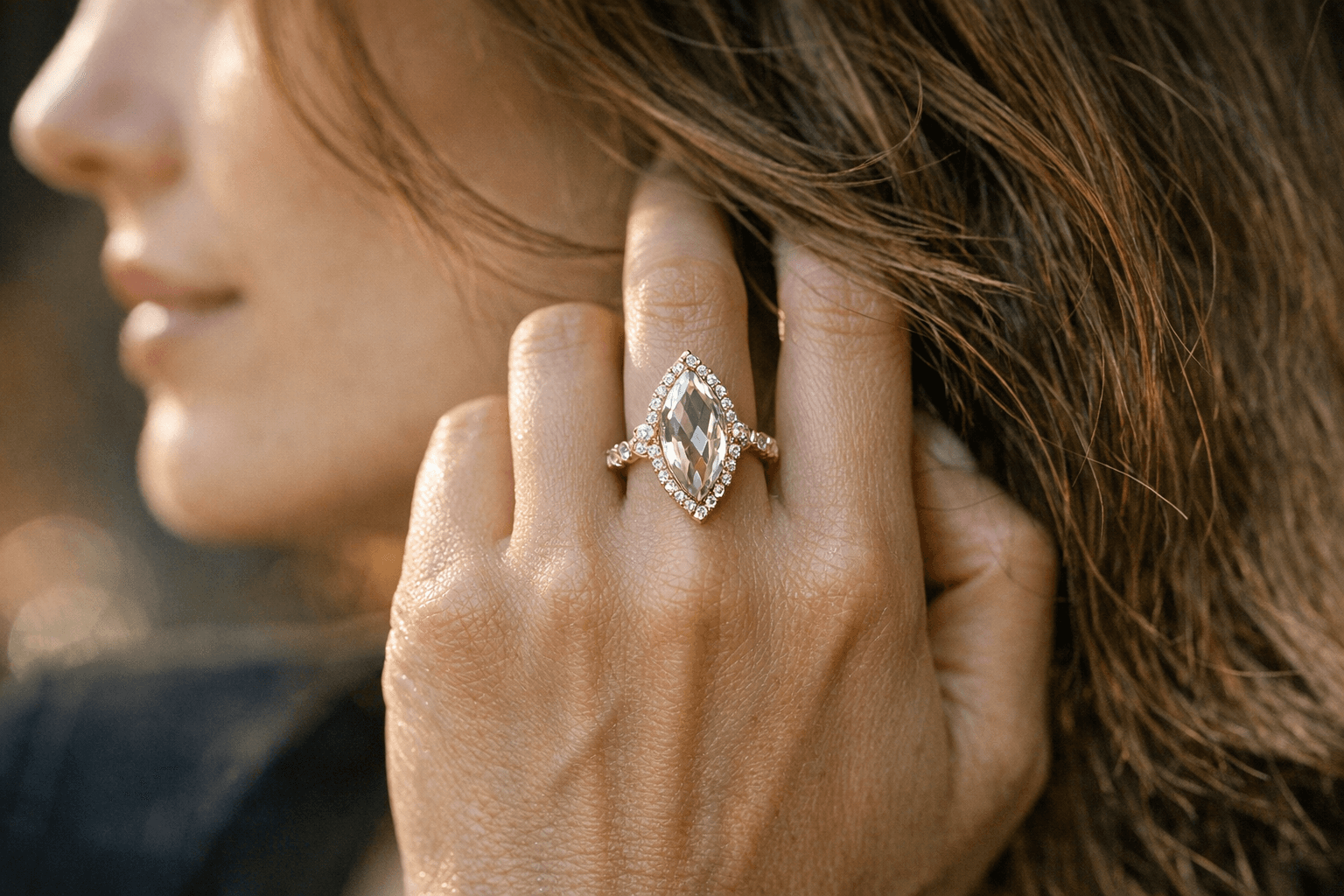
The center stone commands attention from every angle. A 9.5 carat marquise cut in Brazilian quartz, it carries a carved "bubble" detail along its side elevation that gives the stone a quality you don't often encounter: it looks less like it was faceted and more like it was caught mid-motion, as though carbonation had been suspended inside the gem at precisely the right instant. The phrase "a celebration frozen in time" is not hyperbole here. It is an accurate description.
The Stone and Its Challenge
A marquise quartz of 9.5 carats already presents scale. Add a carved three-dimensional bubble along the side profile, and you introduce a vulnerability that any responsible jeweler has to reckon with: how do you set a stone with an intentional structural irregularity without either hiding the detail or compromising the stone's security? This was the central design problem Bardet set out to solve.
"One detail I was determined to honor was the carved 'bubble' that dips along the side elevation," she explains. The answer came in the form of a half-bezel setting, a choice that threads the needle between aesthetics and engineering. A full bezel would have enclosed and obscured the carved feature; prongs alone might not have offered sufficient protection for a carved stone of this size. The half-bezel frames the bubble visually while, as Bardet puts it, "offering the most secure technical solution." It is the kind of decision that looks effortless in the finished piece and reveals itself as deeply considered only when you understand what was at stake.
Proportion as Craft
Getting the setting right was only the beginning. "Refining the scale and proportions of the ring became an art form in itself," Bardet says. "Design is never linear, and neither was this piece." That candor matters. In an industry where bespoke often means expensive-and-expedient, her description of an iterative, non-linear process signals something closer to true craft practice. The 9.5 carat marquise is a large stone with a long silhouette, and the shank, the half-bezel's height, and the overall visual weight of the ring all had to be calibrated so the piece sits harmoniously on the hand rather than overpowering it. No specific measurements or timelines for this calibration are disclosed, but the language Bardet uses suggests multiple rounds of adjustment rather than a single resolved sketch.
The Enamel: A Study in Patience
The second major design decision concerns the color, and it is here that the ring moves from technically accomplished to visually arresting. Bardet introduced cold enamel to the piece, and not in a conventional accent color. She reached for a reference that serious colorists will immediately understand: Yves Klein Blue, the saturated, almost metaphysical ultramarine that the French artist patented in 1960 as International Klein Blue. It is an audacious touchstone.
"I wanted to push the envelope with custom blue cold enamel inspired by Yves Klein Blue, which meant multiple rounds of color testing on sterling silver before committing to 18k yellow gold," Bardet says. The choice to test on sterling silver before the final substrate is a methodologically sound one: cold enamel interacts differently with metal surfaces, and the warmth of 18k yellow gold shifts how a cool, saturated blue reads in natural light. By prototyping on silver, which provides a neutral base, Bardet could isolate the enamel's chromatic behavior before introducing the visual complexity of gold undertones.
The application itself is uncompromising. "Cold enamel requires patience," she notes. "It's hand-applied and left to cure for several days, so every iteration demanded intention." Unlike vitreous or cloisonné enamel, which is fired in a kiln, cold enamel cures at room temperature through a chemical process. It allows for rich, glossy color, but it cannot be rushed. Each color test was effectively a multi-day commitment, which means the "multiple rounds" Bardet references represent a significant investment of time before a single component of the final ring was completed.
The result is described as a "vibrant splash of blue" that reads against the 18k yellow gold with the kind of contrast that feels confident rather than garish. Yellow gold and Klein-adjacent ultramarine have a long art historical relationship, and Bardet's use of it here anchors a contemporary piece in something with genuine visual intelligence.
Materials and Provenance
The Brazilian quartz at the center of this ring deserves a note on its own. Quartz is not a stone that typically commands the same reverence as corundum or beryl, but Brazilian material has a long reputation for clarity and size, and a well-carved marquise in this weight is far from ordinary. The "bubbly" carving that defines the piece requires a lapidary with the skill to introduce an intentional convex feature to a stone without cracking it, a technically demanding ask in a material that can be brittle along certain planes.
No gemological grading report or treatment disclosure is referenced in available information about this piece, which is worth noting for prospective buyers. If you are seriously considering a price-on-request custom piece of this nature, requesting full provenance documentation for the Brazilian quartz, including natural versus treated declarations and any clarity assessments, is a reasonable and standard ask.
The metal is 18k yellow gold, a practical choice for a ring that will be worn. It offers better durability than 24k and a warmer tone than 14k, which suits the deep blue of the enamel. The combination of materials here is not accidental: Brazilian quartz, 18k gold, and Klein Blue cold enamel each bring specific visual properties that work together rather than compete.
What Makes This Piece Matter
Custom jewelry exists on a wide spectrum. At one end are pieces that are "custom" in name only, a standard setting resized, a stone swapped in from a house inventory. At the other end are pieces like this one, where the design problem is genuinely novel, where the solution requires material testing and iterative calibration, and where the finished object could not have been arrived at by a different path. Bardet's Bubble ring sits firmly at that second end.
The ring is available at price on request directly through Matilda Bardet, which is standard practice for one-of-a-kind commissions at this level. What you are paying for, beyond materials, is the documented design labor: the enamel tests, the proportion studies, the engineering logic of a half-bezel chosen not because it is fashionable but because it is correct. For a buyer who understands that distinction, the conversation is worth having.
Know something we missed? Have a correction or additional information?
Submit a Tip

