Minimalist Nameplates and Layered Initials Define Personalized Jewelry Trends in 2026
Personalized jewelry hit $42 billion in 2026, and the sharpest shift is aesthetic: the ornate script nameplate is giving way to something leaner, more layerable, and built to last.

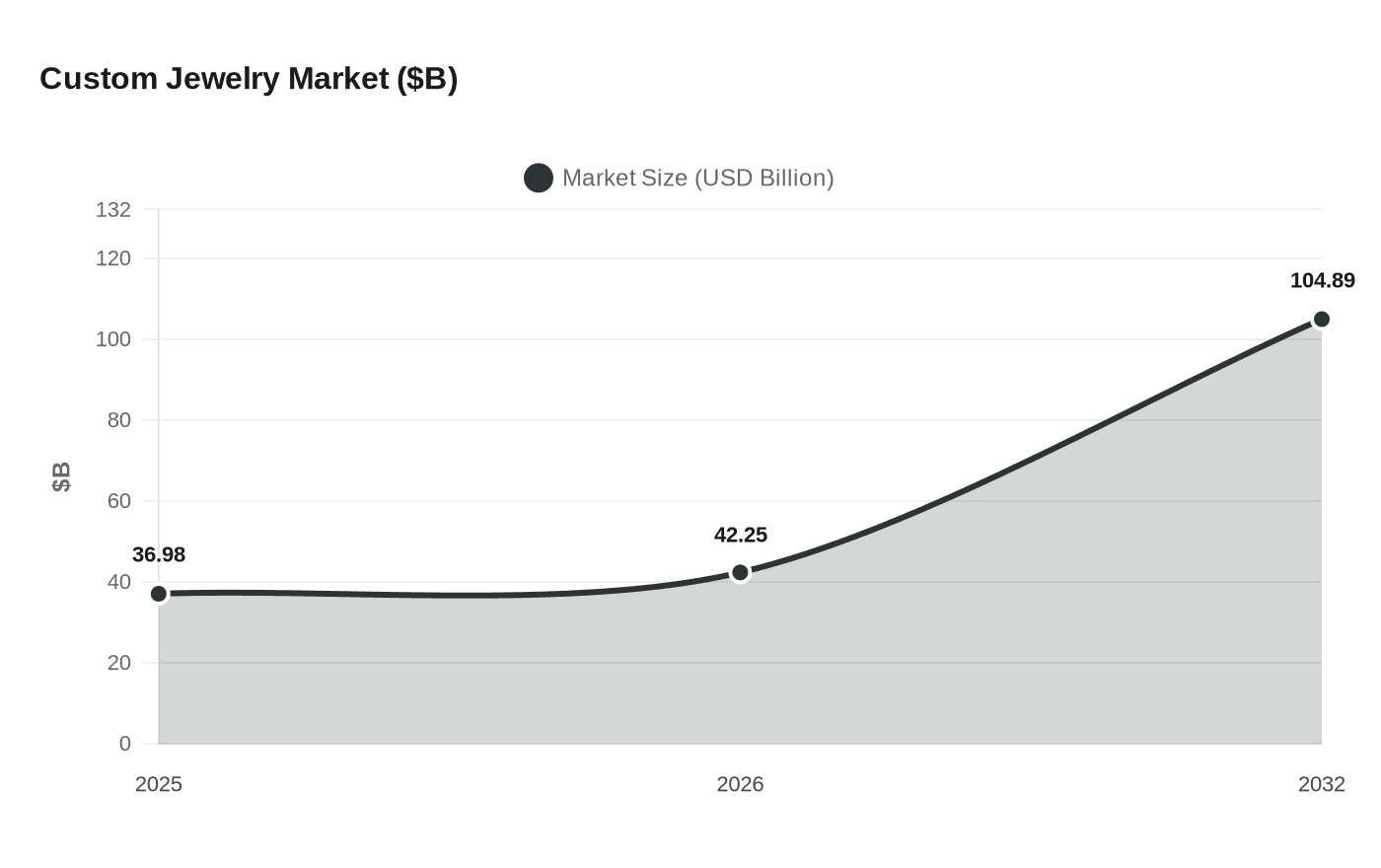
After tracking Etsy's best-seller tags, mapping Pinterest board activity in the personalized jewelry category, and following the cultural arc of a trend that has outlasted every fashion cycle since the 1990s, one thing becomes unmistakable: personalized jewelry in 2026 is not decelerating. It is refining itself. The global customized jewelry market grew from USD 36.98 billion in 2025 to USD 42.25 billion in 2026, and is projected to expand at a 16.06% CAGR, reaching USD 104.89 billion by 2032. But the more interesting story is not the scale. It is the direction of taste operating inside it: away from ornate flourishes and toward something precise, wearable, and quietly modern.
A trend with deep roots
The nameplate necklace originated among African-American and Latino communities in 1970s New York, drawing on graffiti and hip-hop culture. Its first major mainstream crossover came in 1998, when *Sex and the City* costume designer Patricia Field was inspired to include the necklace in Carrie Bradshaw's wardrobe after carrying similar items in her New York City shop. That single styling decision introduced the gold nameplate to a global audience, and the popularity of nameplate necklaces, which began with Black and Latinx youth in the '90s, resurged throughout the aughts as a result of the show.
The 2010s Etsy boom democratized the form further, making custom script necklaces accessible at every price point. Familiarity, over time, bred a hunger for refinement. By 2026, the wide looping-script nameplate has been largely displaced on Etsy's best-seller lists by something leaner and more considered.
The minimalist shift: what 2026 actually looks like
The defining aesthetic of this moment is restraint. Nameplates are moving toward clean-font executions on narrow metal bars rather than the broad, gilded script plates of earlier decades. Think sans-serif lettering, tight kerning, and a profile slim enough to sit flush against the collarbone without announcing itself across a room. Brands oriented specifically around this quieter execution, including Caitlyn Minimalist, have found a clear market in shoppers who want identity-forward jewelry that does not shout.
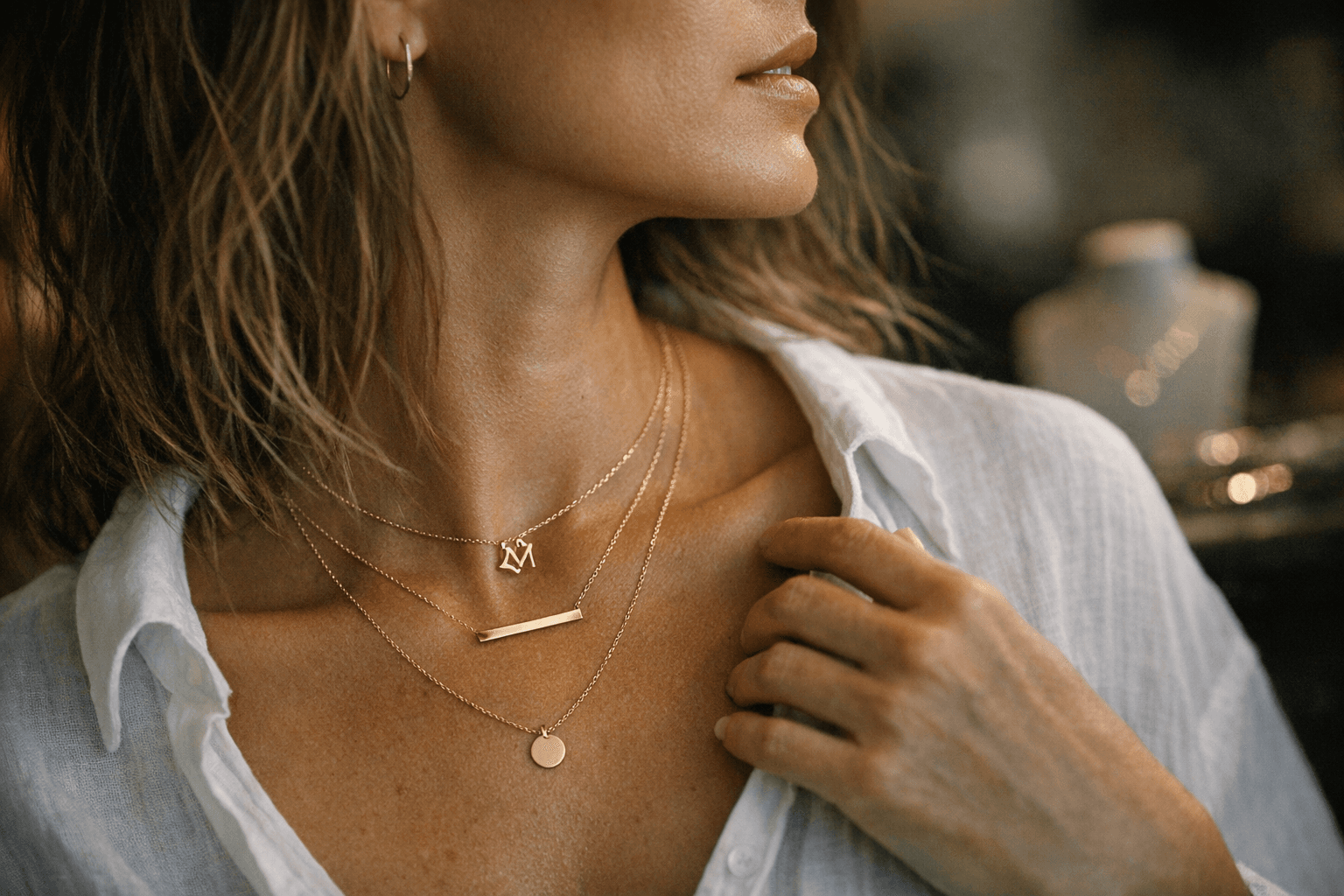
This is not minimalism as trend for its own sake. It is minimalism as a practical response to how people are actually wearing jewelry right now: in layers. A wide ornate nameplate competes badly in a stack. A narrow engraved bar or a delicate single-initial pendant, by contrast, plays well with other pieces without dominating them.
Initial pendants have evolved alongside nameplates. The single-letter charm that once stood alone is increasingly paired with tiny birthstone accents, a small prong-set stone beside the letter, adding color and personal specificity without adding visual noise. It is a small change with significant styling impact, transforming what was once a basic monogram piece into something with gemological dimension.
Non-Latin scripts are also expanding the category meaningfully. Custom pieces in Arabic, Hebrew, Devanagari, and Hangul are appearing with greater frequency in personalized jewelry searches, reflecting both global demand and a broader shift toward celebrating heritage through wearable form.
Three layering formulas worth keeping
The appeal of a layered personalized neck stack is that it reads as curated rather than accumulated. The mechanics require intentional variation in length, chain weight, and pendant scale. Three formulas that translate cleanly from the trend into real wardrobes:
- The short-long pairing: A 16-inch initial pendant rests just below the collarbone; a 20-inch nameplate bar hangs lower, over the sternum. The gap between them creates negative space that makes both pieces individually legible.
- The birthstone bridge: Anchor the stack with a dainty 14-inch chain bearing a birthstone solitaire, add an 18-inch initial charm in the same metal, and finish with a 22-inch fine-link chain with no pendant to provide visual weight at the base without competing for attention.
- Deliberate metal mixing: Pairing yellow gold and sterling silver is no longer a stylistic misstep; it is a marker of ease and confidence. The lived-in quality of a mixed-metal neck stack reads as more sophisticated than a perfectly matched set, and the best-seller tags on Etsy confirm that shoppers are actively seeking dual-tone pieces.
For neckline pairings: crew necks frame a choker-length initial best, letting the pendant rest at the fabric's edge rather than disappear behind it. V-necks accommodate longer layered stacks well, with the deepest pendant following the natural line of the neckline. Boat necks and off-shoulder styles call for a single short nameplate or nothing at all; the neckline itself is doing the visual work and does not need competition.
Choosing your metal: solid gold, gold-filled, or vermeil
This is the most consequential decision in the buying process, and the most frequently misunderstood. For a nameplate worn daily, the gap between these materials is not cosmetic. It is structural.
Solid gold jewelry does not tarnish, retains value, and can last generations with minimal care. It is the right choice for a nameplate you intend to layer permanently and never remove. 14k strikes the best balance of durability and color richness for everyday wear.
Gold-filled jewelry has a substantially thicker gold layer than standard plating; the gold is mechanically bonded to a brass core, giving it a lifespan much closer to solid gold than most consumers expect. For wearers who want longevity without the solid gold price point, a well-made gold-filled nameplate is a reasonable long-term investment.
Gold vermeil (pronounced ver-MAY) requires a base of solid sterling silver and a minimum of 2.5 microns of gold plating at 10k or higher. It is hypoallergenic and offers a more refined aesthetic, wearing well over time if kept away from water and abrasion. Higher-end vermeil uses 18k gold plating, which produces a richer, warmer tone. The honest caveat: it will eventually wear through with constant daily exposure in ways solid gold will not.
Gold-plated jewelry, by contrast, may start fading within months, making it a poor investment for a piece intended to carry long-term personal meaning.
What to confirm before you place the order
Custom jewelry has a narrow margin for error. A misspelled name or a piece that arrives after the occasion it was made for is not returnable in most cases. Before confirming any order:
- Verify the spelling exactly as submitted. Most makers will produce precisely what you type, without autocorrection.
- Confirm turnaround time in writing. Standard lead times for custom nameplate and initial pieces run two to four weeks; rush options often carry a 20-30% premium.
- Understand the return policy specifically for custom orders. Most personalized pieces are final sale; chain-length exchanges are sometimes available, but name corrections typically are not.
- For non-Latin script orders, confirm the maker has direct experience with that specific script and request a digital proof before production begins. Letterform quality in non-Latin engraving varies significantly across suppliers.
Why this moment holds
A market valued at $42.25 billion in a single year reflects something more durable than a trend cycle. Personalized jewelry sits at the intersection of self-expression and meaningful gifting, two purchase motivations that hold even as other discretionary categories soften. The minimalist direction of 2026 is a maturation, not a correction. The ornate script nameplate is not disappearing; it is being joined by a cleaner, more layerable counterpart that fits the way most people actually dress. The pieces that will outlast this moment are the ones that earn a permanent place in a daily stack: narrow, precise, and made in materials that do not ask to be replaced.
This article was produced by Prism’s automated news system from verified source data, official records, and press releases, then run through automated quality and moderation checks before publishing. The system is built and supervised by the people who set the standards it runs under. Read our full AI policy.
Did this article answer your question?