Pandora Minis Campaign Features Katseye and 17 New Personalized Charms
Katseye styled all 17 new Pandora Minis charms themselves, turning a charm campaign into a genuine creative collaboration between jewelry and pop's most internationally assembled new act.

Jewellery has long been a form of self-expression, but Pandora's newest campaign makes that idea feel freshly urgent. The brand has partnered with global girl group Katseye to front Pandora Minis styled by Katseye, a capsule of 17 new mini charms built around one conviction: that jewellery is most powerful when it is personal.
What separates this from a standard celebrity endorsement is the word "styled." Katseye's members didn't simply wear pieces selected by a creative director and stand in front of a camera. According to the campaign's own framing, the charms were styled by Katseye themselves, which positions the group as genuine collaborators in the creative process rather than faces on a billboard. That distinction matters, particularly for a brand whose entire identity rests on the idea that charm jewellery is an act of self-authorship.
Who Is Katseye?
If you haven't tracked the group's rise, a brief introduction is useful context. Katseye was assembled by Hybe and Geffen Records, a joint venture that brought together two of the music industry's most powerful forces: the Seoul-based label behind BTS and the Los Angeles major that helped define American pop and rock for decades. The group's formation was documented in real time on the Netflix reality series Pop Star Academy: Katseye, which chronicled the audition and assembly process and gave the group a global audience before they had released a single official track.
Critically, Katseye was international by design from day one. Its members were drawn from different countries, a deliberate construction that distinguishes it from most K-pop acts, which typically recruit domestically or from a narrow regional pool. The group's sound carries that same boundary-crossing energy. As the campaign copy describes it, their music "gleefully sidesteps the more rigid conventions of K-pop," swinging from the industrial grit of their track "Gnarly" to the tongue-in-cheek drama of "Gabriela." Equal parts chaos and charm is how that musical range has been characterized, and it is a description that maps surprisingly well onto the visual language of layered, mixed-metal jewellery.
The Case for Mini Charms
The 17 new pieces in the capsule are all mini charms, a format that rewards exactly the kind of layering and stacking Katseye has become associated with. Mini charms, smaller in scale than Pandora's standard offerings, are inherently combinatorial: they invite wearers to build compositions rather than make single statements. Stack three on a bracelet and you have a vibe; stack seven and you have a biography.
Pandora has long understood that the charm format is less about individual pieces and more about the system those pieces create. The Pandora Minis capsule deepens that logic by styling the collection around layering freely and mixing metals, two moves that require a certain confidence to pull off. The campaign's entire visual and editorial language is built around that confidence, the idea that there is no wrong combination as long as it is yours.
Specific pricing, available metals, gemstone details, and retail distribution for the 17 charms have not been disclosed in campaign materials. Those details are worth confirming directly with Pandora before purchasing decisions are made, particularly for buyers who want to understand whether the charms are compatible with existing Pandora bracelets or require the Minis-specific hardware the brand has developed in recent years.
A Partnership Built on Cultural Timing
The campaign's framing explicitly acknowledges that both Pandora and Katseye are "operating at the height of their cultural relevance," and that timing is not incidental. Pandora has spent several years repositioning itself from a brand associated with gifting occasion purchases toward something more fashion-forward, leaning into stacking culture and collaborations with culturally resonant acts. Katseye, meanwhile, arrives with a Netflix documentary-fueled origin story, a Hybe and Geffen Records backing that signals serious institutional investment, and a cross-continental fanbase that skews young and digitally engaged.
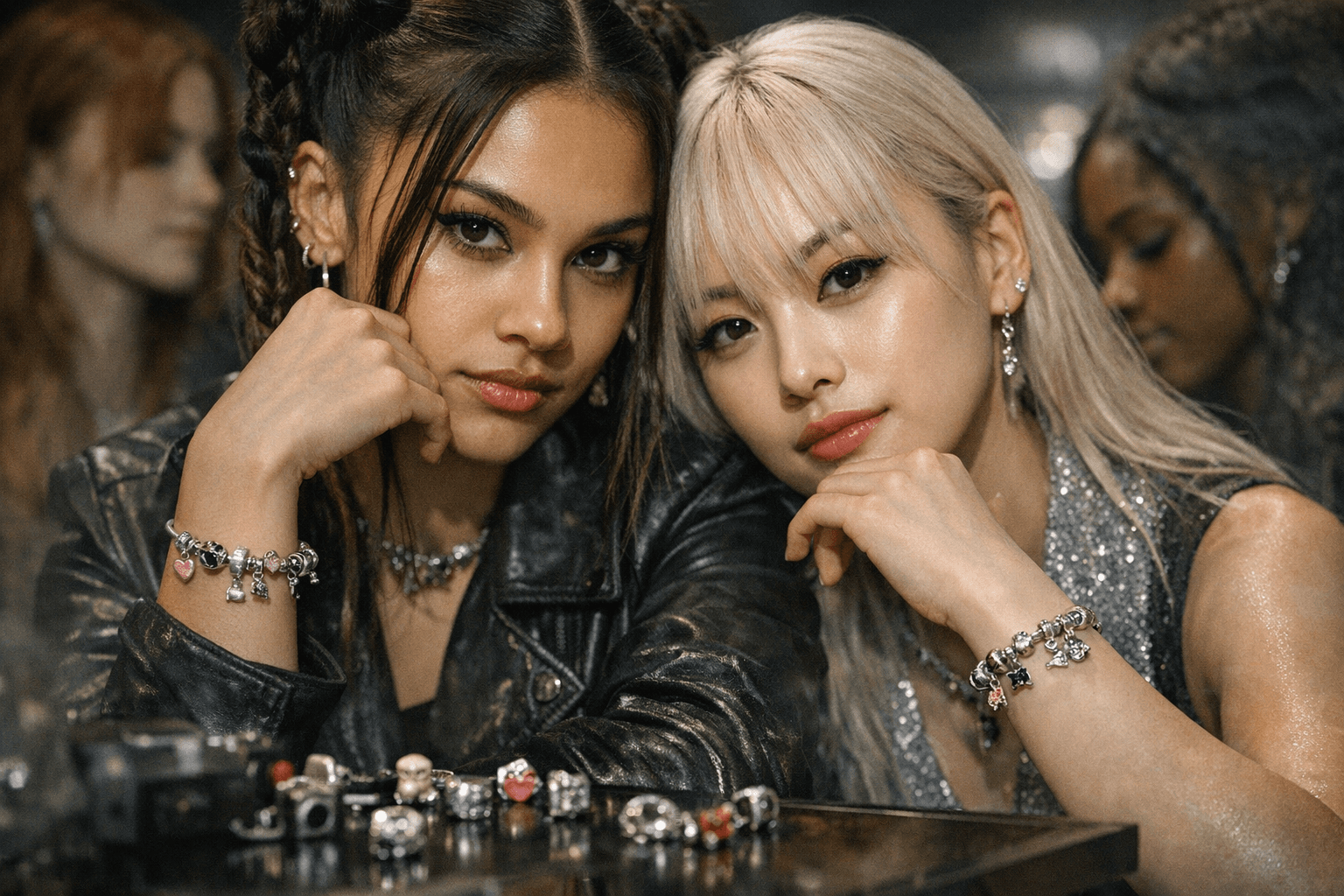
The partnership marries Pandora's iconic charm language with one of pop music's most compelling new acts, as the campaign puts it. That is branded-content language, and it is worth reading it as such: this campaign was presented as branded editorial in The Straits Times, labeled explicitly as sponsored content. The enthusiasm in the copy reflects Pandora's marketing position, not independent criticism. But the strategic logic underneath the promotional language holds up to scrutiny. Katseye's members bring a playful confidence to the way they wear Pandora jewellery, whether by mixing metals or layering freely while stacking charms with an effortless beat of their own. For a brand selling the idea that jewellery is personal, ambassadors who visibly treat it as personal are more persuasive than those who simply look expensive.
What the Capsule Actually Represents
Seventeen is a specific number, and it is worth pausing on it. Most capsule collaborations between brands and pop acts land on round numbers because round numbers are easy to communicate. Seventeen suggests that the selection was driven by something other than symmetry, whether that is the number of styles Katseye genuinely wanted to style, a reference to something meaningful within the group's identity, or simply the count that fell out of the design process. Without confirmation from Pandora, the significance of 17 remains open, but it gives the capsule a specificity that feels intentional rather than arbitrary.
What is clear is that the collection is positioned as an entry point into Pandora's personalization philosophy for a new generation of wearers. Mini charms are accessible in scale and, typically, in price relative to larger jewellery investments. They are also shareable: a single bracelet with a distinctive charm stack photographs well on a wrist, on a flat lay, or worn against the kind of layered styling that Katseye demonstrates in campaign imagery.
The broader industry context is worth noting. The personalized jewellery market has grown substantially over the past several years, driven by consumers who increasingly want jewellery that signals specific identity rather than generic luxury. Pandora's charm model was built for exactly this moment, even if the brand predates the current conversation about personal expression by decades. The Minis campaign, and the decision to let Katseye style rather than simply wear, is Pandora's clearest recent statement that it understands where that conversation is headed.
For anyone who wears Pandora already, 17 new reasons to rebuild a stack is a generous offer. For anyone who has found the brand's classic aesthetic too nostalgic or conventional, Katseye's involvement makes a compelling case that the pieces can carry a different kind of energy entirely.
This article was produced by Prism’s automated news system from verified source data, official records, and press releases, then run through automated quality and moderation checks before publishing. The system is built and supervised by the people who set the standards it runs under. Read our full AI policy.
Did this article answer your question?