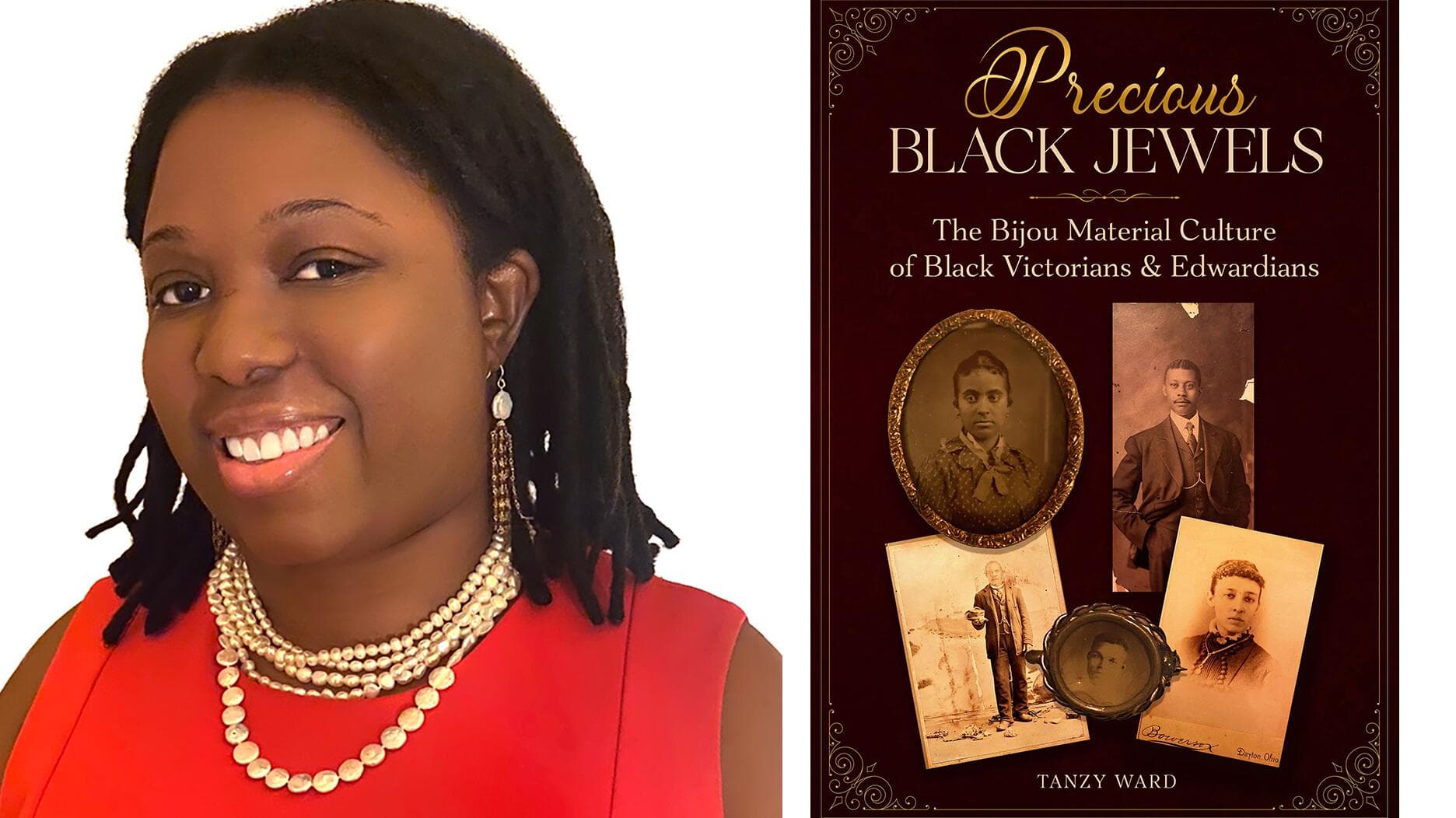
Tanzy Ward’s Precious Black Jewels preserves Black jewelry history
Tanzy Ward’s new book reopens Black Victorian jewelry history, showing how portraits, mourning materials, and memorial objects can reshape modern personalized pieces.
A richer canon for personalized jewelry
Tanzy Ward’s *Precious Black Jewels: The Bijou Material Culture of Black Victorians & Edwardians* does something rare in jewelry writing: it restores Black American presence to a visual history that has too often been flattened, sidelined, or left out entirely. By reading portraits of Black people from 1837 to 1910, Ward shows that adornment was never just decoration. It was identity, memory, taste, and self-definition worn in public.
That matters for today’s personalized jewelry because the usual references for heirloom-style pieces still lean heavily on a narrow Victorian canon. Ward expands that frame. Her portraits reveal a richer vocabulary of brooches, necklaces, earrings, bracelets, sleeve buttons, and black mourning materials, all of which can inspire modern pieces that feel intimate without becoming generic.
Why Ward’s archive changes the story
Ward is not approaching this as a distant historian alone. She is an antique jewelry dealer, historian-preservationist, and author, and *Precious Black Jewels* is her third book. That background gives the project a collector’s eye and a preservationist’s urgency, especially in a field where provenance is often praised but not always documented with care.
Her earlier exhibition, *Our Ancestral Garden*, pointed in the same direction. It brought together original daguerreotypes, tintypes, cabinet cards, real photo postcards, ceremonial fraternal badges, and antique jewelry from her personal collection. The mix is revealing: Ward treats jewelry as part of a broader material culture, where photographs, badges, and adornment all help tell the same family and community story.
Black Victorian jewelry was deeply personal long before “custom” became a selling point
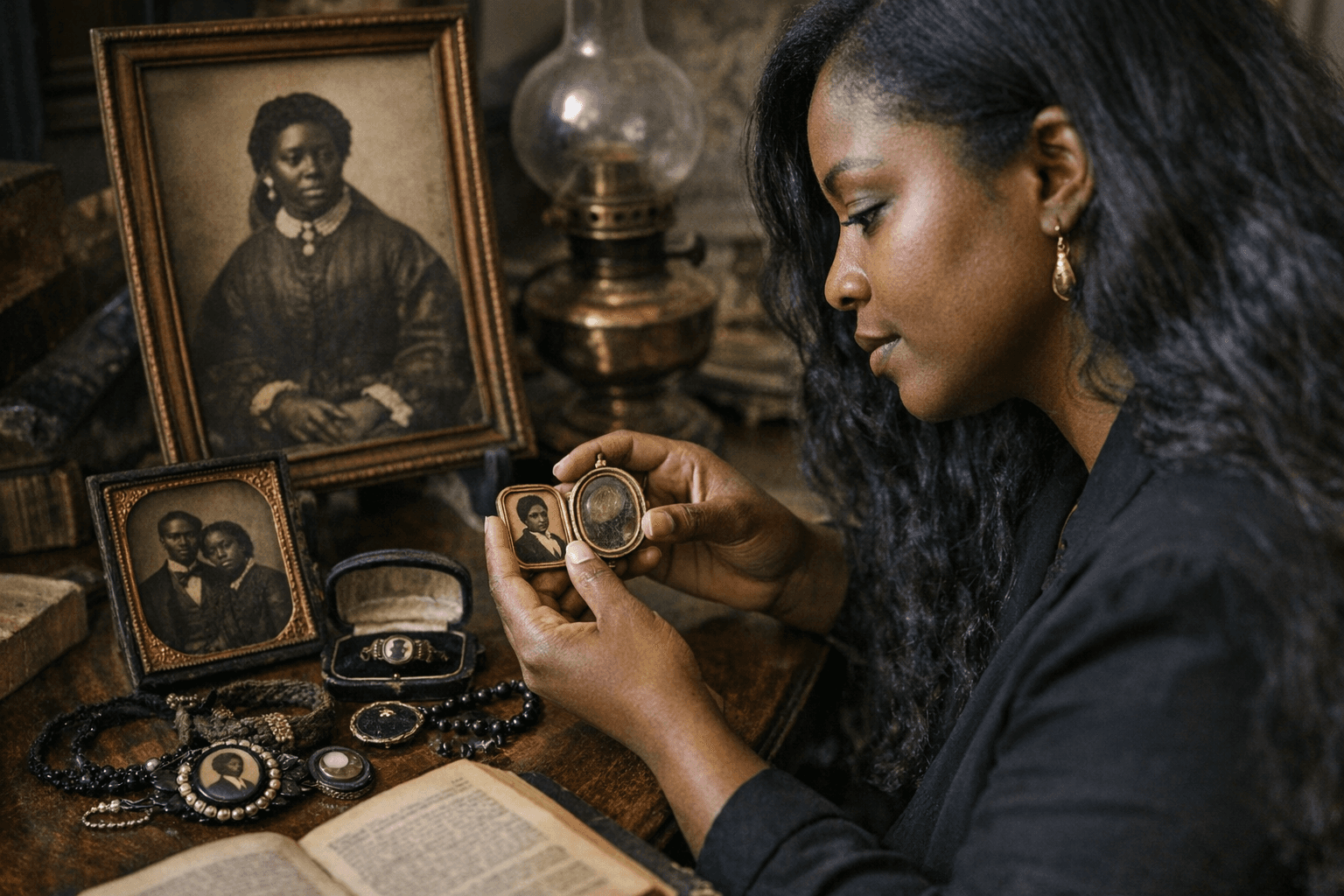
The book’s core argument is that Black Victorians and Edwardians have long been absent from authentic representation within the decorative arts, even though portraits show them wearing elegant adornments that reflected individuality, taste, and sentimental symbolism. That insight should change the way personalized jewelry is understood now. A custom piece does not need to be loud to carry meaning; in Black Victorian tradition, meaning could be held in a jet brooch, a mourning chain, or a carefully chosen black stone.
The historical context matters here. The Victorian era ran from 1837 to 1901, and the Edwardian era is commonly placed from 1901 to 1910, though some jewelry histories extend it into the 1910s. Within that span, mourning jewelry became a major category, especially after periods of deep mourning, when black materials such as jet, onyx, chalcedony, and black enamel were widely used. Hair was also part of that language of remembrance, giving the jewelry an intimate, bodily connection to the person being remembered.
What contemporary buyers can take from this history
Ward’s work offers more than a correction to the historical record. It gives modern buyers a deeper bench of references for personalized jewelry that feels rooted, not merely styled as vintage. The Black Victorian and Edwardian examples suggest that personalization can be built through material choice, portraiture, memorial symbolism, and the quiet authority of black-on-black design.
- jet, onyx, chalcedony, or black enamel for a restrained, memorial palette
- brooches, sleeve buttons, lockets, and chains as formats that once carried visible meaning
- ceremonial fraternal badges as a reminder that jewelry could mark affiliation, status, and belonging
- antique silhouettes that leave room for initials, dates, names, or family references without overwhelming the design
A contemporary piece inspired by this history might draw from:
The strongest lesson is not to copy the past, but to understand its codes. Black Victorian jewelry was often elegant and exacting, never accidental. That same discipline can give engraved or heirloom-style pieces more emotional weight than a generic charm or standard nameplate ever could.
A broader push to expand the jewelry canon
Ward’s work also sits inside a wider effort to make the jewelry industry more inclusive and historically literate. The Black in Jewelry Coalition describes itself as an international nonprofit membership organization dedicated to the inclusion and advancement of Black professionals in the gem and jewelry industry. That mission matters because representation is not only about who works in the trade, but also about whose histories the trade preserves, teaches, and sells back to the public.
The enthusiasm around *Precious Black Jewels* shows that this is not a niche subject. A public author signing and lecture tied to the book was scheduled for January 21, 2026, at the Hapeville Depot Museum in Hapeville, Georgia, and that kind of community response signals real appetite for a fuller story. Jewelry history becomes more useful when it is allowed to reflect more than one lineage.
Ward’s book makes a clear case: personalization should not be confined to the familiar language of the mainstream Victorian era. Black Victorian and Edwardian jewelry adds a more expansive set of visual references, memorial traditions, and material choices, and that is exactly what modern collectors and custom buyers have been missing.
This article was produced by Prism’s automated news system from verified source data, official records, and press releases, then run through automated quality and moderation checks before publishing. The system is built and supervised by the people who set the standards it runs under. Read our full AI policy.
Did this article answer your question?