Top
After testing four leading smart rings, the gap between jewelry and tech has almost closed; which ring fits your life depends on how you already wear your hands.
After sixty-plus hours of long-term testing across tracking accuracy, battery life, app experience, subscription cost, and the kind of manufacturing precision that separates a ring you forget about from one you can't stop fidgeting with, one finding cuts through the noise: the smartest smart ring for most people is not the one with the most features. It's the one that disappears on your finger.
The smart ring market has matured fast, with the top options offering accurate health tracking, sleep monitoring, and stress insights. Choosing between today's best options now requires the same deliberate thinking you'd apply to selecting a fine band. Which finish suits your existing jewelry? How does a 2.8mm profile compare to 2mm when stacked against a wedding ring? Does a monthly subscription change the total cost calculation over three years? These are jewelry questions as much as tech questions, and most buying guides never ask them.
The Four Picks
Best Smart Ring Overall: Oura Ring 4
Despite increased competition, the Oura Ring 4 remains the best smart ring you can buy, offering a range of premium designs, the most polished app, and countless actionable insights into nighttime rest, readiness, and body responses. Its "Smart Sensing" platform adapts to the unique structure and skin tone of each wearer's finger, driving accuracy across sleep staging, heart rate variability, SpO2, and stress. Unique features like the Adenosine Clearance Window guide caffeine intake for better rest, while the app's modular PowerPlugs allow a customizable experience, including AFib detection and jet lag advice.
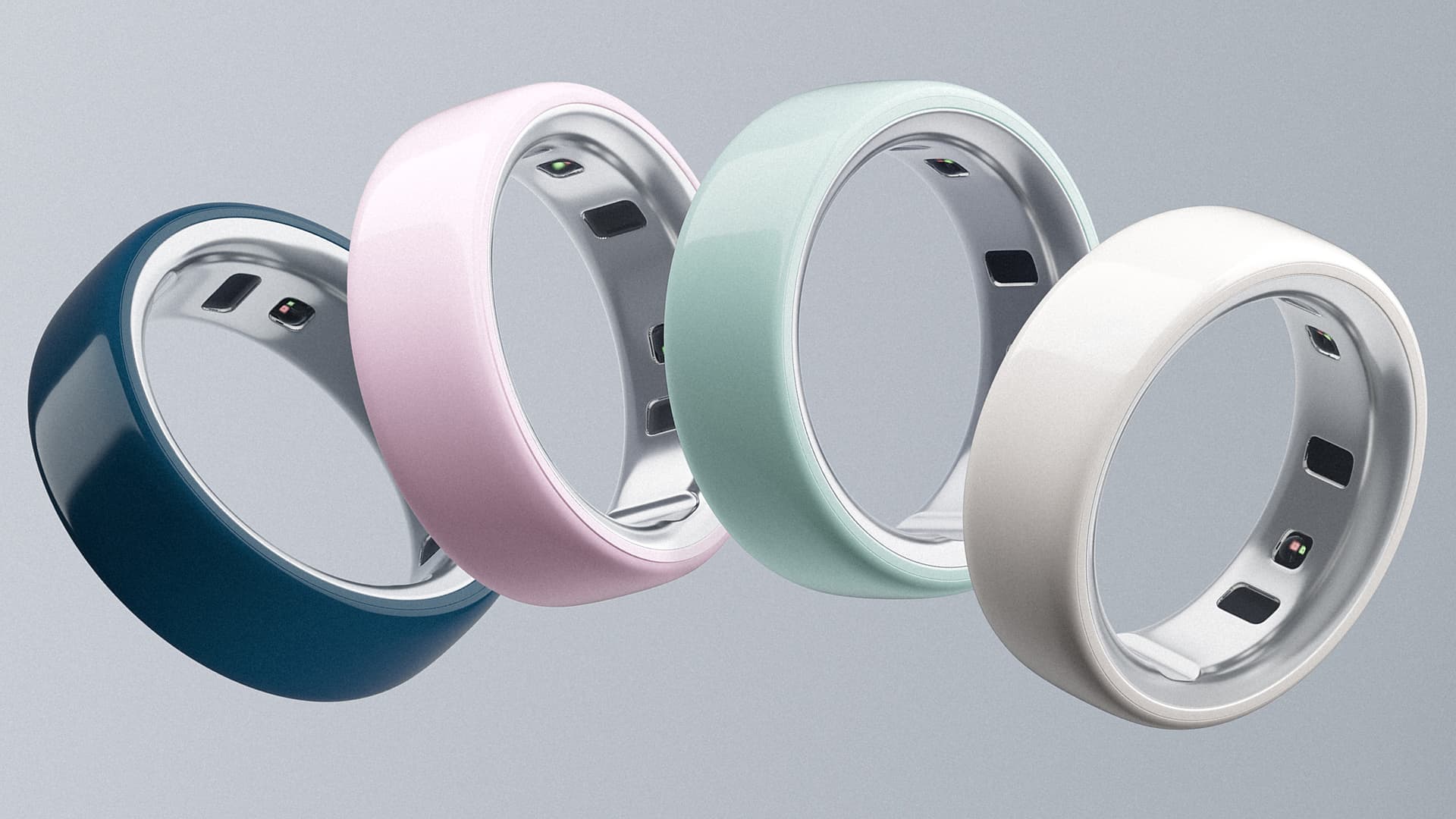
From a jewelry perspective, the Ring 4's lineup is the most considered in the category. The core titanium collection comes in Black, Silver, Brushed Silver, Gold, and Rose Gold, finished with physical vapor deposition coating and priced from $349 to $499. The ceramic collection, launched in late 2025, introduced four hues, Tide, Petal, Cloud, and Midnight, inspired by traditional ceramics from around the world and chosen to complement a wide range of skin tones. A multi-ring support feature lets you connect multiple Ring 4 devices to a single account and switch between them without losing data, meaning you can own several finishes and rotate them with your wardrobe.
The subscription is the real friction: Oura requires a $5.99/month fee to access full insights, historical data, and advanced features. Over three years, that adds $207 to the hardware cost. For committed health trackers, the app's clinical-grade depth justifies it. The scale of adoption signals staying power: Oura sold 2.5 million rings in a single year and expects to generate $1 billion in revenue this year. Its wearers include Mark Zuckerberg, Kim Kardashian, Prince Harry, and Gwyneth Paltrow, a roster that speaks to the ring's design ambition as much as its data credentials.
Best Without a Subscription: RingConn Gen 2
At $299, with no monthly subscription fee and titanium construction, the RingConn Gen 2 delivers a compelling package. Sleep tracking, stress monitoring, HRV, skin temperature, and breathing rate are all available through the app, with data accuracy that compares well against Oura across sleep and recovery insights. The app is graph-heavy and slightly cluttered relative to Oura's, but raw-data enthusiasts will appreciate the depth. For buyers who want solid ongoing tracking without a recurring bill, RingConn disrupted the market by proving you don't need a monthly fee to get good data; over a two-year period, it's the most economical choice in the category.
Worth watching: the Ultrahuman Ring Air ($349, no subscription) sits just above RingConn in app sophistication. Ultrahuman's presentation is meaningfully better than RingConn's, now much closer to Oura in its ability to surface personalized, actionable insights from sleep, heart rate, SpO2, and stress data. And Ultrahuman officially announced the Ring Pro in February 2026, a $479 third-generation flagship boasting a category-leading 15-day battery life, whose impending rollout makes the Ring Air feel like a tougher sell to new buyers.
Best for Ring Stacks: RingConn Gen 2
The RingConn Gen 2's 2mm thickness means it's got as close as any smart ring brand to replicating the feeling of an actual ring. That reduced thickness compared to the Oura Ring 4's approximately 2.8mm also affects weight significantly: the Gen 2 weighs 2-3g depending on size, while Oura's ranges from 3.3-5.2g despite its all-titanium construction. When wearing rings on adjacent fingers, those extra millimeters become immediately noticeable. For someone building a curated stack, the RingConn Gen 2 is the only current option that doesn't visually compete with the bands beside it.
Best for Small Hands: RingConn Gen 2
The same 2mm profile and 2-3g weight that makes the Gen 2 ideal for stacking also makes it the most proportionate choice for smaller hands and narrower fingers. Smart rings tend to exaggerate their bulk on petite fingers, and the Gen 2 is the product most deliberately engineered against that effect. Both Oura and RingConn provide sizing kits spanning sizes 6-13, but the physical dimensions of the ring itself matter more than the size range: a 2.8mm, 5g ring will read as substantial on a small hand in a way a 2mm, 2.5g band simply won't.
The Jewelry Layer: What Tech Guides Don't Tell You
How Finishes Scratch
All four leading smart rings use titanium as their base material, but finish behavior varies considerably. Polished finishes, including Oura's standard Silver and Gold, will show hairline scratches within weeks of daily wear because polished titanium behaves like polished precious metal under micro-abrasion. Brushed finishes, such as Oura's Brushed Silver, are far more forgiving: surface marks blend into the texture rather than catching the light. Oura's ceramic Ring 4, crafted from high-performance ceramic, combines advanced health technology with refined design. Ceramic resists surface scratches well and holds color with exceptional depth, but it can chip under sharp lateral impact in a way titanium won't. For active hands, brushed titanium is the most practical daily finish. For aesthetics-first wear, ceramic's visual payoff is worth the slightly higher care requirement.
Sizing When You Already Wear Bands
Most smart ring brands ship a free sizing kit before the actual ring, and the standard recommendation is to wear each trial size for at least 24 hours to account for natural finger fluctuation throughout the day. But there is a jewelry-specific consideration tech guides consistently skip: if you already wear a band on the same finger, your sizing may read differently with that ring in place.
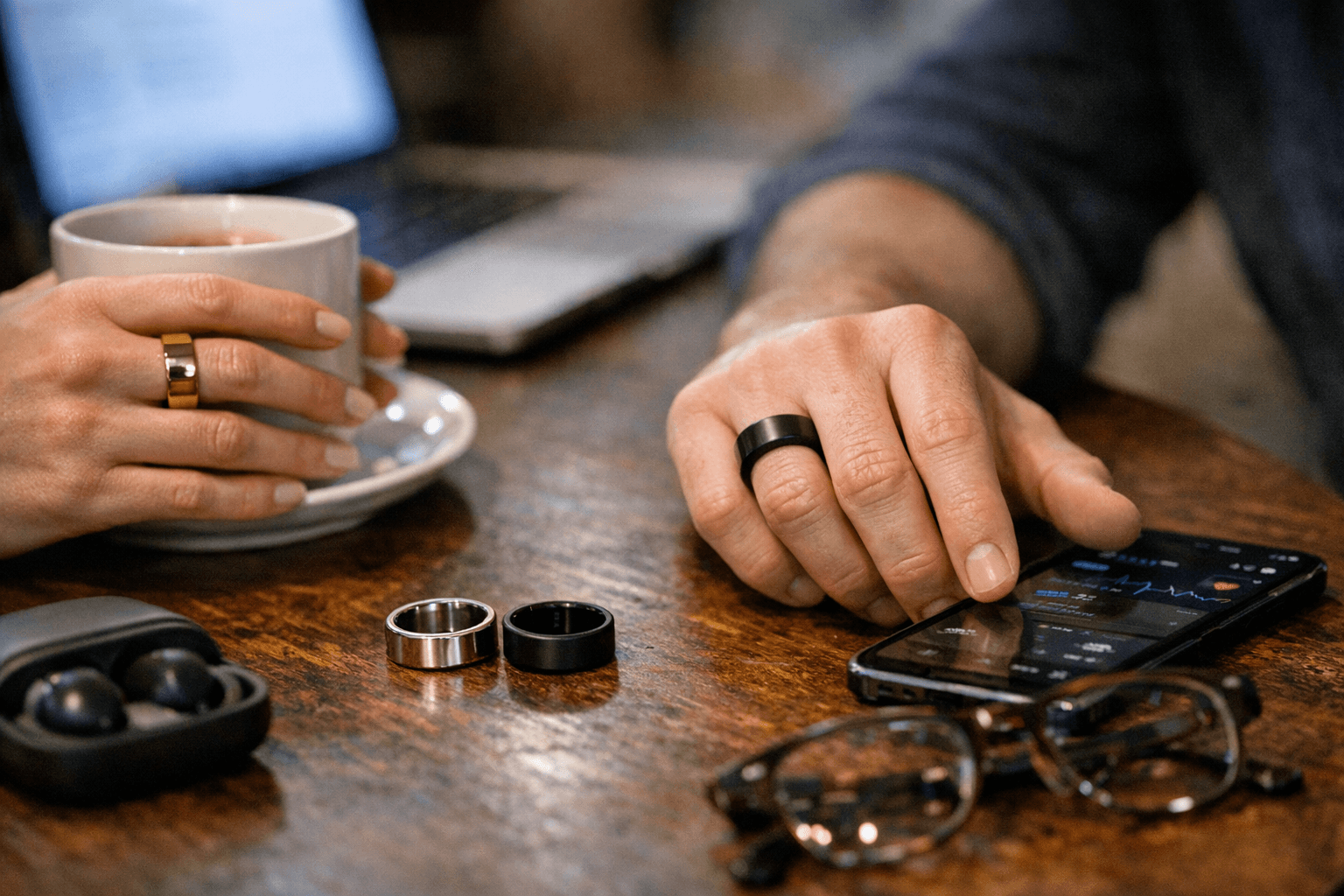
Try the sizing kit with your existing jewelry already on the finger. Wearing a smart ring on the index finger avoids it rubbing against a wedding ring if you wear one, and the index finger typically provides a more stable sensor read due to positioning against the palm. For stacks specifically, the middle ring in a curated set tends to feel tightest at the knuckle; sizing the central piece a half-size up from the flanking bands allows the stack to move naturally.
Personalization: Colors, Coordinating Bands, and Engraving Alternatives
Smart rings cannot be engraved. The interior surface of every current model is reserved for optical sensors and temperature readers, which rules out the kind of interior inscription that personalizes a traditional band. Oura's chief design officer Miklu Silvanto, who has worked at Apple and Bang & Olufsen, frames it well: "A ring is such an intimate object. You might wear it alongside your wedding ring. You need to think comfort, and beauty, and fashion." That philosophy is visible in Oura's multi-ring support feature, which treats the ceramic color range as a rotation rather than a single purchase, letting you match the ring to your outfit the way you'd select a different watch.
For coordinating with existing jewelry: Oura's Gold and Rose Gold read warm and pair naturally with yellow and rose gold bands; Silver and Brushed Silver sit alongside white gold and platinum. RingConn offers black, silver, and gold finishes; Oura extends further with matte and brushed options and rose gold, giving it a broader palette for personalization.
Choose Your Ring: A Quick Flowchart
- Want the deepest health data and the most polished app, and are comfortable with a subscription? Choose the Oura Ring 4.
- Want zero ongoing fees with proven tracking and app quality? Choose the Ultrahuman Ring Air, or wait for the Ultrahuman Ring Pro to evaluate its 15-day battery at $479.
- Want maximum economy with no subscription and good baseline tracking? Choose the RingConn Gen 2 at $299.
- Already in the Samsung ecosystem with a Galaxy Watch? The Samsung Galaxy Ring integrates its AI-driven Energy Score across both devices at no subscription cost.
- Want to stack rings, have smaller hands, or prioritize wearing comfort above all else? The RingConn Gen 2 at 2mm and 2-3g is the answer.
- Want color options that treat the ring as jewelry first? Choose the Oura Ring 4 Ceramic in Tide, Petal, Cloud, or Midnight.
The question is no longer whether smart rings can look like jewelry. The best ones already do. The question is which ring looks right on your hand, and which one earns its place there every day.
Know something we missed? Have a correction or additional information?
Submit a Tip

