U.S. Gemstone Market Set for Strong Growth Through 2036, Colored Stones Lead
Emerald commands 30% of the U.S. gemstone market, a counterintuitive lead that reframes how to commission custom colored-stone jewelry as the sector approaches $25B by 2036.
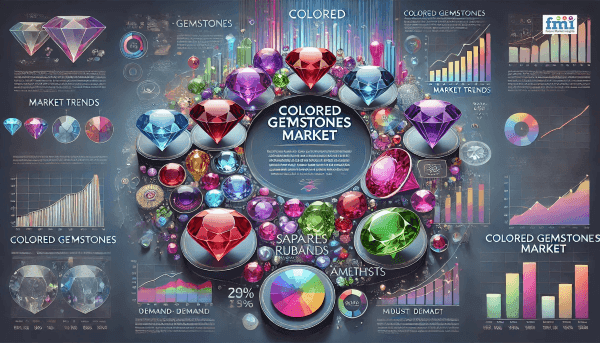
The number that should stop any custom jewelry buyer mid-scroll: emerald, long typecast as the fragile stone jewelers quietly steer clients away from for everyday wear, now commands roughly 30 percent of the U.S. gemstone market by product type. That single figure from a Future Market Insights analysis published this month reframes the entire conversation about which colored stones to commission, when to commission them, and what supply chain forces will shape availability and pricing through 2036.
The broader market context is formidable on its own terms. The U.S. gemstone sector is projected to grow from $13.50 billion this year to $24.87 billion by 2036, a 6.3 percent compound annual growth rate powered by a convergence of forces: rising preference for colored gemstone engagement rings, ethical sourcing demands among younger buyers, and increasing requests for personalized pieces where a center stone carries biographical weight, a birthstone, an anniversary month, a meaningful hue. Jewelry and ornaments account for roughly 80 percent of that market, meaning fine jewelry is the engine, not industrial or investment applications.
The shift underneath those numbers deserves careful reading. Traditional diamond solitaires are gradually losing market dominance as consumers move toward colored, symbolically specific stones. Emerald, sapphire, and ruby are the primary beneficiaries, driven in part by social media visibility and celebrity engagement ring choices that have given colored stones a new aspirational frame. But these three stones are not equal from a sourcing standpoint, and buyers commissioning custom pieces over the next decade should understand the differences before committing to a stone type.
Ruby is the most geopolitically complex of the three. The United States has long restricted imports of Burmese rubies and jade under sanctions linked to Myanmar's military government, pushing buyers and manufacturers toward Mozambique as the dominant alternative source. Gemfields Group Limited, one of the leading companies active in the U.S. market, operates mines in Mozambique and has helped establish that origin as a credible, traceable source for commercial and fine rubies. But the history of sanctions uncertainty has meant longer lead times and sharper price volatility for custom ruby pieces, particularly vivid, high-saturation stones above two carats. A buyer commissioning a bezel-set ruby solitaire today should build extended sourcing lead time into the project timeline and confirm Mozambican or Sri Lankan origin with GIA documentation before the design phase begins.
Sapphire sits at the opposite end of the sourcing stability spectrum. Sri Lanka, Madagascar, and Montana all produce commercially available material, and no major geopolitical trade restriction currently shadows the primary supply routes. For custom work, sapphire may be the most reliably sourceable of the three classic colored stones over the forecast period. Its range, from cornflower blue to padparadscha's pink-orange to teal parti-sapphires, gives designers and clients significant latitude. That versatility, combined with a Mohs hardness of 9 (shared with ruby, as both are corundum), also makes sapphire the most structurally sound choice for daily-wear engagement settings, including prong configurations that leave more of the stone's surface exposed to contact.

Emerald's 30 percent market dominance remains the forecast's most counterintuitive data point. The stone measures 7.5 to 8 on the Mohs scale but is structurally more vulnerable than that number suggests: natural emeralds almost universally contain inclusions, the internal fracture networks jewelers call "jardin," which can make the stone sensitive to impact and thermal shock. Colombia and Zambia are the principal sources, and the origin difference is meaningful enough that GIA certification now functions as a significant pricing variable in the custom market. For buyers commissioning emerald pieces, the setting conversation is not optional. An emerald in a protective bezel or channel setting, or as a pendant or earring center stone where impact risk is lower, makes considerably more gemological sense than the same stone in a classic six-prong solitaire. The stone's rising market share suggests consumers are choosing it for its saturated green and its symbolic resonance, May's birthstone and historically one of the rarest precious stones in commerce. Buyers who understand the setting calculus protect both the stone and the investment behind it.
Navigating these three stones toward a single custom piece decision works best in three stages. The first is budget, which now includes the lab-grown tier: ruby, sapphire, and emerald grown in controlled environments are available at a fraction of natural stone pricing, with some platforms positioning lab-created options at approximately five to ten percent of equivalent mined stone costs. For buyers whose priority is the stone's birthstone meaning or color rather than natural provenance, lab-grown is a growing and credible alternative, though it competes directly with natural stones in a market where authenticity and treatment disclosure are increasingly scrutinized. The second consideration is durability relative to how the piece will actually be worn. A daily ring demands corundum hardness; a pendant or occasional-wear piece opens the door to emerald. The third question is certification: for natural stones, GIA origin documentation has shifted from a premium add-on to a practical purchase prerequisite among informed buyers. Direct-to-consumer platforms offering GIA-certified stones have also begun to compress traditional markup structures, creating a more accessible custom-piece market than existed even five years ago.
The regional dimension of this forecast carries practical weight. The Western U.S. is growing at 7.2 percent annually, outpacing the national 6.3 percent rate, and already shows the country's strongest adoption of colored gemstones. That concentration of demand in markets like Los Angeles and the Pacific Northwest is accelerating the artisan and dealer ecosystem in those areas, which can shorten custom-piece lead times as skilled setters and specialty stone dealers cluster where clients are.
Supply chain volatility, pricing fluctuations, and authenticity disclosure concerns will remain the structural challenges of the next decade alongside rising competition from lab-grown alternatives. Blockchain-based traceability tools are in development to address provenance verification, and the GIA expanded its origin-determination services in January 2026 to cover additional stone varieties, a signal of where the authentication infrastructure is heading. The leading companies active in the U.S. market, including Kiran Gems Private Limited, Gem Diamonds Limited, Gemfields Group Limited, and Anglo American plc, compete on precisely those credentials: authenticity, ethical sourcing practices, product quality, and long-term supplier relationships across the luxury ecosystem. In a market on track to nearly double in value over ten years, the custom jewelry buyer who understands which stone sources are politically stable, which settings protect which stones, and which certification path is worth the premium will build pieces that carry their meaning, and hold their value, through the full arc of the forecast.
This article was produced by Prism’s automated news system from verified source data, official records, and press releases, then run through automated quality and moderation checks before publishing. The system is built and supervised by the people who set the standards it runs under. Read our full AI policy.
Did this article answer your question?