Art Deco Jewelry Turns 100, Its Glamour Still Shapes Collecting and Design
A century after Paris introduced Art Deco, the style still tells collectors what to buy, what to trust, and how to spot a true period jewel.
The modernity that never left
A century after Paris introduced Art Deco at the 1925 Exposition Internationale des Arts Décoratifs et Industriels Modernes, the style still reads as fresh, sharp, and unmistakably expensive. That is the paradox collectors understand immediately: what began as a modern break from ornament now feels like one of jewelry’s clearest languages, built from geometry, symmetry, and confidence.
The Metropolitan Museum of Art describes Art Deco as a broad label for decorative arts and architecture between the world wars, but in jewelry it means something more exacting. The best pieces balance modern sophistication with craftsmanship and older traditions, which is why they still look current on the wrist, at the throat, or pinned to a lapel. The style was born in a period of global turbulence, drawing energy from Cubism and ancient Egypt, and that tension between discipline and fantasy is exactly what gives it its charge.
How to read an authentic Art Deco jewel
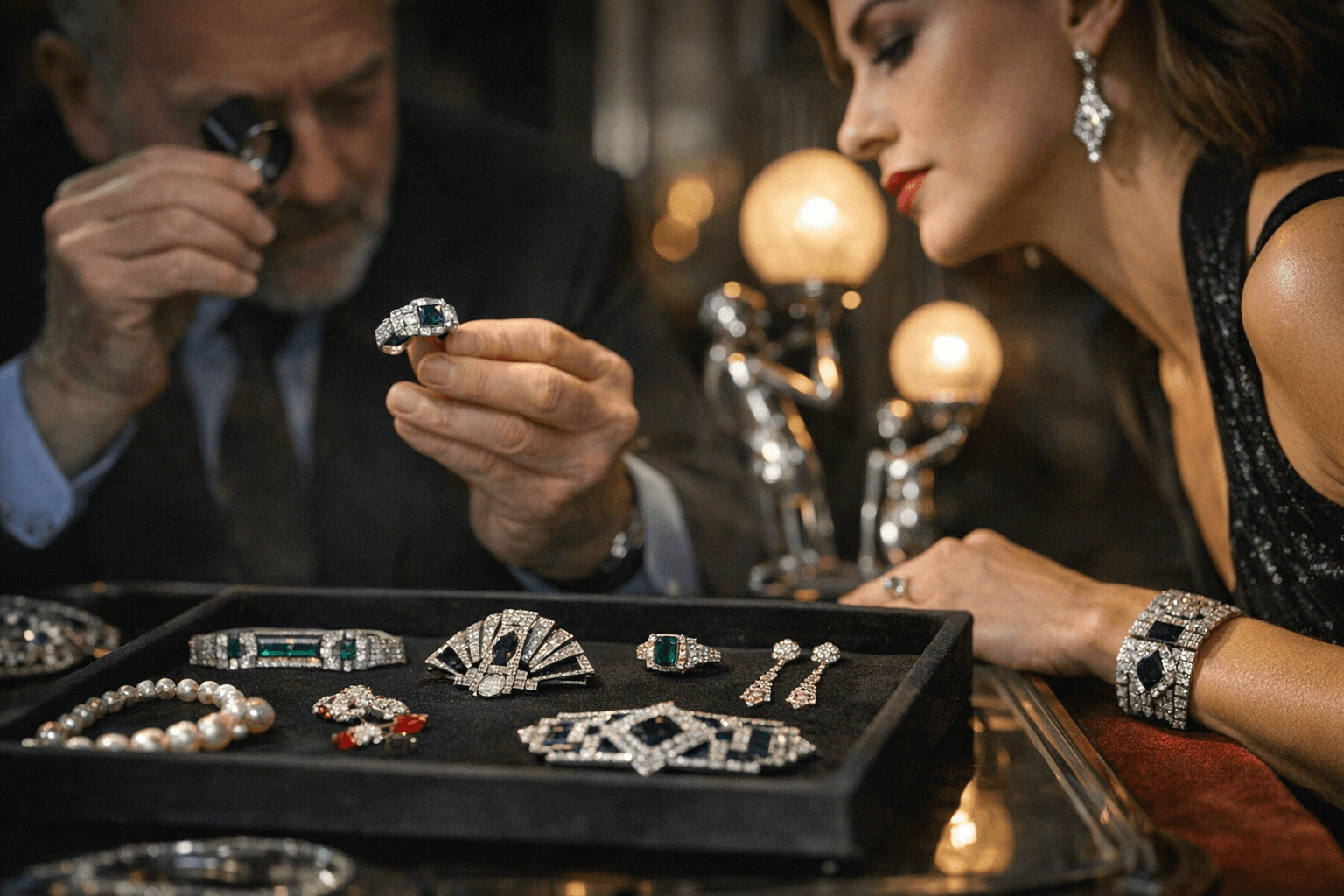
The quickest way to recognize a true Art Deco piece is to look for structure. Authentic examples tend to favor clean lines, stepped forms, sharp symmetry, and a kind of architectural poise that turns the jewel into a tiny skyline. Christie’s traces the style’s development to jewelers who moved away from Art Nouveau’s naturalism and into something cooler, more graphic, and far more urbane.
The details matter. Period pieces often use calibré-cut stones, precisely sized so they nest together with almost mosaic-like precision, and they frequently pair bright diamonds with dark onyx or other strong contrasts. Platinum is another clue, not just because it was prized for its strength and fine, white finish, but because it allowed makers to build the airy, intricate settings Art Deco demanded. When the work is right, the jewel feels engineered, not merely decorated.
Look for these signals in a case, at auction, or online:
- crisp geometry rather than florid scrolls
- stepped or fan-like silhouettes
- calibré-cut stones fitted closely into the design
- strong black-and-white contrast, often with onyx
- platinum settings with delicate but determined construction
- a signed mount or workshop mark from a known maker
The signature matters because the strongest names helped define the language in the first place. Christie’s identifies Cartier, Van Cleef & Arpels, Janesich, Ostertag, René Boivin, Paul Brandt, Raymond Templier, and Fouquet as master jewelers who shaped the style through the 1930s and into the 1940s. That lineage is part of the appeal, and part of the value.
Why names still move the market
Cartier remains the lodestar. Jacques Cartier and his house earned a reputation that still reverberates today, helped along by King Edward VII’s famous description of the firm as “the jeweller of kings and the king of jewellers.” That kind of royal shorthand lingers in the market because it still tells collectors something useful: a signed Cartier jewel carries both design authority and historical gravity.
Auction houses continue to treat Art Deco as an active collecting category, not a nostalgic one. Sotheby’s currently offers sales that explicitly include Art Deco jewelry among vintage and signed pieces, and it highlights Cartier as a major name across recent sales and upcoming lots. Christie’s, too, keeps Art Deco in view through collecting guides and branded history pages, while a 2024 lot description for an Art Deco Cartier necklace circa 1935, from the Sassoon Family Collection, shows how strong the appetite remains for signed period work.
The market history is not theoretical. Christie’s ran an Art Deco Jewellery sale in Geneva in 1998 that closed at CHF 4,707,900, a figure that still signals how seriously collectors value the category when the pieces are right. Sotheby’s also notes that vintage Cartier Tutti Frutti pieces are rare in the secondary market and extremely popular with collectors, which is a reminder that rarity, signature, and condition still drive desire in equal measure.
True period pieces versus Deco-inspired later work
This is where a collector earns the purchase. True Art Deco jewelry usually feels precise in the hand and disciplined in the eye, with construction that supports the design rather than merely copying its outline. Later Deco-inspired pieces may borrow the look, but they often flatten the architecture, soften the stone-fitting, or use materials and proportions that feel more commercial than handcrafted.
A useful test is to slow down and read the jewel the way a dealer would. Does the symmetry feel intentional, or merely decorative? Are the stones fitted with the exactness of a built object, or arranged in a looser imitation of the period style? Is the setting platinum and fine, or a later metalwork substitute that imitates the silhouette without the same rigor?
The difference is not only academic. A genuine period jewel carries the decisions of its era, from the choice of stones to the engineering of the mount. A later homage may still be handsome, but it will usually lack the tension, precision, and historical specificity that make the best Art Deco pieces so collectible.
Why the style still shapes what gets bought now
The centenary has only sharpened attention around the category. The Victoria and Albert Museum has marked 2025 with a talk titled The Enduring Allure of Art Deco Jewellery, underscoring that the movement still speaks to contemporary makers and buyers. The Met’s own collecting history is equally telling, since it has actively gathered French Art Deco since the 1920s, acquiring pieces directly from designers in Paris.
That continuity explains why Art Deco never quite disappears from design conversations. Its hard edges, clean silhouettes, and graphic contrasts keep returning in new jewelry because they solve a perennial problem: how to make a piece feel both immediate and enduring. For collectors, the lesson is even simpler. The best Art Deco jewelry is not just beautiful for its age, it is beautiful because its structure, signature, and materials still know how to look modern.
This article was produced by Prism’s automated news system from verified source data, official records, and press releases, then run through automated quality and moderation checks before publishing. The system is built and supervised by the people who set the standards it runs under. Read our full AI policy.
Did this article answer your question?