Art Deco vintage jewelry, how to spot its geometric style
Art Deco jewelry gives away its age in angles: platinum, white metal, and calibrated stones built for symmetry. Learn the clues that separate a 1920s original from a later revival.
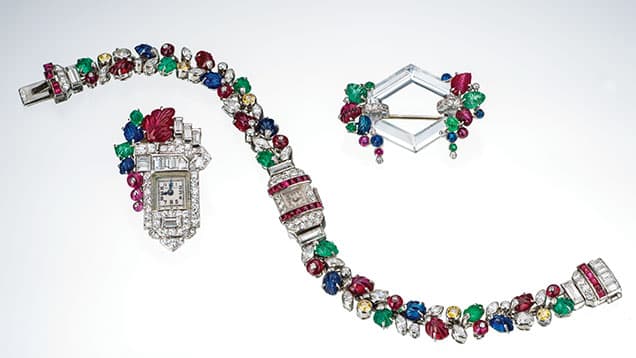
An authentic Art Deco jewel declares itself in hard geometry, a mirror-still balance of lines, and stones cut to fit the design rather than simply sparkle within it. “Art Deco” remains one of the most overused labels in vintage jewelry listings.
The look begins with line, not decoration
Art Deco jewelry took shape in the 1920s and 1930s, when Paris turned modernity into a public spectacle. The 1925 Exposition Internationale des Arts Décoratifs et Industriels Modernes ran from April 29 to November 8, 1925, on the Esplanade des Invalides, along both banks of the Seine, and around the Grand Palais, and more than 16 million visitors passed through. Cartier, Boucheron, and Georges Fouquet were among the jewelers invited to exhibit.
What changed was the visual grammar. Art Nouveau had leaned into soft curves and botanical swell; Art Deco went the other way, toward vertical lines, repeated geometry, and an architectural crispness. When you look at a period ring, brooch, bracelet, earring, or pendant, the first question is simple: does it read like a drawing of structure? Arcs, circles, triangles, squares, rectangles, and strong contrasts are the clues that matter most.
What to look for first
A true period piece usually gives away its age in the way the design is organized. The best checklist starts with the overall silhouette, then moves down to the stone work and the metal.
- Symmetry: Art Deco design often mirrors itself from the center outward. Even when the motif is bold, the composition should feel deliberate and balanced.
- Geometry: Look for stepped forms, chevrons, sunbursts, rectangles, and sharp edges rather than scrolling vines or naturalistic flowers.
- Contrast: The period loved black-and-white tension, whether through stone pairing, enamel, or the stark read of diamonds against white metal.
- A clean profile: The piece should look composed and engineered, not crowded.
Much Art Deco jewelry from the 1920s and 1930s used abstract geometric forms that complemented the simple lines of contemporary dress. The jewel and the clothing of the era were designed to speak the same language, with the ornament echoing sleek fashion rather than fighting it.
The metal and stones tell the next part of the story
Material choice is one of the strongest authenticity markers. Platinum and white gold sit at the center of Art Deco jewelry, and that cool palette is one reason the style still reads as sharp rather than fussy. If a piece claims to be Deco but is dominated by warm yellow gold and floral excess, the burden of proof rises quickly.
The stone cutting matters just as much as the setting. Geometric diamond cuts such as baguette, triangle, trapeze, and half-moon are hallmarks of the period. They were used because they lock into geometric designs with precision, making the jewel feel built, almost drafted.
A genuine Deco jewel often uses stones in combinations that look tailored to the architecture of the piece. Expect straight lines of baguettes framing a central stone, or stepped borders that tighten the design visually. The more exact the fit, the more convincing the piece becomes. Loose, mismatched, or overly decorative stones can suggest a later homage rather than a period original.
Egyptian glamour, modern industry
Art Deco did not emerge from geometry alone. Howard Carter’s discovery of Tutankhamun’s tomb in November 1922 fueled renewed interest in Egyptian motifs, and that influence filtered quickly into jewelry. The fascination was not just with pharaohs and scarabs, but with the aura of ancient power translated into modern form.
At the same time, the movement was looking straight ahead. Ideas once considered avant-garde were widely accepted once they were adapted into fashionable luxury objects. Raymond Templier put that mindset into one line in 1930, saying he saw jewelry ideas everywhere in the wheels, cars, and machinery of the day.
The result was a style that could hold multiple references at once, from Egyptian revival motifs to the angular force of skyscrapers, jazz-age speed, and the machinery of industry. Art Deco drew on global influences, archaeological discoveries, and historical romanticism.
How to separate an original from a revival
Later Deco revivals can be beautiful, but they should not be mistaken for period work. The quickest test is whether the design feels genuinely integrated or merely decorated with Art Deco vocabulary. A revival piece may borrow zigzags, stepped edges, or a black-and-white palette, yet lack the disciplined metalwork and stone fitting that period jewelers used to create tension and balance.
Use the following practical checks:
- Study the construction: Original Art Deco pieces usually have an engineered feel, with settings and stone shapes tightly integrated into the design.
- Check for period-correct materials: Platinum and white gold are especially persuasive in this era.
- Look at the cut pattern: Baguette, triangle, trapeze, and half-moon stones are more convincing than a generic modern brilliant cut alone.
- Examine symmetry under magnification: Period work often shows a clear central axis and repetitive geometry.
- Compare the silhouette to museum examples: The Metropolitan Museum of Art, the Victoria and Albert Museum, and the Musée des Arts Décoratifs in Paris preserve the visual vocabulary of the period with the kind of clarity that helps separate original design from later imitation.
Resale listings often use “Art Deco” as a catch-all for anything angular or old-looking.
Why these details shape value and confidence
For buyers, the most important distinction is not whether a piece looks Deco at a glance. A documented period jewel with platinum or white gold, geometric diamond cutting, and a disciplined, symmetrical layout carries more collector confidence than a later piece that merely borrows the style.
This article was produced by Prism’s automated news system from verified source data, official records, and press releases, then run through automated quality and moderation checks before publishing. The system is built and supervised by the people who set the standards it runs under. Read our full AI policy.
Did this article answer your question?