Art Nouveau jewelry redefined beauty with nature-inspired forms
Art Nouveau turned jewelry into a living surface, where asymmetry, enamel, and unusual stones mattered more than polish or symmetry. Its beauty lies in craft so refined it seems effortless.
The break from Victorian polish
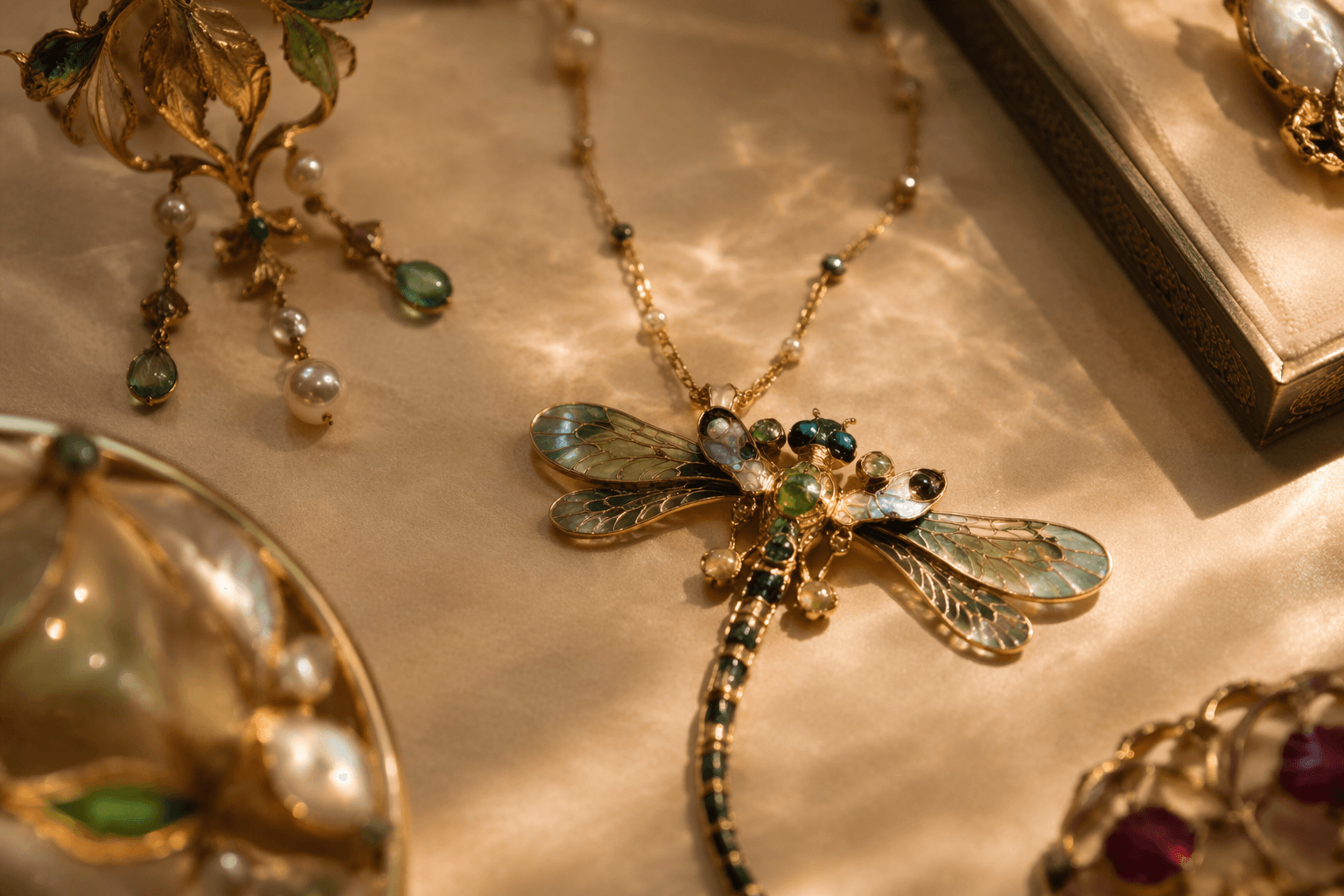
Art Nouveau did not simply decorate the body. It changed the terms of beauty. Where Victorian jewelry often prized symmetry, formal balance, and the easy read of status, Art Nouveau let lines wander and motifs bloom. The result was jewelry that felt alive: tendrils, lilies, dragonflies, insect wings, and dewdrop-like surfaces replaced the tidy, declarative look of earlier taste.
That shift matters because it reframed diamonds, too. In Art Nouveau pieces, stones were not always the headline. Rose-cut and old mine-cut diamonds often worked as part of an overall artistic atmosphere, catching light without overpowering the design. The effect was sensuous rather than showy, and that subtlety is one of the movement’s most important signatures.
How to recognize the real thing
Genuine Art Nouveau jewelry is rarely about perfect repetition. Look for organic asymmetry, softened contours, and forms that seem to grow rather than assemble. The movement drew its energy from nature, but not from nature prettified into symmetry. It took inspiration from the unruly side of the natural world: a curled stem, the translucence of a wing, the fragile shimmer of a petal or shell.
Materials reinforce that feeling. Enamel appears often, especially plique-à-jour, the technique that leaves tiny openings so light can pass through the colored surface. That translucency gives leaves and floral panels a luminous, almost stained-glass effect. You also find moonstones, opals, pearls, and carved horn, all chosen for their softness, iridescence, and ability to suggest moisture, mist, or skin rather than hard sparkle alone.
For collectors, this is where value often lives: in the tension between delicacy and invention. Imperfection is not a flaw here. It is part of the language. A slightly irregular contour or a stone chosen for glow instead of clarity is often exactly what makes the piece feel true to the era.
Why the materials feel so modern
Art Nouveau ran from the 1880s until the First World War, with jewelry historians often placing its peak around 1890 to 1910, or through 1914. It belonged to the broader Belle Époque and reflected a larger Western European and American cultural shift away from rigid academic and Victorian conventions. It was also shaped by Japonisme and by the Arts and Crafts movement, which prized handwork over industrial mass production.
That context explains why the materials seem so deliberate. Rose-cut diamonds and old mine-cut diamonds offer a gentler, candlelit brilliance than modern brilliants. Moonstones and opals provide internal light, while carved horn introduces a warm, organic matte surface that feels startlingly contemporary even now. In a true Art Nouveau jewel, the stones are not merely set into a framework. They participate in the mood of the design.
The handcraft is equally telling. Plique-à-jour enamel is not an afterthought; it is a technical statement. Because the enamel sits without a backing, light moves through it and animates the jewel. That is why the technique became so associated with Art Nouveau: it made jewelry behave like a living thing.
The makers who defined the style
René Lalique is one of the essential names to know. He founded his own firm in Paris in 1885, and by 1900 he had triumphed at the Exposition Universelle in Paris, where his avant-garde jewelry won the admiration of the intellectual elite. His clients included Sarah Bernhardt and Calouste Gulbenkian, names that tell you something important about the audience for Art Nouveau at its highest level: it was both radical and coveted.
Louis Comfort Tiffany brought a different but equally influential sensibility. He founded Tiffany Studios in 1902 and became one of the most creative and accomplished artists of the Art Nouveau era. His work, like Lalique’s, often used plique-à-jour enamel to conjure luminous leaves, flowers, and wing forms. In his hands, jewelry became part of a larger decorative universe, one that extended the movement’s ideas beyond the brooch or pendant into the atmosphere of the whole object.
Paris was not the only center. Georges Fouquet’s atelier also became part of the movement’s story, especially through its collaboration with Alphonse Mucha between 1899 and 1901. That partnership shows how porous Art Nouveau could be: jewelers, designers, and illustrators worked in dialogue, each feeding the other’s vision.
Beyond the elite atelier
It is tempting to imagine Art Nouveau as a purely rarefied French style, but that is too narrow. In the United States, it also appeared in mass-produced forms in manufacturing centers such as Newark, New Jersey, and Providence, Rhode Island. That wider production tells you the movement was not confined to a handful of luxury workshops. It spread into commercial jewelry as well, carrying its organic lines and floral vocabulary into more accessible pieces.
For collectors, that means the market includes both singular handcrafted jewels and broader production examples. The difference usually shows up in the details. Elite pieces often reveal more nuanced enamel work, richer compositional asymmetry, and more daring material pairings. Mass-produced examples may echo the style more superficially, but they still trace the movement’s reach and cultural force.
What to value when you collect
When you hold an Art Nouveau jewel, you are holding an argument against rigidity. The best pieces do not try to dominate the body with hard geometry or uniform sparkle. They hover, curve, and unfurl. Their worth lies in the intimacy of their making: the careful setting of an old mine-cut diamond into a fluid line, the use of opal or moonstone to soften a design, the decision to let enamel glow like backlit skin.
If you love Art Nouveau, look past the generic “floral” label. Ask whether the jewel uses nature as decoration or as structure. Ask whether the stones serve brilliance alone or help build an atmosphere. Ask whether the asymmetry feels intentional, because in this style, it usually is. The finest Art Nouveau jewelry does not merely imitate the natural world. It translates its irregular beauty into precious form, and that remains its greatest achievement.
This article was produced by Prism’s automated news system from verified source data, official records, and press releases, then run through automated quality and moderation checks before publishing. The system is built and supervised by the people who set the standards it runs under. Read our full AI policy.
Know something we missed? Have a correction or additional information?
Submit a Tip