Ballerina rings dance back, mid-century glamour returns to collectors
A true ballerina ring is all motion: a center stone flanked by radiating baguettes or marquises, built for mid-century drama and still coveted by collectors.
What makes a ballerina ring unmistakable
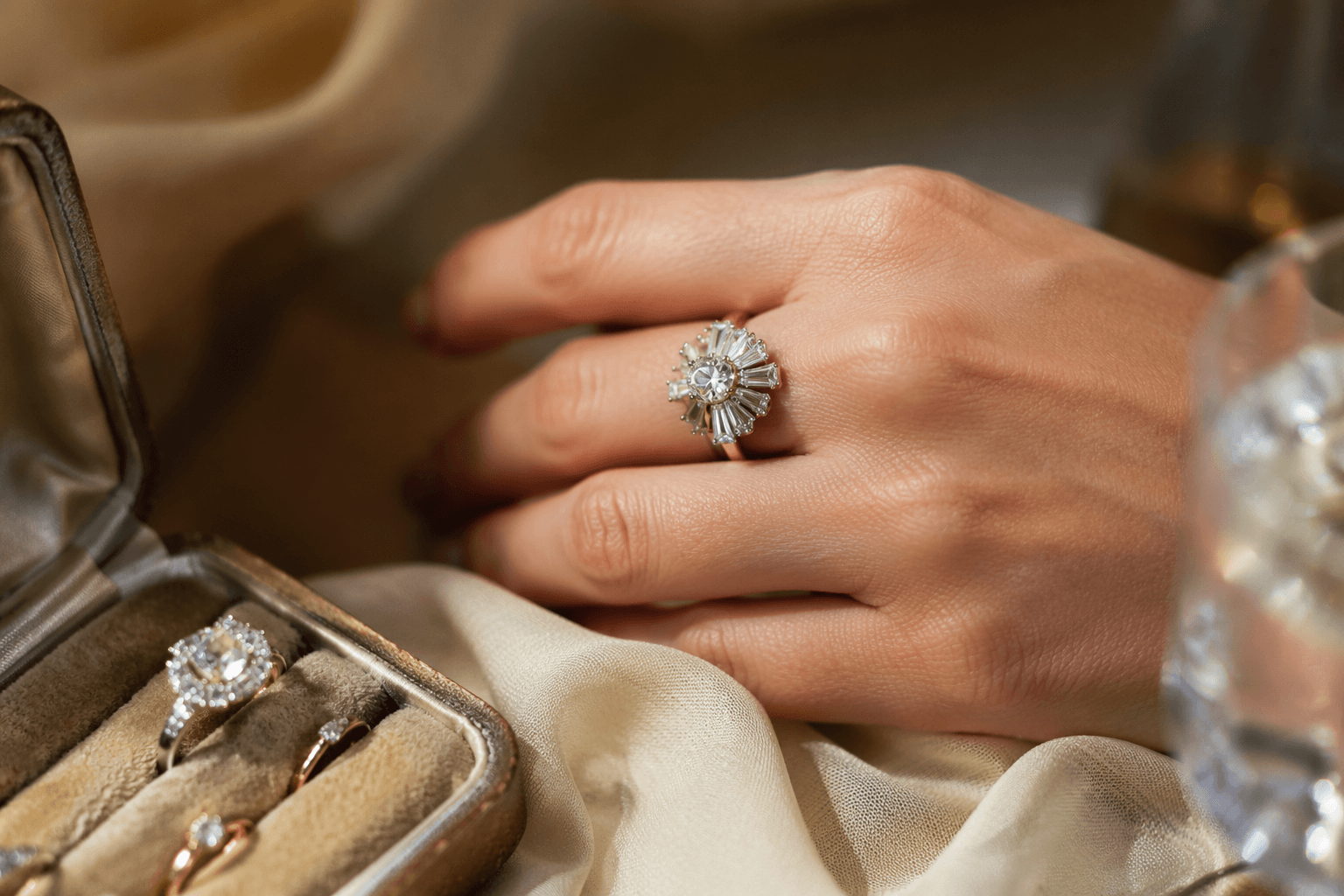
A ballerina ring is built like a tiny stage set. At its center sits one principal stone, then tapered baguette or marquise-cut diamonds fan outward in a radiating, tutu-like halo that gives the ring its name. The look is sculptural rather than neat, and that three-dimensional motion is what separates a true ballerina from a generic cocktail ring with a simple surrounding border.
That silhouette is the heart of the style’s appeal. It was never meant to whisper; it was designed to catch light across every angle, creating the kind of dramatic sparkle that reads as formal, even theatrical. When the stones flare outward in layered tiers, the ring feels period-correct. When the spread is too flat or the proportions are timid, the effect becomes merely retro-inspired rather than authentically mid-century.
Why the style belongs to the post-war years
Ballerina rings rose to prominence in the post-war era, when jewelry and fashion turned back toward glamour, femininity, and abundance after years of wartime austerity. That timing matters, because the style reflects more than taste. It captures a cultural shift toward ornament, with larger, more flamboyant cluster rings helping translate a renewed appetite for elegance into wearable form.
Mid-century jewelry histories place the style firmly in the 1950s and 1960s, alongside the era’s love of dramatic silhouettes and polished social dressing. Lang Antiques describes ballerina and cluster rings as a way to create bold visual impact with many smaller diamonds, a clever design response to a widening middle-class market that wanted presence without always choosing one enormous center stone. In other words, the ballerina ring is both glamorous and pragmatic, which is part of why it endures.
How to read a true period example
The best mid-century ballerina rings feel architectural. Look for a center stone that is framed by tapered baguettes or marquises arranged in a radiating fan, not simply surrounded by round melee in a conventional halo. The overall effect should resemble a tutu in motion, with the outer stones creating a sense of lift and sweep around the middle.
Metal choice also matters. Estate examples currently on the market show ballerina rings in rich 18K yellow gold and 18K white gold, both of which suit the style’s substantial, dressy character. A ring in these metals with bold, dimensional stonework tends to read as more convincingly vintage than a lighter, flatter modern remake.
Proportion is another useful clue. A current estate listing describes a marquise diamond ballerina ring with a 1.68-carat marquise center stone and about 5.00 carats of tapered baguette diamonds surrounding it. That kind of scale tells you a lot about the design language: the center is important, but the outer fan is where the drama lives.
Stone choices beyond the obvious diamond version
Although diamond ballerina rings are the classic image, the silhouette is more flexible than many buyers expect. Current estate examples show the form in emeralds, opals, tourmalines, spinel, and other gemstones, which proves the setting is a design idea rather than a single gem category. The center stone may change, but the radiating, dressy energy remains.
One especially striking estate example uses a 2.46-carat oval black opal at the center, wrapped in a tutu of icy white tapered baguette and round brilliant-cut diamonds. That combination works because the dark opal sharpens the contrast and lets the fan of white stones read almost like a spotlight. Another vintage listing, described as a 1950s to 1971 ballerina cluster ring, carries 4.67 total carats of diamonds, underscoring how substantial these rings were meant to feel on the hand.
For collectors, the gemstone variety is part of the fun. A diamond center is the most traditional, but colored stones can make the silhouette feel especially vivid, provided the setting keeps the same radiating architecture. The stronger the fan and the more intentional the arrangement, the more convincingly the ring belongs to the ballerina family.
How to tell vintage from later revival pieces
The difference between authentic mid-century and later reproduction often comes down to confidence of construction. Period ballerina rings tend to have a dense, carefully engineered look, with stones packed to create volume and movement. Later versions sometimes soften that edge, using lighter proportions or a simplified halo that references the shape without capturing its real tension.
Collectors also pay attention to the overall mood. A true vintage piece usually feels tied to cocktail-ring culture, with enough size and sparkle to read as evening jewelry. If the ring feels dainty, overly symmetrical, or stripped of its layered dimensionality, it may be borrowing the vocabulary without fully speaking the language.
Why collectors and modern brides are coming back to it
The ballerina ring is having a resurgence because it offers something many contemporary buyers want but cannot get from mass-market settings: history, craftsmanship, and a little bit of theater. Natural Diamonds describes the style as appealing to collectors and modern brides who want vintage inspiration with old-Hollywood glamour, and that combination makes sense in a market where originality matters as much as shine.
These rings also wear well as statements. Their cocktail-ring scale means they are meant to be seen, not tucked away, and the radiating stone layout gives them a distinct profile from nearly every angle. For someone building a collection, that makes the ballerina ring especially satisfying: it is instantly readable, deeply period-specific, and still adaptable enough to move between diamond, emerald, opal, tourmaline, and spinel without losing its identity.
The strongest examples balance spectacle with precision. They have the heft of mid-century design, the sparkle of a formal jewel, and the unmistakable sense that every stone was placed to create motion. That is why ballerina rings are not just back in style. They remain one of the clearest, most collectible expressions of post-war glamour.
This article was produced by Prism’s automated news system from verified source data, official records, and press releases, then run through automated quality and moderation checks before publishing. The system is built and supervised by the people who set the standards it runs under. Read our full AI policy.
Did this article answer your question?