Beaded Jewellery Reclaims Its Place in Vintage and Designer Collections
From childhood craft tables to Chanel's spring runways, beaded jewellery is back — and the vintage pieces in your estate boxes may be worth far more than you think.
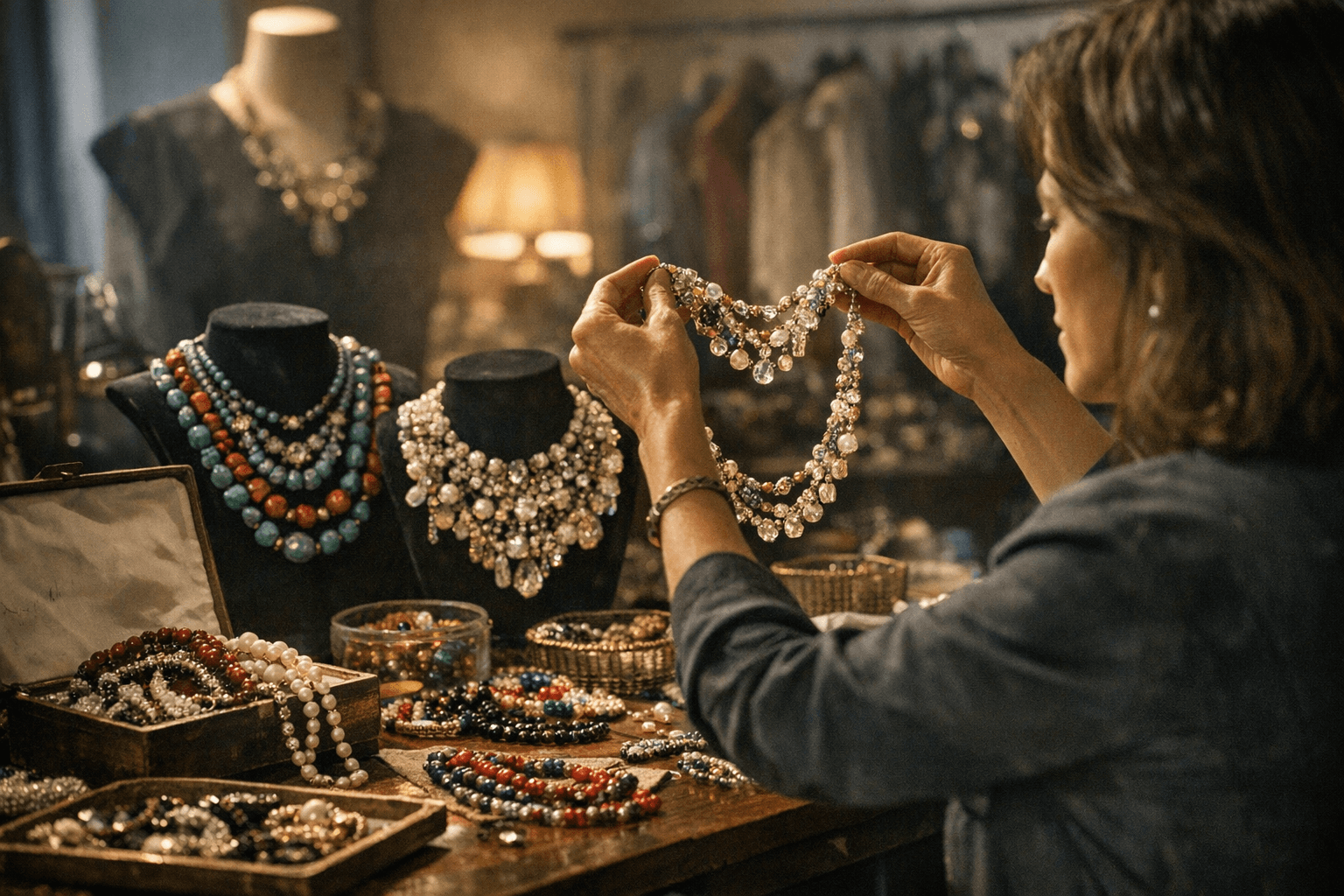
Pick up a strand of old coral beads from the bottom of an estate box and you are holding a small archive. The colour tells you where the material was harvested. The knots between each bead tell you when, and by whose hand, the piece was assembled. The clasp tells you whether it has ever been tampered with. Beaded jewellery has always carried more information per inch than almost any other form of adornment, which may be precisely why it has returned so forcefully to both vintage collecting and contemporary design in 2026.
The Icons Who Never Stopped Wearing Them
The cultural precedent for treating beads seriously rather than sentimentally is long and vivid. Peggy Guggenheim, who moved permanently to Venice in 1947 and spent comparatively little on clothing, directed her eye and her budget toward pieces that commanded attention: oversized costume jewellery sourced from Venetian variety stores, worn alongside commissioned sculptural earrings. Everything she put on her body, her biographers note, was chosen to be noticed. Diana Vreeland, whose fashion jewellery collection was later sold at auction, shared the same conviction that a considered bead or an unusual stone was a legitimate vehicle for personal expression, no less serious than a diamond setting. And then there is Tina Chow, the American model and designer who, in the late 1980s, produced several small collections using rock crystal, gold, silver, wood, bamboo, and silk cording, selling them at Bergdorf Goodman in New York, Maxfield's in Los Angeles, Ultimo in Chicago, and from 1988 at Galerie Naila Monbrison in Paris. Her most celebrated piece, the Kyoto Bracelet, a woven bamboo bangle encasing seven rough rock crystals or rose quartz in their natural form, is still regarded as a benchmark of organic jewellery design. Among her personal commissions was a lapis lazuli bead necklace set with diamond, gold, and platinum star constellations, a piece that later sold in the six figures. These three women collectively established the template: beads chosen with the same rigour brought to any precious object.
What Changed on the 2026 Runways
The spring 2026 season confirmed what collectors and vintage dealers had been sensing for several seasons: beaded jewellery has shed its last association with craft-table nostalgia and arrived firmly in considered fashion. Presley Oldham's coveted, hand-strung strands accented Zankov's clothing, while Etro and Chanel showed gold and pavé-diamond beaded necklaces that were lightyears ahead of the ones you made at summer camp. There were also marine-inspired baubles made of coral beads and seashells at Tory Burch, grounding the trend in natural materials rather than purely in manufactured glitter. Net-A-Porter's Porter noted long swinging necklaces in riotous colors paired with extra-long drop earrings and lashings of bracelets stacked with abandon. What links these very different runway interpretations is a shared interest in color, texture, and the tactile quality of materials that have weight and warmth in the hand. A Marie Claire analysis noted that "color is key" with this trend, with beads and natural stones adding depth and character that minimalist fine jewellery cannot replicate.
The Vintage Collector's Terrain
For anyone approaching beaded jewellery through the lens of collection rather than fashion, the specific categories worth understanding are: natural coral, carved stones, old glass, and early 20th-century trade beads. Each has a distinct set of authenticating markers and a distinct set of pitfalls.
Natural coral, particularly the deep red and angel-skin pink varieties, was harvested in significant quantities through the late 19th and early 20th centuries before protections restricted trade. Genuine antique coral beads tend to be strung on silk cord, often with individual knots between each bead, a construction technique that both protects the material from abrasion and indicates original, considered assembly. The drill holes on authentic antique coral are typically narrow relative to the bead diameter; later reproductions and dyed substitutes often show wider, less precise drilling.
Early 20th-century trade beads, produced primarily in Venice and Bohemia for exchange markets across Africa and the Americas, represent one of the most complex and rewarding collecting categories in vintage beadwork. These pieces carry genuine material histories: their colour palette, glass type, and surface treatment can often be traced to specific production periods and regional markets. The challenge is that trade beads have also been among the most aggressively reproduced categories in the market, and parcels of genuine old beads are frequently mixed with later additions before being restrung as a single piece.
Carved stone beads, particularly those in jade, coral, lapis lazuli, or rock crystal, warrant close examination of the carving quality. Hand-carved beads from the early 20th century show slight asymmetries and tool marks that distinguish them from the even, machine-produced regularity of modern reproductions. Vintage glass beads, including Venetian millefiori and Bohemian pressed glass, can be identified by surface depth of pattern, the quality of the core glass, and the finish of the drill channel.
Reading the Evidence of a Piece
The four physical details most likely to tell you whether a beaded necklace is original or has been compromised are the stringing material, the knotting, the clasp, and the drill holes.
- Stringing: Original silk stringing will show age-related discolouration and slight brittleness. Modern restringing typically uses nylon or synthetic thread that appears uniformly white or colourless, and which catches light differently to aged silk.
- Knotting: Traditional hand-knotted strands show slight variation in knot placement and tension. Machine-restrung pieces tend to have perfectly regular knot spacing, which is a signal of recent intervention.
- Clasps: The clasp is often the easiest place to identify restringing or later alteration. A box clasp in yellow gold with a period-appropriate construction style is consistent with a necklace from the 1920s through 1960s; a spring-ring clasp in silver or plated metal may indicate the necklace has been repaired or commercially restrung at some point, even if the beads themselves are genuine.
- Drill holes: Bead drill patterns are a quieter but meaningful indicator. Antique hand-drilled beads show slight imprecision in channel direction and diameter. Modern machine-drilled beads are almost perfectly centred and consistent across the strand.
When examining a piece from an estate, the most important questions to ask are whether it has ever been restrung and whether documentation or provenance accompanies the purchase. A restrung necklace is not necessarily a bad acquisition, but the value proposition changes substantially: what you are buying is the bead material alone, not an intact original construction with all of its embedded history.
Why This Moment Matters for Beads Specifically
The broader trend toward color, natural materials, and tactile craftsmanship on the 2026 runways has given beaded jewellery an editorial legitimacy it has not reliably held since the height of the Arts and Crafts and Art Nouveau movements. For vintage collectors, this is a meaningful shift. Pieces that spent decades consigned to the back of estate drawers are now attracting sustained attention from buyers who understand both their material content and their personal histories. A strand of early 20th-century Venetian glass beads with original silk stringing and a period gold clasp now occupies the same conversation as a signed brooch or a hallmarked bracelet. The collectors who recognise that before the market fully recalibrates are the ones most likely to find something extraordinary at an estate sale price.
Tina Chow understood this before almost anyone. Her lapis lazuli strand, set with stars in diamond and platinum, was at once a bead necklace and one of the most significant personal jewels of the late 20th century. The distinction, she seemed to suggest, was always somewhat artificial.
This article was produced by Prism’s automated news system from verified source data, official records, and press releases, then run through automated quality and moderation checks before publishing. The system is built and supervised by the people who set the standards it runs under. Read our full AI policy.
Did this article answer your question?