Brooches make a comeback from Bronze Age fasteners to runway stars
Brooches are back as serious jewelry, from Bronze Age fibulae to Met Gala and runway styling, with Victorian, Art Deco and mid-century pieces leading collectors’ interest.
Brooches have escaped the category of polite afterthought and returned as the kind of jewel that can set the tone of an entire look. Their new life is visible everywhere, from the 2025 Met Gala red carpet to the fall/winter 2024 runway circuit and into spring 2026 collections, where the pin is no longer merely decorative but deeply intentional.
From ancient fastener to modern signifier
The brooch began as a practical solution: a way to fasten clothing securely in the Bronze Age, then in Greek and Roman dress. Britannica traces the fibula, brooch or pin to the safety-pin principle, which explains why the form has lasted for millennia even as its meaning changed. What began as utility later became ornament, status marker, and, in some historical periods, a quiet declaration of identity.
That history matters now because the modern revival is not simply about nostalgia. A brooch worn today carries the authority of an object that has always lived between function and symbolism, which is precisely why it feels so current in an era that prizes pieces with visible craft and a personal story. The best contemporary brooches still nod to the engineering of the original fibula: a secure catch, a strong hinge, and a silhouette that sits cleanly on fabric rather than drooping or twisting.
Why the revival has real momentum
The current brooch renaissance did not arrive as a viral flash. It picked up speed on the fall/winter 2024 runway circuit, where Schiaparelli, Miu Miu, Tory Burch and Chanel all helped recast the piece as a focal point rather than an accessory afterthought. By spring 2026, the styling was still building, with Dolce & Gabbana and Tory Burch showing brooches in fresh, visibly fashion-forward ways.
That runway repetition is what separates a trend from a passing moment. Brooches were also singled out on the 2025 Met Gala red carpet, where the accessory’s scale and placement made it impossible to ignore. The message across fashion media is consistent: this is a multi-season shift, not a one-night novelty.
The royal quiet start and the search spike
Trade coverage suggests the revival began in a more restrained register, with the Princess of Wales wearing heirloom brooches for national events before younger consumers, influencers and stylists took notice. That arc makes sense. When a brooch appears on a public figure known for polished restraint, it reads as heritage and composure rather than costume, and that makes the jewel newly desirable to a broader audience.
The numbers back up the mood. One trade column reported searches for brooches reaching 170,000 in a single month, a striking signal that curiosity is turning into intent. In jewelry, search traffic often follows visibility, and the timing here lines up neatly with red-carpet appearances, runway repetition and the wider appetite for quiet luxury.
What collectors are looking for now
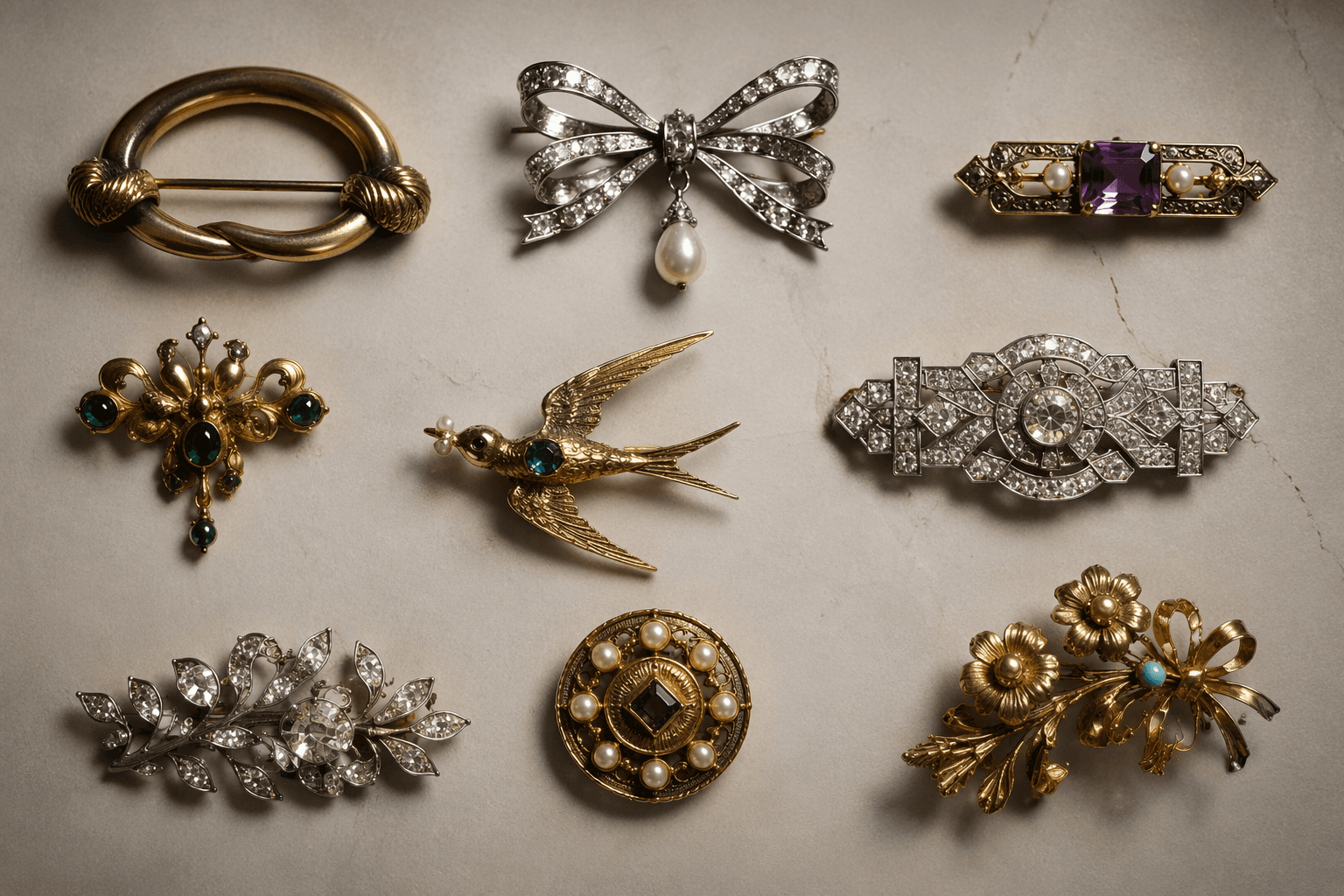
The renewed demand is strongest for brooches that feel historically grounded rather than generic. Victorian examples, with their sentimental sensibility and ornate surfaces, are especially resonant because they speak to personal narrative as much as decoration. Art Deco brooches, by contrast, answer to a modern eye through geometry, symmetry and crisp lines, while mid-century pieces often bring a sculptural, almost architectural lightness that reads beautifully on contemporary tailoring.
Those styles are finding new life because they wear well beyond their original context. A good antique brooch can still hold a lapel, but it can also anchor a scarf, mark the closure of a wrap dress, or bring structure to a soft sweater. For collectors, the appeal lies in the fact that these pieces feel specific: a carved motif, a calibrated arrangement of stones, or the measured thickness of a gold mount tells you far more than a logo ever could.
How to wear a brooch now
The modern way to wear a brooch is to treat it as punctuation. Pin one to a blazer shoulder instead of the lapel for a sharper, less expected line, or cluster a pair on a scarf to create movement and asymmetry. On a handbag, a brooch behaves almost like jewelry for an object, giving even a minimalist bag a more personal finish.
Current styling has pushed the brooch even further. It is being worn on dresses, in hair, and in places that once would have seemed too casual or too unconventional for a formal pin. That shift is what makes the category feel alive again: a brooch can be serious without being stiff, and decorative without losing its sense of purpose.
What makes a brooch worth buying
For buyers, craftsmanship matters as much as style. Look for a secure clasp, a straight pin, and a setting that suits the stones rather than forcing them into an awkward frame. If the brooch is antique, the condition of the hinge and catch is crucial, because even the most beautiful jewel loses value if it no longer sits safely on fabric.
Stone choice and construction also shape value. A finely made brooch with well-matched stones, crisp metalwork and a strong period design will always outlast a vaguely vintage-looking pin with no clear identity. The best examples feel tactile and deliberate, whether they are diamond-set, enamelled, or built in gold with the kind of proportion that lets them sit flat and finish a garment with authority.
A jewel with a long future
The brooch is back because it solves a modern problem elegantly: how to wear something that feels expressive, legible and personal without relying on obvious branding. Its journey from Bronze Age fastening to Met Gala flourish is proof that the most enduring jewelry forms are usually the most adaptable. In the hands of collectors, stylists and designers, the brooch has become what it always had the potential to be: a small object with unusually large presence.
This article was produced by Prism’s automated news system from verified source data, official records, and press releases, then run through automated quality and moderation checks before publishing. The system is built and supervised by the people who set the standards it runs under. Read our full AI policy.
Did this article answer your question?