Buckingham Palace exhibition pairs Queen Elizabeth II's jewels with her gowns
Queen Elizabeth II’s gowns and jewels are shown together at Buckingham Palace, turning familiar sparkle into documented history.

Jewel and gown as a single language
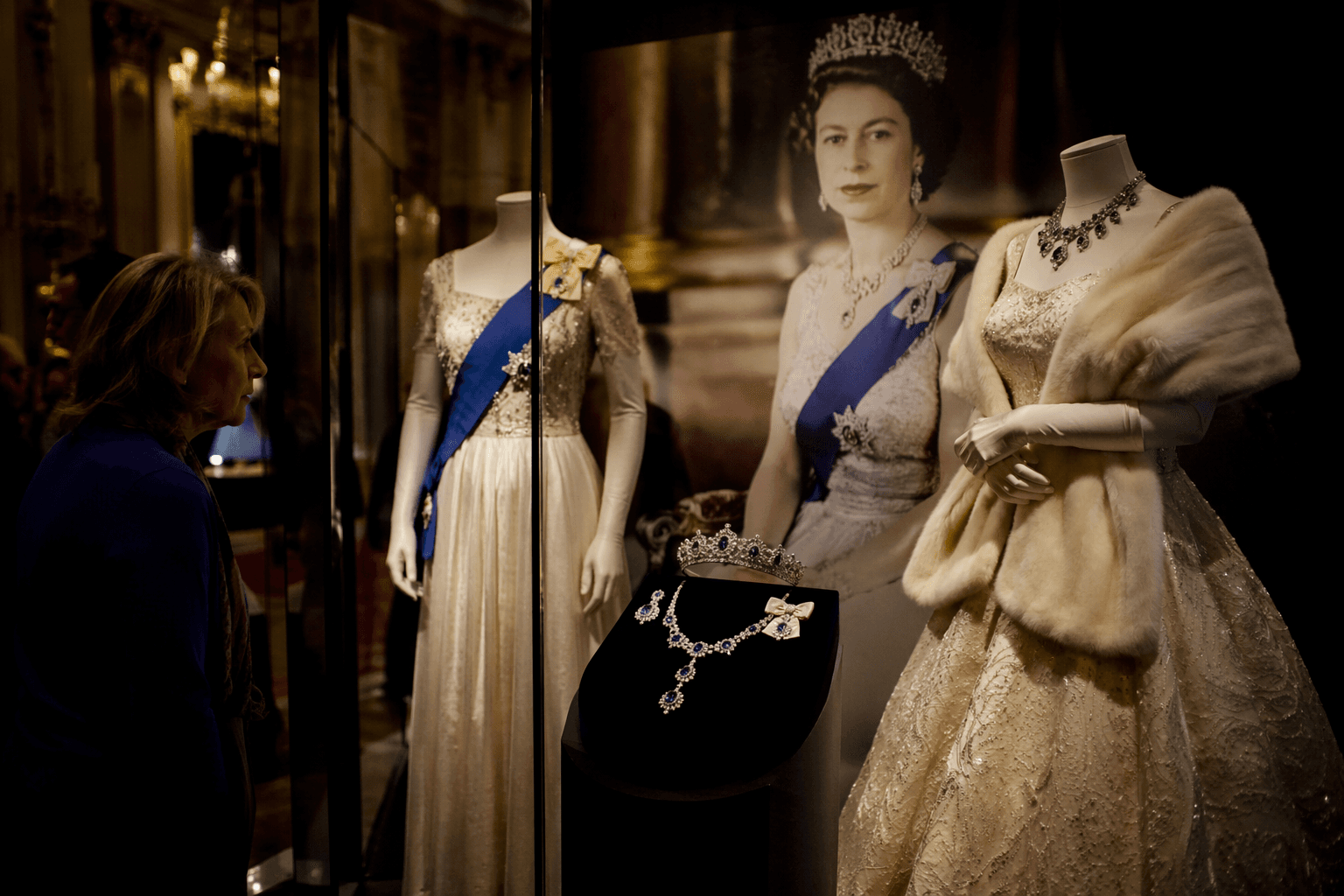
At The King’s Gallery, Buckingham Palace, Queen Elizabeth II’s jewels are not treated as isolated treasures. They are shown with the dresses, hats, shoes and accessories she wore alongside them, so the eye reads the complete performance of royal dress rather than a line of glittering objects in glass. That approach gives the exhibition its force: a diamond brooch or tiara matters more when you can see the exact outfit, occasion and public moment it was meant to serve.
The exhibition, Queen Elizabeth II: Her Life in Style, marks the centenary of the late Queen’s birth on 21 April 1926 and has been presented as the largest and most comprehensive display of her fashion ever mounted. More than 300 items from her personal archive are included, many shown for the first time, which means the story stretches well beyond the familiar shorthand of pearls and parade gowns. This is about a working royal wardrobe, built over decades and calibrated for ceremony, diplomacy and private life alike.
What is actually on view
The display ranges across clothing, jewellery, hats, shoes, accessories, design sketches, fabric samples and handwritten correspondence. That breadth matters, because it shows fashion as a process, not just a finished look. A gown can only be understood fully when you see how it was discussed, fitted and paired with ornaments that made it read properly under the pressure of state occasions and photography.
Royal Collection Trust says more than half the items had never been exhibited before, and the revelations are as interesting for what they tell us about repetition as for rarity. Wedding necklaces appear alongside a newly displayed tiara, a reminder that the most historic jewels are often the ones worn again and again, not locked away after a single triumphant appearance. For readers of vintage jewelry, that is the key lesson: documented wear is not a loss of value. It is often the source of a jewel’s meaning.
How the Queen built meaning through repetition
Queen Elizabeth II’s style was never only about novelty. Her most recognizable jewels gained authority because they returned in specific contexts, with specific gowns, at specific moments. The same piece could move from a wedding setting to a diplomatic dinner or a ceremonial portrait, and each reappearance added another layer of public memory.
That repeated pairing turns a jewel into evidence. A tiara worn with one formal gown becomes tied to a state visit; a necklace seen with a particular silhouette becomes part of the visual record of the reign. In that sense, the exhibition is as much about provenance of use as it is about provenance of ownership. The object’s story is not complete unless you can trace where it went, when it was worn and why it was chosen.
From princess to queen, private life to public ritual
The exhibition traces Queen Elizabeth II’s style from childhood through adulthood, from princess to queen, and from off-duty dressing to diplomatic and ceremonial wear. That progression is not just chronological. It shows how clothing and jewels were used to project continuity while adapting to changing roles, audiences and constitutional responsibilities.
For vintage collectors, that layered wardrobe offers a practical standard. Pieces with a clear occasion, a known wearer and a documented timeline usually carry more cultural weight than unlabeled finery. A jewel linked to a wedding, a coronation, a state banquet or a formal portrait becomes more than decorative. It becomes readable, and that readability is what transforms beauty into historical substance.
Why the archive matters to jewelry lovers
The archive now forms part of the Royal Collection, which gives the material a formal place in the historical record. That matters because jewelry often floats in the market stripped of context, reduced to metal weight, gem counts or period labels. Here, context is the whole point: the show restores the relationship between object, body and institution.
It also underlines how much can be learned from the supporting material around a jewel. Design sketches reveal intent. Fabric samples show how color was balanced against stones and metal. Handwritten correspondence hints at the working relationship between the Queen and the makers who helped shape her image. Even when the stones themselves are the headline, the surrounding paperwork is what makes the story durable.
The designers, the book and the continuing legacy
The exhibition is accompanied by the official book Queen Elizabeth II: Fashion and Style, written by curator Caroline de Guitaut. That publication extends the gallery experience into a record readers can return to, and it reinforces the idea that the Queen’s wardrobe belongs to cultural history, not just royal nostalgia. The presence of the book also signals that this is an exhibition built to be studied, not merely admired.
Three British designers, Erdem Moralioglu, Richard Quinn and Christopher Kane, are contributing pieces to the show. Their involvement points to the Queen’s continuing influence on British fashion, where the codes of propriety, color, silhouette and ceremonial polish still resonate. In an exhibition focused on legacy, their contributions are a reminder that royal style has never been static. It keeps being reinterpreted by the next generation of dressmakers and designers.
What vintage readers should take from it
The exhibition offers a clear lesson for anyone drawn to vintage jewelry: value is not only in carat weight, craftsmanship or age. Provenance, occasion and documented wear can make a jewel far more compelling than its materials alone. A necklace, tiara or brooch that can be placed in a sequence of real events carries a kind of evidence that anonymous luxury never will.
It also argues for looking at jewelry the way a curator does, in relation to clothes, posture and public ritual. A piece worn with a particular gown may reveal a designer’s intention, a diplomatic message or a personal continuity that would be invisible if the jewel were shown alone. That is why the Queen’s most famous ornaments feel so alive in this exhibition: they are not just beautiful objects, they are witnesses to a reign.
With the show now extended through 18 April 2027, there is time to see how royal style is built, not by singular masterpieces alone, but by the repeated, disciplined pairing of jewels and dress. In Buckingham Palace’s galleries, that pairing turns fashion into history and history into something you can study one clasp, one hem and one tiara at a time.
This article was produced by Prism’s automated news system from verified source data, official records, and press releases, then run through automated quality and moderation checks before publishing. The system is built and supervised by the people who set the standards it runs under. Read our full AI policy.
Did this article answer your question?