Common Era honors historic women with cameo-inspired jewelry
Common Era turns historic women into cameo-style gold jewelry, pairing antique forms with recycled metals and pointed feminist storytelling.
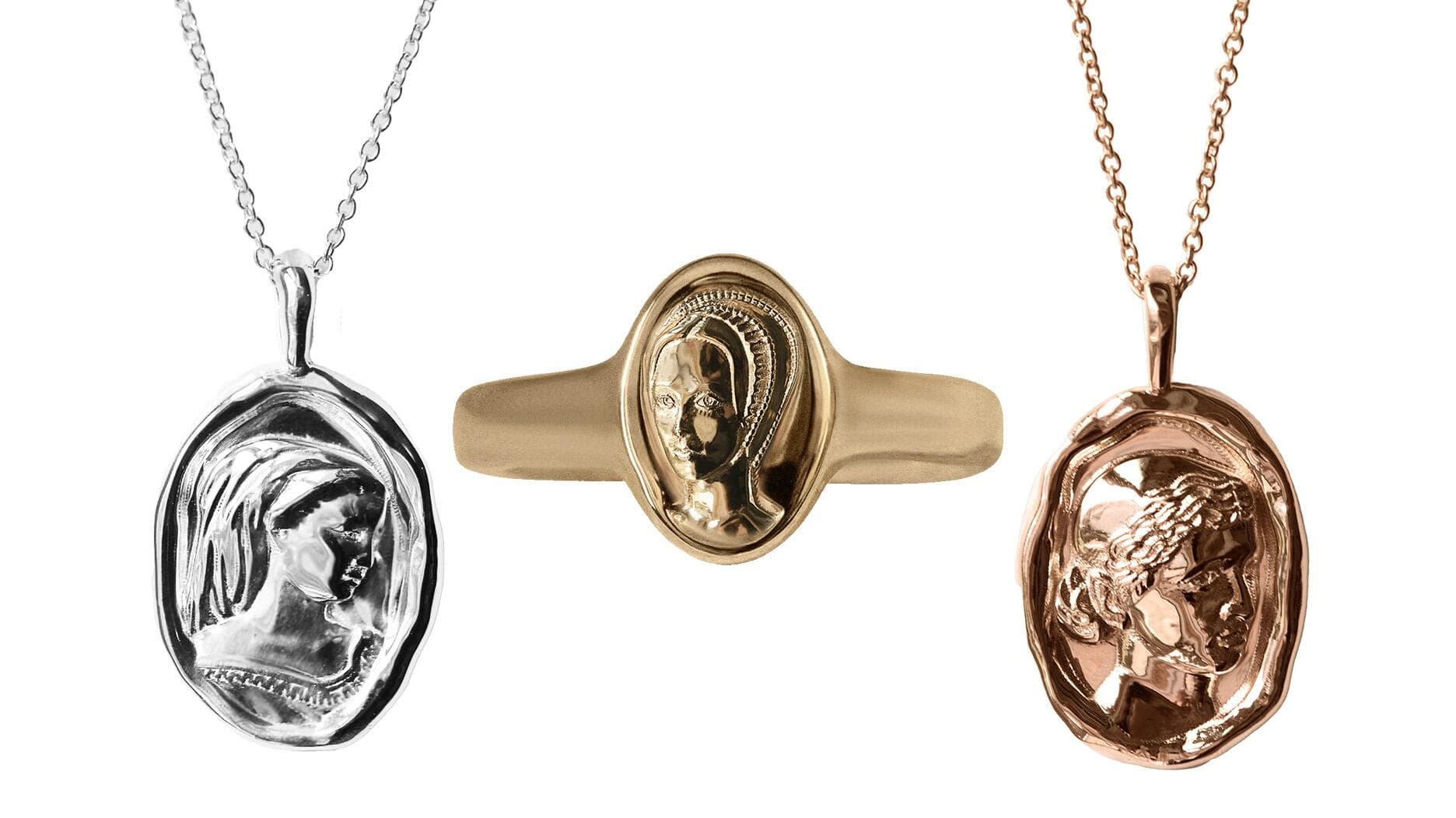
Common Era’s Difficult Women collection turns historic women into wearable portraits, using cameo-style pendants, solid gold signet rings, and engraved names to make antique language feel pointedly current. Centered on 12 figures, the line reads like a small archive in recycled gold, with Olga of Kyiv, Anne Boleyn, Cleopatra, Sappho, and Hypatia of Alexandria cast as women whose lives were judged as much for their defiance as for their influence.
A cameo vocabulary, sharpened for now
The collection borrows the visual grammar of antique jewelry with real precision. Cameo silhouettes recall the profile portraits that have long signaled status, memory, and allegiance in historic adornment, while signet rings echo the rings once used to stamp wax and assert identity. Common Era keeps those cues intact, then updates them by replacing aristocratic initials and family crests with named women whose stories were often flattened, sensationalized, or rewritten by men.
That is why the pieces feel recognizably old and unmistakably contemporary at the same time. The portrait signet ring in solid gold bearing Sappho’s likeness, for example, reads like a classical intaglio made newly legible by naming the subject outright. The same is true of Hypatia of Alexandria, whose ring centers a philosopher and mathematician rather than a dynasty, and of the latest Olga of Kyiv pendant, titled “The Avenger” in 14-karat yellow gold for $1,500.
Historic figures, recast as a female archive
Common Era says Difficult Women is an ode to women who scandalized the world and defied patriarchy, and that framing matters because it changes the usual hierarchy of antique-inspired jewelry. Instead of using the past as a decorative mood board, the brand builds a cast of women who were cast as villains or simply dared to think in a world dominated by men. The result is less costume than correction.
Olga of Kyiv carries particular weight in that lineup. Historically, she was the first recorded female ruler of Rus and the first member of the ruling family of Kyivan Rus to adopt Christianity, a biography that gives the pendant’s title a sharper edge than a generic historical reference ever could. Sappho brings a different kind of authority, as the Greek lyric poet from Lesbos widely admired in antiquity, while Hypatia of Alexandria stands for intellectual independence as a philosopher and mathematician of antiquity.
Materials, price, and what the fine-jewelry claim actually means
The collection is built in 14-karat yellow gold, 14-karat rose gold, and recycled gold, which places it squarely in the fine-jewelry category rather than in fashion jewelry. The Cleopatra pendant is offered in 14-karat rose gold for $1,500, and the Anne Boleyn ring in 14-karat yellow gold is priced at $1,600, putting the line in a contemporary luxury band that is accessible relative to higher-carat or gem-heavy designer pieces, but still priced for precious-metal craftsmanship.
The recycled-gold claim is the most meaningful sustainability detail here. It does not make the collection automatically virtuous, but it does shift attention toward material origin, which is the right place to start when a brand is asking buyers to think about provenance, history, and the treatment of women in the past. The jewelry’s value is carried by metal, form, and engraving rather than by stone size or flash, which gives the collection a quieter and more considered luxury.
- Cameo-style pendants supply the profile motif that makes the line feel antique.
- Solid gold signet rings give the collection a weightier, more archival character.
- Wax-seal motifs connect the pieces to documents, authority, and legacy.
- Recycled gold supports a cleaner materials story than newly mined metal, provided the sourcing remains clear.
Why this collection landed at Women’s History Month and International Women’s Day
The timing is as deliberate as the design language. In the United States, Women’s History Month is observed in March, and its roots trace to Women’s History Week in Sonoma County, California, in 1978, scheduled to coincide with March 8, International Women’s Day. International Women’s Day is marked annually on March 8, and Common Era positioned the collection for that calendar, which gives the project more than decorative relevance.
That matters because the brand was already built around historic resonance. Torie Tilley, who founded Common Era in 2019 after a career as a tech executive, has described herself as an “ancient history geek,” and the label’s broader universe draws from mythology, ritual, relics, and ancient craft. She said the Difficult Women idea had been on her wishlist since she launched the company, and she released it gradually rather than all at once, a choice that suits a collection organized by subject rather than season, “like a living archive.”
Why the revival matters now
Common Era succeeds because it understands that antique inspiration is strongest when it is specific. It is not simply borrowing cameos, signets, and historical names for surface decoration. It is using those forms to ask who gets memorialized, who gets dismissed, and why women who were once treated as troublesome can become the central figures in a modern jewelry narrative.
That is what gives the collection its force in vintage-language jewelry today: the antique references are real, the updating is visible, and the point is not nostalgia. It is reclamation, written in gold.
This article was produced by Prism’s automated news system from verified source data, official records, and press releases, then run through automated quality and moderation checks before publishing. The system is built and supervised by the people who set the standards it runs under. Read our full AI policy.
Did this article answer your question?