Essential Books and Digital Tools for Researching Antique Hallmarks and Maker's Marks
A single stamped mark can unlock a piece's entire provenance — here are the authoritative books and digital archives serious collectors rely on.
Pick up an inherited ring or a brooch pulled from an estate sale, and you're holding a small archive. The metalwork may whisper Art Nouveau or shout mid-century modernism, but it's the marks — the tiny punched symbols on the shank, the clasp, or the cartouche — that speak with legal precision. Reading them fluently requires the right library. Not every book does the same job, and knowing which reference to reach for first can mean the difference between confident attribution and costly misidentification.
Understanding the Two Types of Marks
Before opening any reference book, it helps to understand that hallmarks and maker's marks are fundamentally different categories of information, and they answer different questions.
Hallmarks are government-mandated quality assays, struck by an independent assay office to certify the fineness of gold, silver, platinum, or palladium. In Britain, assay offices have been operating since the 14th century, and their date letters, town marks, and standard marks create a precise paper trail. In France, the system is called the poinçon: that famous eagle's head, for instance, has indicated a minimum fineness of 18-karat gold since 1838. Maker's marks, by contrast, are the voluntary or trade-registered stamps of individual goldsmiths, jewelry houses, and manufacturers. They identify who made a piece, not just what it's made of. The two systems overlap but require different reference tools, and conflating them is one of the most common errors made by novice researchers.
The Cornerstones of Any Hallmark Library
*Jackson's Hallmarks* remains the non-negotiable starting point for anyone working with British silver and gold. First published in 1905 under the title "English Goldsmiths and Their Marks," it has been the bible for scholars, dealers, and collectors for over a century, selling in hundreds of thousands of copies. The Antique Collectors' Club issued a thoroughly revised edition edited by Ian Pickford in 1989, and the pocket edition — covering English, Scottish, and Irish silver and gold marks from 1300 to the present day — includes updated date letters, commemorative marks, and even the more recently introduced marks for palladium. If you only own one British hallmark book, this is it.
For French marks, the essential text is Emile Beuque's *Dictionnaire des Poinçons: Officiels Français et Étrangers, Anciens et Modernes*, published in Paris in 1925. It traces official French and foreign hallmarks from the 14th century forward, covering the full sweep of royal guaranty marks, revolutionary-era changes, and the post-Napoleonic reforms that reshaped the French assay system. Complementing Beuque for contemporary use are two Tardy publications: *Les Poinçons de Garantie Internationaux pour l'Or, le Platine et le Palladium* (1984) and *Poinçons Actuels des Métaux Précieux* (2000), both published in Paris and indispensable for identifying marks on pieces that crossed borders within the European hallmarking framework.
For collectors whose interests extend beyond the Anglo-French axis, *World Hallmarks, Volume I: Europe, 19th to 21st Centuries* by William B. Whetstone, Danusia V. Niklewicz, and Lindy L. Matula is the most comprehensive English-language survey of European precious metal marks currently in print. Published by the Hallmark Research Institute in San Francisco, this 380-page volume covers gold, silver, platinum, and palladium hallmarking systems across the continent, grounding each country's marks in their historical and legislative context. The Hallmark Research Institute was co-founded by the same three authors specifically to advance hallmark literacy through publication and education.
For broader coverage of American silver and accessible international cross-referencing, Seymour B. Wyler's *The Book of Old Silver: English, American, Foreign*, reissued by Skyhorse Publishing in 2013, remains a reliable desk companion, particularly for generalist appraisers handling mixed collections.
Regional Specializations: The Americas
No single volume covers the full landscape of North American marks, and the region rewards specialist reading. For jewelry and silver from the American Southwest, two authoritative titles fill distinct niches. Barton-Wright's *Hallmarks of the Southwest*, published by Schiffer Publishing in 2000, provides an overview of Native American and regional silversmithing traditions alongside their identifying stamps. For deeper granularity, Bille Hougart's *The Little Book of Marks on Southwestern Silver* (TBR International, 2011) and its expanded successor, *Native American and Southwestern Silver Hallmarks*, together document more than 225 individual silversmith entries with over 500 mark images, making them effectively the field guide for anyone buying or authenticating Navajo, Zuni, or Pueblo silver.
Mexican silver deserves its own shelf. Hougart's *The Little Book of Mexican Silver Trade and Hallmarks* (TBR International, 2006) maps the trade marks, eagle marks, and assay codes that govern Mexican silver production, while Mary L. Davis and Greta Pack's *Mexican Jewelry*, published by the University of Texas Press, situates the marks within the richer cultural history of makers like Hector Aguilar and the Taxco silversmithing movement.
Navigating Maker's Mark Registries
Where hallmark dictionaries confirm authenticity of metal content, maker's mark registries solve the attribution problem: who signed this piece? Dorothy T. Rainwater's *American Jewelry Manufacturers* (Schiffer Publishing, 1997) is the standard reference for identifying American studio and commercial marks from the 19th and 20th centuries. For trade names and brand stamps, the *Trade-Marks of the Jewelry and Kindred Trades, Sixth Edition* (Jewelers' Circular-Keystone, 1950) and *The Keystone Jewelry Trade Mark Book* (1934 edition, reprinted by Golden Era Publications in 1990) together cover the mid-century American market with breadth no single modern guide has replicated.
Malcolm Haslam's two-volume series offers particular value for decorative arts collectors. *Marks & Monograms: The Modern Movement 1875-1930* and its companion *Marks & Monograms: The Decorative Arts 1880-1960* catalog the marks of Arts and Crafts, Art Nouveau, and modernist metalwork across Britain and Europe, connecting stamps to named studios and individual craftspeople in a way that purely assay-focused books cannot.
Digital Resources and the AJU Advantage
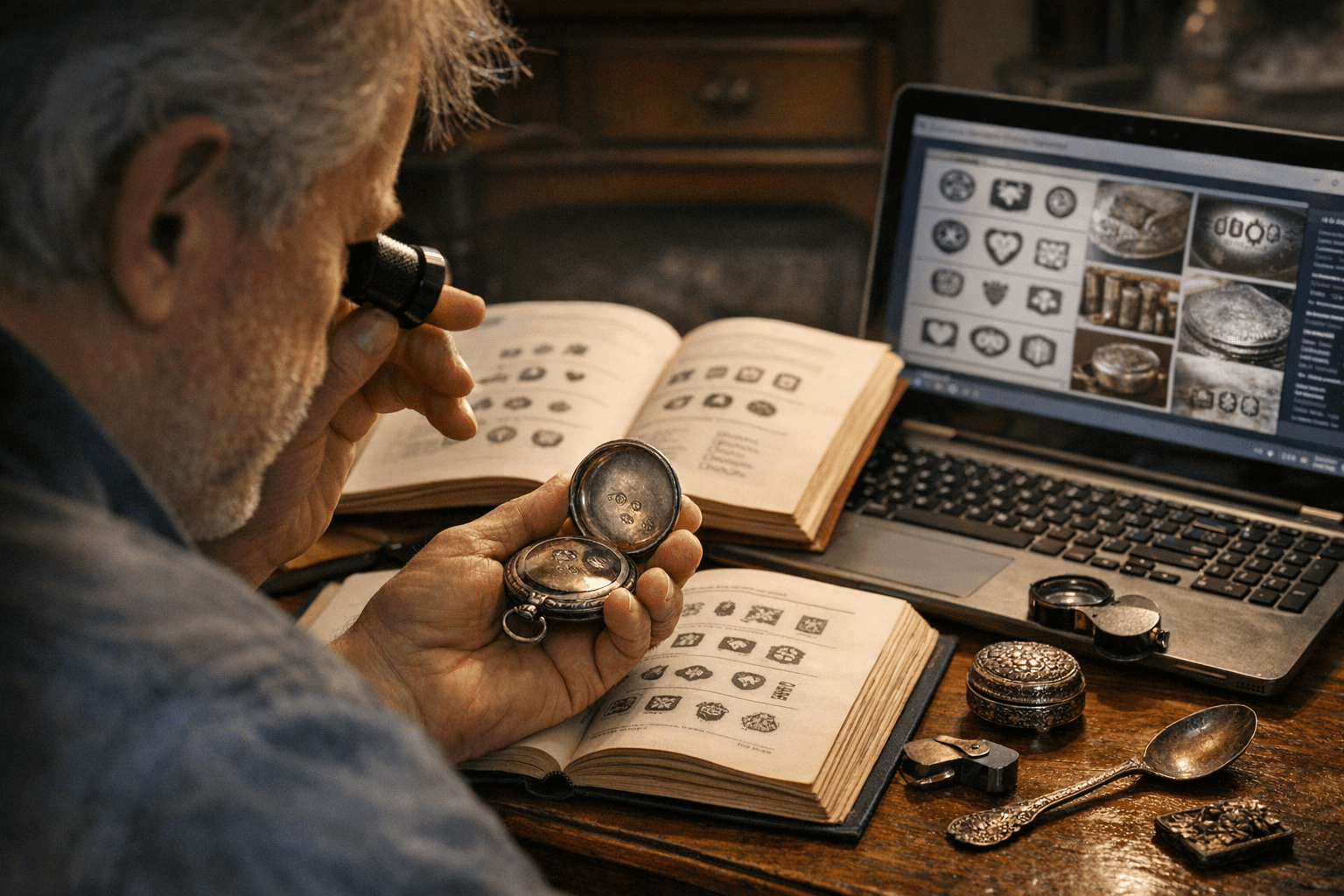
Print references are authoritative, but digital databases have transformed the speed of initial research. Antique Jewelry University, the educational arm of Lang Antiques in San Francisco, maintains both a curated resource list of the books above and a searchable Maker's Marks archive accessible directly on its site. The archive allows researchers to search by mark image, initials, or country of origin using a dedicated search bar and three filter menus, making it one of the most practical free starting points for rapid mark identification online.
The AJU resource list itself is worth bookmarking as a living bibliography: it distinguishes hallmark dictionaries from maker's mark registries, flags which print volumes are foundational versus regional, and organizes references by geography. For collectors working across multiple collecting areas, having this taxonomy clear before pulling books off a shelf saves hours of redundant searching.
A Research Method That Actually Works
The most reliable approach to authentication runs in a specific sequence. Begin with physical diagnostics: examine construction techniques, stone cuts, and stylistic vocabulary to establish a probable period and region. An Old European cut diamond in a hand-fabricated silver mount points in a different direction than a calibrated synthetic in a die-struck gold bezel. Once you have a stylistic hypothesis, turn to hallmarks to confirm or challenge it. If the marks align with your visual dating, you're building a coherent case. If they contradict it, investigate further before reaching a conclusion.
The 19th-century reference books carry their own particular value here. Markham's 1898 *Hand Book to Foreign Hall Marks on Gold and Silver Plate* and Redman's 1893 *Illustrated Hand Book of Hall-Marks and Date-Letters from 1509 to 1920* predate many of the reforms that modern references summarize; they document marks as contemporaries encountered them, which occasionally reveals details that retrospective compilations smooth over.
No single reference solves every problem. A piece of Mexican silver from the Taxco workshops, a Birmingham Arts and Crafts buckle, and a Scandinavian modernist brooch each require a different book opened to a different page. The collector who builds this library deliberately, one region at a time, develops something that no single digital database can replicate: the judgment to know which question to ask before looking up the answer.
This article was produced by Prism’s automated news system from verified source data, official records, and press releases, then run through automated quality and moderation checks before publishing. The system is built and supervised by the people who set the standards it runs under. Read our full AI policy.
Did this article answer your question?