GIA's Study of Famous Diamonds Highlights Critical Importance of Provenance Documentation
GIA's World Diamond Day showcase revealed that the Hope Diamond weighed a full carat more than recorded history suggested — until proper lab documentation settled the question.
Pick up a diamond with a name and you are holding centuries of disputed weight, contested color grades, and ownership chains that skip continents. The Gemological Institute of America made that point concrete on World Diamond Day, April 8, 2026, by revisiting five of the most consequential stones it has ever examined and drawing a straight line from those case studies to a principle every collector and heir should internalize: without institutional documentation, even a famous diamond's most basic facts remain negotiable.
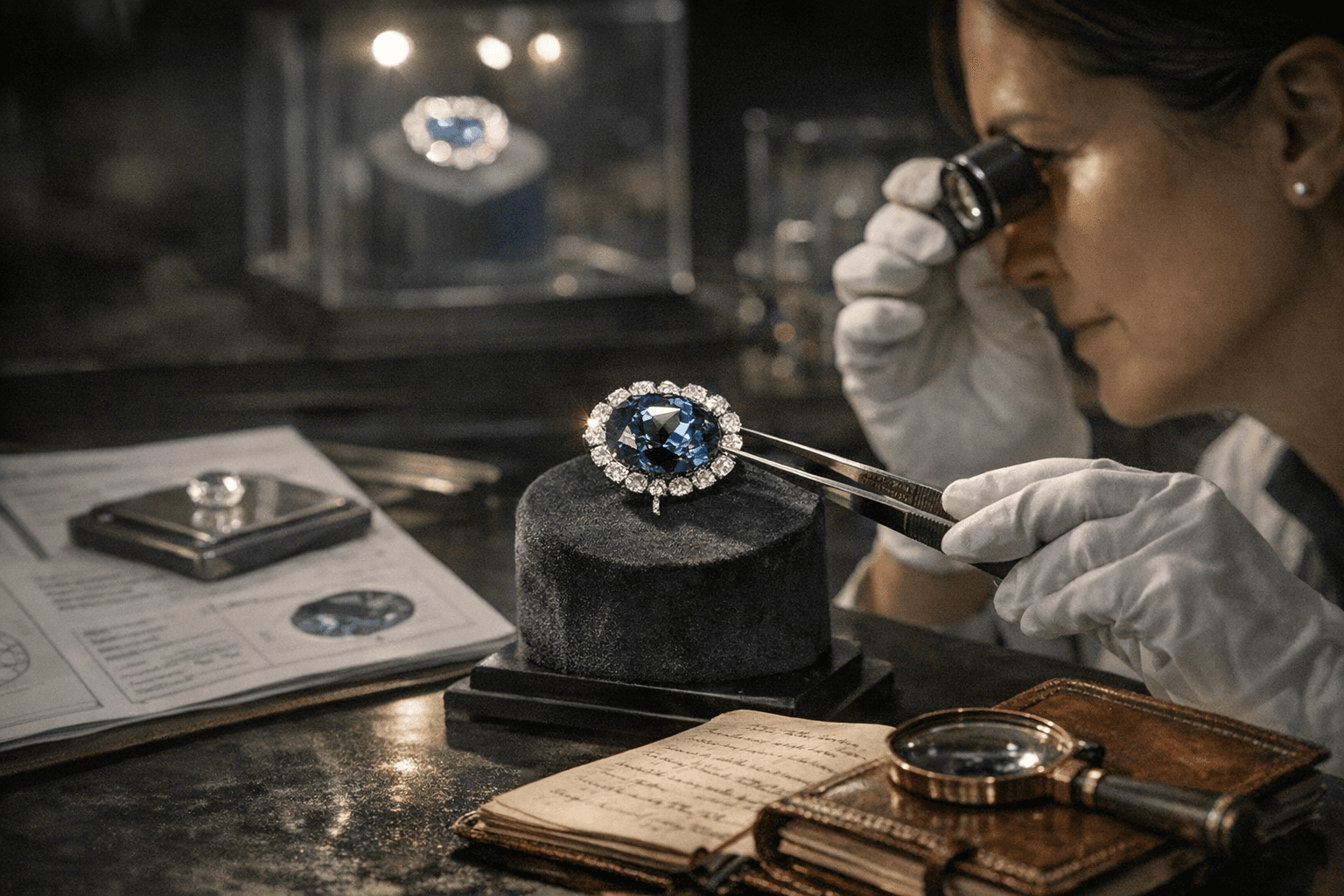
The 45.52-carat Hope Diamond is the sharpest illustration of that lesson. Before GIA's rigorous examination, historic literature placed the weight at 44.50 carats. It was only after the stone was removed from its mounting and weighed on calibrated laboratory scales that the true figure, a full carat heavier, was confirmed. The Hope, classified as Fancy Deep grayish blue and traced in origin to India, now resides at the Smithsonian Institution, its provenance anchored by precisely that kind of documented record.
The Dresden Green presents a contrasting archival challenge. At approximately 41 carats, it is the largest known natural green diamond, yet because it has not been removed from its historic bezel mounting since 1768, no precise modern weight exists. GIA's engagement with the stone underscores what happens in the absence of that documentation: the gap between what a stone is believed to be and what science can confirm it to be widens with every generation.
Rarity of a different order defines the 2.33-carat Winston Red, one of the world's rarest pure red diamonds and the only Fancy red diamond currently on public display anywhere. At that scale, a single authenticated GIA report represents an irreplaceable paper trail. The Taylor-Burton Diamond, a 69.42-carat pear-shaped stone graded E-F color and Internally Flawless, carries its own paper history: cut by Harry Winston from a 240.80-carat rough crystal recovered at South Africa's Premier Mine in 1966, sold at auction to Cartier for $1.05 million in 1969, and ultimately negotiated into Richard Burton's possession before changing hands again. Each transaction in that chain is legible precisely because grading records exist to confirm what was being bought and sold.
The most recent stone in GIA's showcase is also the largest it has ever examined. The Motswedi, a 2,488.32-carat rough crystal recovered at Lucara Diamond Corporation's Karowe mine in Botswana in August 2024, is the second-largest gem-quality diamond ever discovered, surpassed only by the 3,106-carat Cullinan found in South Africa in 1905. GIA's scientific team in Gaborone, led by Executive Vice President Tom Moses and Vice President of Research Dr. Wuyi Wang, confirmed the Motswedi as a single, type IIa diamond crystal with no detectable nitrogen, making it the largest known single crystal diamond in existence.
The institutional argument running beneath all five stories is the same one that applies to an heirloom cushion-cut in a safety deposit box: what a stone is worth and what it can be proven to be are two different questions. Provenance is not a romantic backstory. For any stone that will ever change hands, it is the foundation of value itself.
This article was produced by Prism’s automated news system from verified source data, official records, and press releases, then run through automated quality and moderation checks before publishing. The system is built and supervised by the people who set the standards it runs under. Read our full AI policy.
Did this article answer your question?