Georgian to Modern Vintage Jewelry, How to Date and Authenticate Pieces
A missing date letter is not proof of fakery. The quickest read starts with hallmarks, then style, then construction.
Read the object before the appraisal
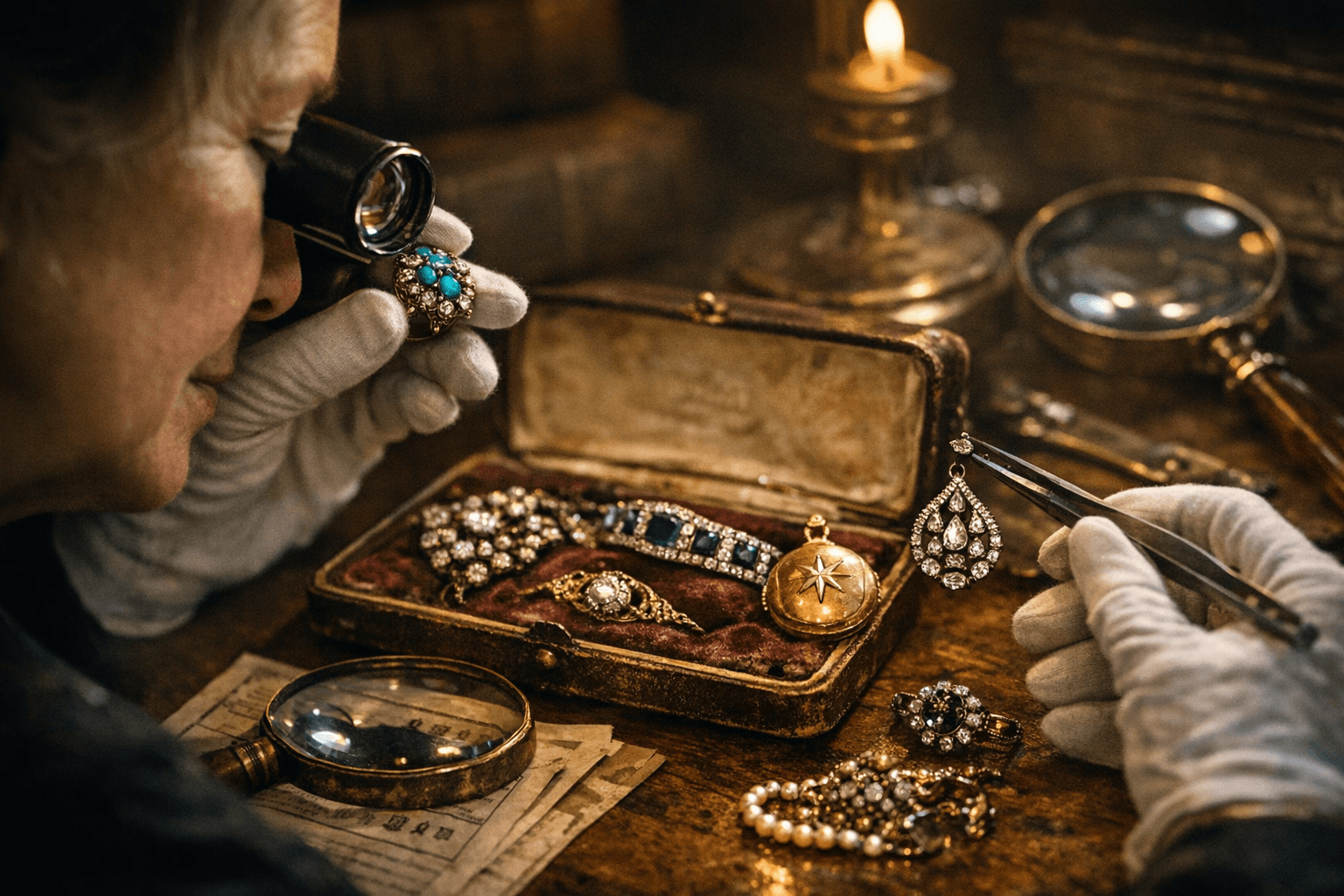
The tiny stamp inside a ring shank or on a clasp can tell you more than a sales receipt ever will. Before you pay for an appraisal, treat inherited or thrifted jewelry like a small archive: read the marks, compare the design to its period, and check whether later repairs have blurred the trail.
Start with the hallmark, because it is the closest thing to a paper record
British hallmarking is one of the oldest consumer-protection systems in jewelry. Official marking of precious metals dates to a statute of Edward I in 1300, and the Goldsmiths’ Company says it has been guaranteeing the purity of precious-metal items since then. The first London Assay Office was established at Goldsmiths’ Hall in 1478, which gives antique British jewelry a long and unusually traceable history.
A full UK hallmark normally includes three core parts: the sponsor’s mark, the fineness mark, and the assay office town mark. The date letter can appear too, but it is optional. Since January 1999, the date letter has been voluntary rather than compulsory, and the traditional lion passant and crown gold marks also became optional in the UK system. That means a missing date letter does not automatically make a piece suspicious, and it does not mean the piece is unmarked or unauthentic.
For readers trying to date an estate piece quickly, the hallmark is the first stop because it tells you who submitted the article, what it is made of, where it was hallmarked, and when it was hallmarked, when the date letter is present. The catch is that hallmark rules and date-letter practices vary by office and period, so the mark should be read as a statutory audit trail, not as a standalone verdict.
Why the date letter is helpful, and why it can mislead
The same date letter has been used by all four UK Assay Offices since 1975, which makes later pieces easier to compare once you know the office mark. Before 1975, the date letter varied for each assay office, so an old chart from one office does not always solve another office’s code. That is one of the most common places beginners get fooled: they see a partial letter, assume they have the year, and overlook the office difference.
The Goldsmiths’ Company Hallmark Authentication Committee says unauthorized marks and alterations are handled under Section 7 of the Hallmarking Act 1973, which is a reminder that the mark itself can be tampered with. A genuine-looking stamp on a worn ring is not enough if the setting has been altered, the shank replaced, or the piece resized so heavily that the marks are distorted.
Period style still matters, especially when the marks are incomplete
Once the hallmark gives you a framework, style narrows the date range. Queen Victoria reigned from 20 June 1837 to 22 January 1901, and Victorian jewelry spans a broad range of forms rather than one fixed look. One of its major motifs was mourning jewelry, which included rings, lockets, brooches, and hair jewelry made to memorialize loved ones.
That is a useful clue when a piece feels emotionally loaded or intentionally somber. A blackened locket, a memorial ring, or a brooch built around woven hair may fit Victorian taste even if the hallmarks are rubbed nearly smooth. The style will not replace the mark, but it can confirm whether the object’s visual language makes sense for the period the metalwork suggests.
Edwardian jewelry is often associated with garland motifs and floral wreath designs. That lighter, airier look, especially around the turn of the 20th century, can help separate later pieces from heavier Victorian forms. If a necklace or brooch claims to be Edwardian but looks stylistically dense, overbuilt, or decorative in a way that feels more modern than floral, the design deserves a second look.
Look for the clues beginners miss
A first-time buyer often focuses on the front of the jewel and forgets the back, the clasp, and the hinge. Those hidden areas are where dating clues usually survive. Hallmarks may sit where the metal is least worn, while maker’s marks can be tucked into a clasp tongue, along an inner band, or beside the assay marks in a concealed spot.
Watch especially for these red flags:
- A hallmark that is crisp on one part of the piece but oddly shallow where metal has clearly been replaced
- A style that looks period-correct on top but has modern findings, later safety catches, or recent solder seams
- A date letter that appears useful but does not match the assay office or era of the surrounding marks
- A piece with strong Victorian or Edwardian style cues but no coherent metal audit trail at all
The most common mistake is to treat missing marks as proof of age or authenticity. They are not. Missing marks can mean wear, repair, a non-UK origin, or simply a later change in the rules. Equally, a mark can survive on a piece that has been heavily altered, which is why construction matters as much as stamping.
Cross-check style, construction, and metal testing
The fastest way to avoid a costly mistake is to triangulate. Start with the hallmark, compare the design language to the period, then inspect the construction: clasp type, solder lines, setting style, and any sign of later conversion. If the metal tests support what the marks claim, the case strengthens; if they do not, the piece needs more scrutiny before anyone assigns value.
That is where assay-office tables and reference standards become essential. CIBJO describes its Blue Books as definitive, regularly updated standards and nomenclature for precious metals and other jewelry sectors, which makes them useful for keeping terminology precise. For broader visual research, GIA says its library and archive are the largest dedicated reference library of their kind, with 65,000 volumes, 230,000 images, 2,200 videos, and 1,200 periodicals, plus more than 1,000 digitized works dating from the 1400s to the 1990s. In practice, those archives help connect a design to its era and separate period workmanship from later revival pieces.
A practical way to date inherited jewelry
The shortest path is not to guess by style alone, and not to trust the stamp alone. Read the hallmark first, then compare it with the object’s silhouette, motifs, and construction, and finally check whether the metal and workmanship match the story the piece is telling. A mourning ring that aligns with Victorian taste, a garland brooch that fits Edwardian fashion, and a hallmark that matches the correct assay office together make a convincing case.
That is the discipline collectors use when they handle a ring, brooch, or locket as evidence rather than decoration. In vintage jewelry, the truth is usually in the combination of marks, materials, and repair history, and the pieces that survive longest are often the ones that have something to hide.
This article was produced by Prism’s automated news system from verified source data, official records, and press releases, then run through automated quality and moderation checks before publishing. The system is built and supervised by the people who set the standards it runs under. Read our full AI policy.
Did this article answer your question?