Georgiana of Devonshire, portrait diamonds made sentiment jewelry status symbol
Georgiana of Devonshire turned private affection into public spectacle, and portrait diamonds made intimacy glitter with status. Collectors still prize the rare fusion of stone, image, and story.
A face under diamond, and a whole social world in miniature
Georgiana Cavendish, Duchess of Devonshire, understood that jewelry could do more than decorate. It could broadcast allegiance, desire, and power in a single glance, and portrait diamonds turned that idea into something exquisitely wearable. In the world she helped define, intimacy was never entirely private. It could be pinned at the throat, tucked at the waist, or worn as a sign that feeling and rank had become inseparable.
Born in 1757 and living until 1806, Georgiana was one of the most famous women of her age, a celebrated beauty, a fashion leader, and a force in British aristocratic and Whig society. Her circle at Chatsworth House and in London made style feel political, and political life feel theatrical. That is the atmosphere in which portrait jewelry flourished: a culture where to wear someone’s likeness was to declare loyalty, intimacy, or influence in public.
Portrait miniatures were the original wearable image economy
Portrait miniatures began long before Georgiana’s day, developing during the reign of Henry VIII and remaining desirable until photography displaced them in the mid-19th century. Their appeal was practical as well as emotional. They were small enough to travel, to be carried as private keepsakes, and to be shown or hidden depending on the moment.
The Victoria and Albert Museum holds more than 2,000 portrait miniatures, the UK’s finest collection, spanning the 16th to the 19th centuries. The museum’s holdings make clear how varied their social function could be. These tiny images worked as political tokens, personal gifts, and romantic pledges, carrying the likeness of a loved one in a form that was intimate but never inconsequential.
For Georgian society, that mattered. An enamel miniature, especially fashionable in Britain from the 1720s to the 1760s, offered color, polish, and portability. Portrait miniatures on ivory carried a different emotional charge: they were closer to a hand-painted likeness, often more delicate, and more obviously tied to the sitter’s identity. In a world ruled by appearance, they made identity wearable.
Why the portrait diamond was such a rare triumph
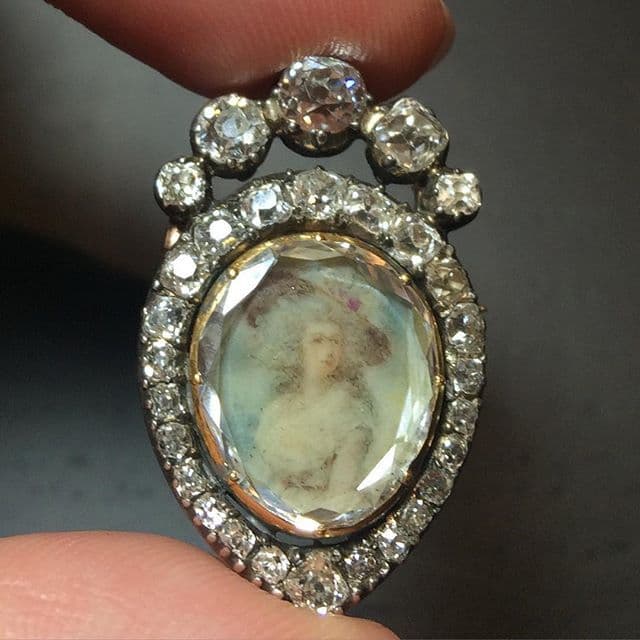
The Metropolitan Museum of Art’s portrait jewel of Georgina, Duchess of Devonshire shows the form at its most accomplished: a miniature painted on ivory, covered with a thin slice of diamond, and surrounded by brilliant-cut diamonds. That construction is the key to the category. The portrait is not protected by ordinary glass but by an extremely limpid, thinly cleaved stone, so flat and clear that it acts almost like crystal and almost like armor at once.
A Bonhams catalogue description of a similar brooch makes the point even more vividly. Portrait diamonds belong to a very rare group of jewels in which a miniature is covered not by glass but by a very flat, transparent sheet of polished diamond, faceted at the edges to catch and illuminate the sitter. The effect is both protective and theatrical. Light moves across the surface, sharpening the face beneath it and turning the jewel itself into part of the portrait.
The cut matters here too. The flat portrait diamond uses the lasque cut, a historic Indian cutting style. India was the world’s primary source of diamonds before the 18th century, which gives these jewels a wider imperial and material history as well as an aesthetic one. A portrait diamond is therefore never only about sentiment. It also reflects the routes by which rare stones traveled, the technical ingenuity required to flatten and cleave them, and the wealth needed to command such a labor-intensive object.
Georgiana and the social power of sentiment
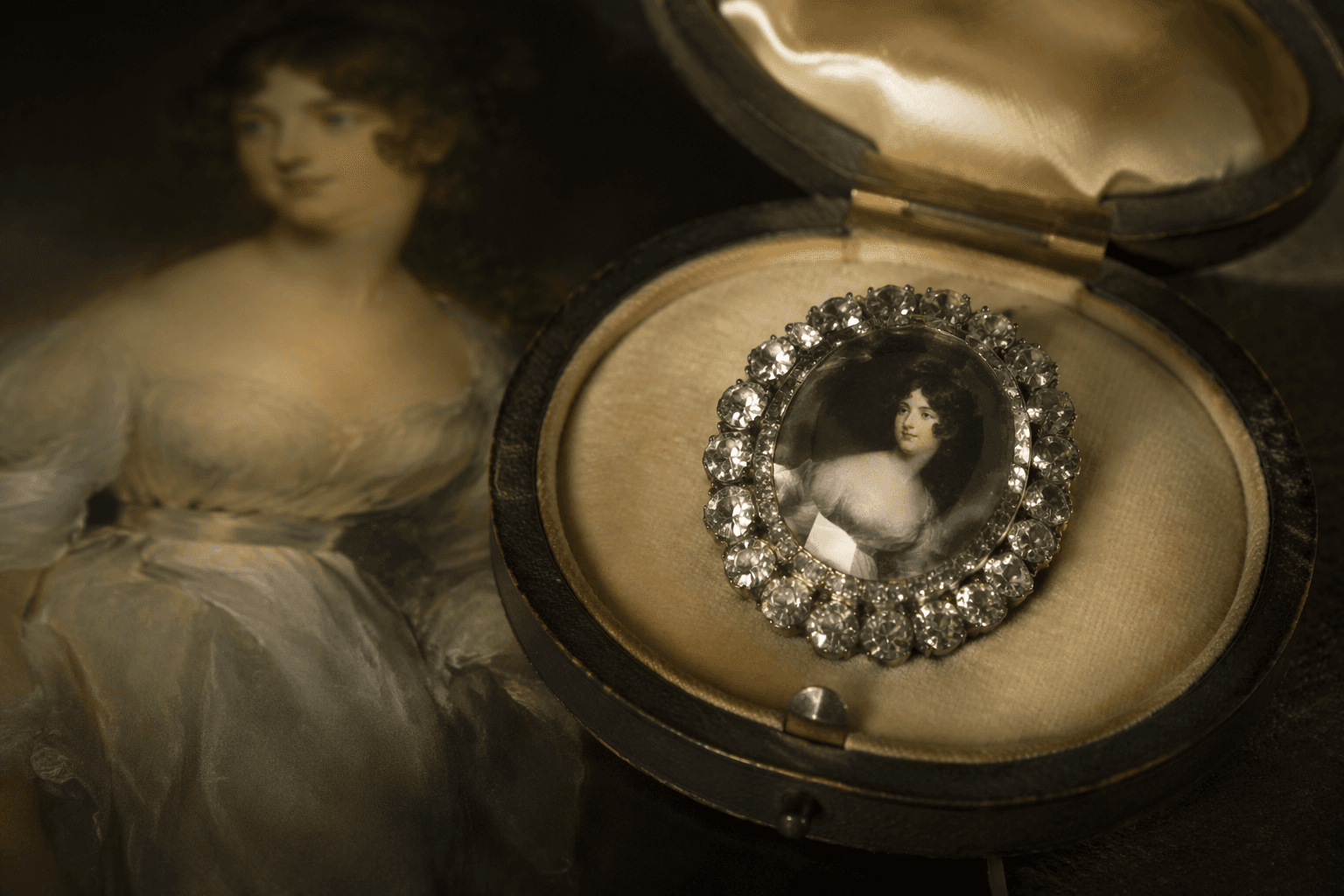
Georgiana’s importance lies not just in owning beautiful things, but in making beauty itself part of social performance. She was a woman whose image circulated constantly, and portrait jewels suited that world perfectly. They allowed the wearer to stage affection without surrendering status, and to make the private language of devotion visible within elite society.
That is why portrait miniatures and portrait diamonds still feel modern. They collapse several desires into one object: the wish to remember, the wish to display, the wish to own a likeness, and the wish to transform feeling into form. In Georgian hands, sentiment was never soft in the naïve sense. It was structured, styled, and often politically charged.
Memorial jewels belong to the same emotional lineage. Where portrait miniatures preserved the living beloved, memorial jewels kept absence present, translating memory into something wearable and legible. Together, these objects show how jewelry became a language for attachment as well as rank. They were not merely ornaments, but social instruments.
What to look for when evaluating a portrait jewel today
For collectors, the appeal of portrait jewelry lies in reading the object correctly. The first question is material. A true portrait diamond should present the miniature beneath a very flat, transparent diamond cover, often with faceted edges that animate the face below it. If the “diamond” cover is too thick, too cloudy, or more like ordinary glass, the jewel may be a later imitation or a different type of homage.
The next clue is construction. The miniature itself should be painted with precision, often on ivory in surviving examples, and set within a mount that feels integral rather than decorative for its own sake. Brilliant-cut diamonds around the edge, as seen in the Metropolitan Museum’s Devonshire jewel, point to the high-status ambitions of the piece. The best examples make the sitter legible while also revealing the technical difficulty of the setting.
Importance also comes from context. A jewel tied to a famous sitter, an important patron, or a documented circle of political and social influence carries more than sentimental value. In Georgiana’s world, a portrait jewel could signal alliance as clearly as a badge. That social function is part of what makes these pieces desirable now: they are not only pretty survivals, but evidence of how the Georgian elite turned affection into display and display into power.
The finest portrait jewels still hold that tension. They are intimate, but never merely private; decorative, but never merely ornamental. In a market crowded with sentimental reproductions, the originals remain compelling because they do what the best jewelry always does: they make a life visible.
This article was produced by Prism’s automated news system from verified source data, official records, and press releases, then run through automated quality and moderation checks before publishing. The system is built and supervised by the people who set the standards it runs under. Read our full AI policy.
Did this article answer your question?