How to Appraise Vintage Jewelry, Identify Value, Authenticity, and Condition
A vintage jewel reveals its value in the marks inside, the repairs it carries, and the paper trail around it. Start with the object, not the price tag, and let condition and purpose shape the appraisal.
Begin with the object in hand
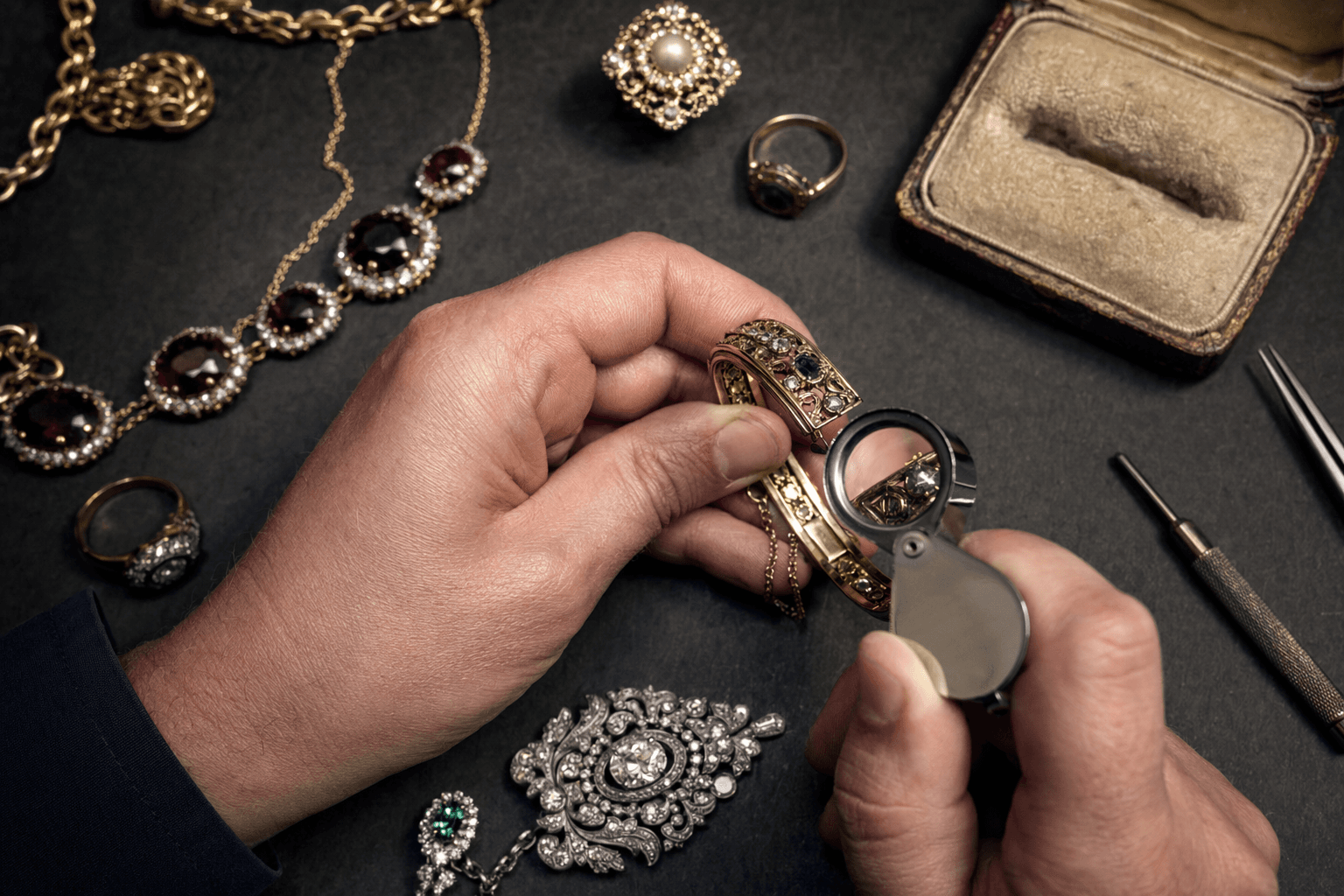
Open the clasp, turn the brooch over, look inside the band. That is where a vintage jewel starts telling the truth. Maker marks, metal stamps, repair traces, and worn edges are the small archives that help separate a collectible from a pretty object, and they often matter more than the first impression of sparkle.
The first question is simple: what is it? Before you think about value, identify the form, the materials, the likely period, and the workmanship. The Metropolitan Museum of Art’s collections and essays make clear that style, technique, and historical period are not decoration around the answer. They are part of the answer.
Identify what the piece is really saying
A Victorian ring, an Art Nouveau pendant, and a midcentury brooch may all share gemstones, but they do not share the same market logic. Design period helps situate the piece, and materials and workmanship tell you whether the object matches the story it is trying to tell. The Met’s essays on nineteenth-century American jewelry and Art Nouveau pieces underscore that dated design language and craftsmanship are central clues, not cosmetic details.
For enamel work, those clues can be technical. In the Met’s essay on Renaissance enameled gold jewelry, chemical analysis of enamel compositions helps distinguish authentic period pieces from later imitations. That matters because a jewel can look convincingly old while actually borrowing the language of an earlier style.
Authenticate before you assign romance to it
Authentication is where the object becomes evidence. Start with maker marks and metal testing, then move to the structure of the piece itself. A mark alone does not prove age or origin, but it can point you toward a maker, a workshop, or a place of manufacture that deserves further scrutiny.
Provenance is equally important. The Met’s research guide on auctions and appraisals points researchers toward sale records and provenance materials, and its provenance guide emphasizes that ownership history can be essential evidence. A documented chain of custody can support authenticity, while a vague family story may add sentiment but not proof.
Repairs also belong in the authentication conversation. A replaced clasp, altered mounting, or resoldered shank can change how a piece is read and how confidently it can be dated. In vintage jewelry, restoration is not automatically a flaw, but it is never neutral. It can alter originality, affect rarity, and change the value an appraiser assigns.
Judge condition with a jeweler’s eye
Condition is where a beautiful jewel can lose ground quickly. Worn prongs, thinning shanks, missing stones, chipped enamel, and polishing that has softened edges all influence value because they change both integrity and originality. A piece that looks excellent from a distance may tell a different story under magnification.
This is also where the mounting matters. GIA notes that jewelry grading is performed only to the extent that the mounting permits. In practical terms, that means a stone seated deep in a closed setting may not yield the same level of grading detail as a loose gem or a mounting that allows fuller inspection.
GIA jewelry reports can include metal testing, total item weight, markings, a photo, and an overall description of the piece. Sample reports can also include the number of stones, shape, estimated carat weight, color range, and clarity range when the mounting allows. Those details matter because a condition judgment is only useful when it is specific enough to compare against the rest of the market.
Use sale records and comparable pieces carefully
Recent sales are useful only when they are genuinely comparable. A signed Art Nouveau brooch in original condition is not the same as an unsigned one with replacement stones and a repaired pin stem. The Met’s auction research guidance is valuable here because it points you toward sale records and provenance materials rather than treating every sold lot as an equal precedent.
Trustworthy comps usually share the features that drive value: maker, period, materials, size, condition, and any meaningful provenance. If one piece has documented ownership history and another has none, they are not interchangeable. If one retains original enamel or settings and the other has been heavily restored, the price gap can be substantial. The point is not to chase the highest number, but to find the closest evidence.
Choose the value purpose before you pay for the report
An appraisal is not one fixed number. GIA defines it as a description and valuation of property based on the appraiser’s research and experience, and the value can serve different purposes. Fair market value may be the right lens for estate planning, while replacement value is used for insurance purposes. Those are not synonyms, and confusing them can lead to overinsurance, underinsurance, or unrealistic expectations at sale.
A current appraisal should also be updated when the item is reexamined and market conditions change. That matters with vintage jewelry because market appetite shifts with designer recognition, collector interest, and the condition of surviving examples. A piece valued years ago may need a fresh look if the market around it has moved.
What a strong appraisal should leave no room to guess
A careful appraisal should read like a clear account of the object, not a sales pitch. It should identify the materials, list the markings, describe the condition, note repairs, and explain the basis for the value conclusion. It should also say what the value is for, because an insurance figure and an estate-planning figure answer different questions.
For the owner of an inherited ring, a signed bracelet, or an estate-sale brooch, that distinction is everything. The goal is not to inflate sentiment into price, or to let a signed example be underestimated because it needs cleaning or has visible wear. The best appraisal treats vintage jewelry as evidence, then matches the valuation to the evidence and the purpose behind it.
This article was produced by Prism’s automated news system from verified source data, official records, and press releases, then run through automated quality and moderation checks before publishing. The system is built and supervised by the people who set the standards it runs under. Read our full AI policy.
Did this article answer your question?