How to find a qualified vintage jewelry appraiser and document value
A real appraisal starts with the clues hidden in marks, clasps, and paperwork, and the right expert will match the valuation to insurance, estate, donation, or resale.

An antique jewel is a small archive
An inherited ring is rarely just a ring. The hidden hallmark inside the shank, the clasp on a brooch, the weight of a pendant, and the way a stone is set all reveal clues about maker, origin, and age. A qualified vintage jewelry appraiser knows how to read those details and turn them into a value that fits the job at hand.
That job matters. The number needed for insurance is not the same number needed for an estate settlement, a charitable donation, a resale decision, or a simple identification of what you own. Start there, because the best appraisal is the one built for the right purpose.
Choose an appraiser who knows jewelry, not just valuables
The first filter is specialization. Antique and vintage jewelry asks different questions than furniture, watches, or general personal property, because the evidence often lives in tiny details: hallmarks, maker’s marks, stone cuts, solder lines, replacement clasps, and later alterations. A strong appraiser should be comfortable with period construction, not just current retail pricing.
Professional credentials help narrow the field. The International Society of Appraisers says its Certified Member designation, ISA CAPP, is its highest level of credentialing, and its directory includes jewelry specialists with GIA graduate gemologist training and USPAP credentials. Those two disciplines matter: gemological training helps with stones and mountings, while USPAP training signals familiarity with recognized appraisal standards.
When you are vetting someone, ask what kinds of jewelry they handle most often. A specialist who regularly studies signed Victorian, Arts and Crafts, Art Nouveau, or midcentury pieces will usually see more in a clasp stamp or construction detail than a generalist who appraises everything from rugs to silver.
Match the appraisal to the reason you need it
The right appraisal begins with the end use. Insurance appraisals are usually designed to establish replacement value for a comparable item, while estate work often needs fair market value for settlement. Donation, resale, and identity checks each call for a different approach, and you should say plainly which one you need before the appointment.
That distinction matters especially for charitable gifts. IRS Publication 561 says that noncash charitable contributions of art and collectibles claimed at more than $5,000 must be supported by a qualified appraisal and Form 8283. The IRS also makes clear that its valuation guidance applies to income, gift, and estate taxes, which means the report should be built with the relevant tax purpose in mind.
If a jeweler offers one vague number for every scenario, keep looking. A true appraisal names its intended use and supports that value with a rationale, not a guess dressed up as expertise.
Bring the evidence trail with the jewel
Vintage jewelry is easier to understand when you hand the appraiser the whole story, not just the object. Provenance can support authentication and attribution, and it can also inform market value because it shows the fuller life of a piece. A family story alone is not proof, but a receipt, old insurance schedule, jeweler’s tag, auction record, or handwritten note can help anchor the object in time.
- Clear, close photos of front, back, side, clasp, hinge, gallery, and interior marks
- Any receipts, previous appraisals, insurance records, or auction listings
- Family letters, inheritance documents, or estate inventories
- Notes about repairs, resizing, missing stones, or replaced clasps
- Any original box, pouch, or retailer tag
Before you book, gather the paperwork and images that give context:
The photos matter because many of the most telling marks are hidden in plain sight. A clasp stamp can name a retailer or workshop. A repair may show that a brooch has been altered for later wear. An image of the underside of a setting can expose whether a stone sits in an original mount or a later replacement.
Know what a careful inspection should include
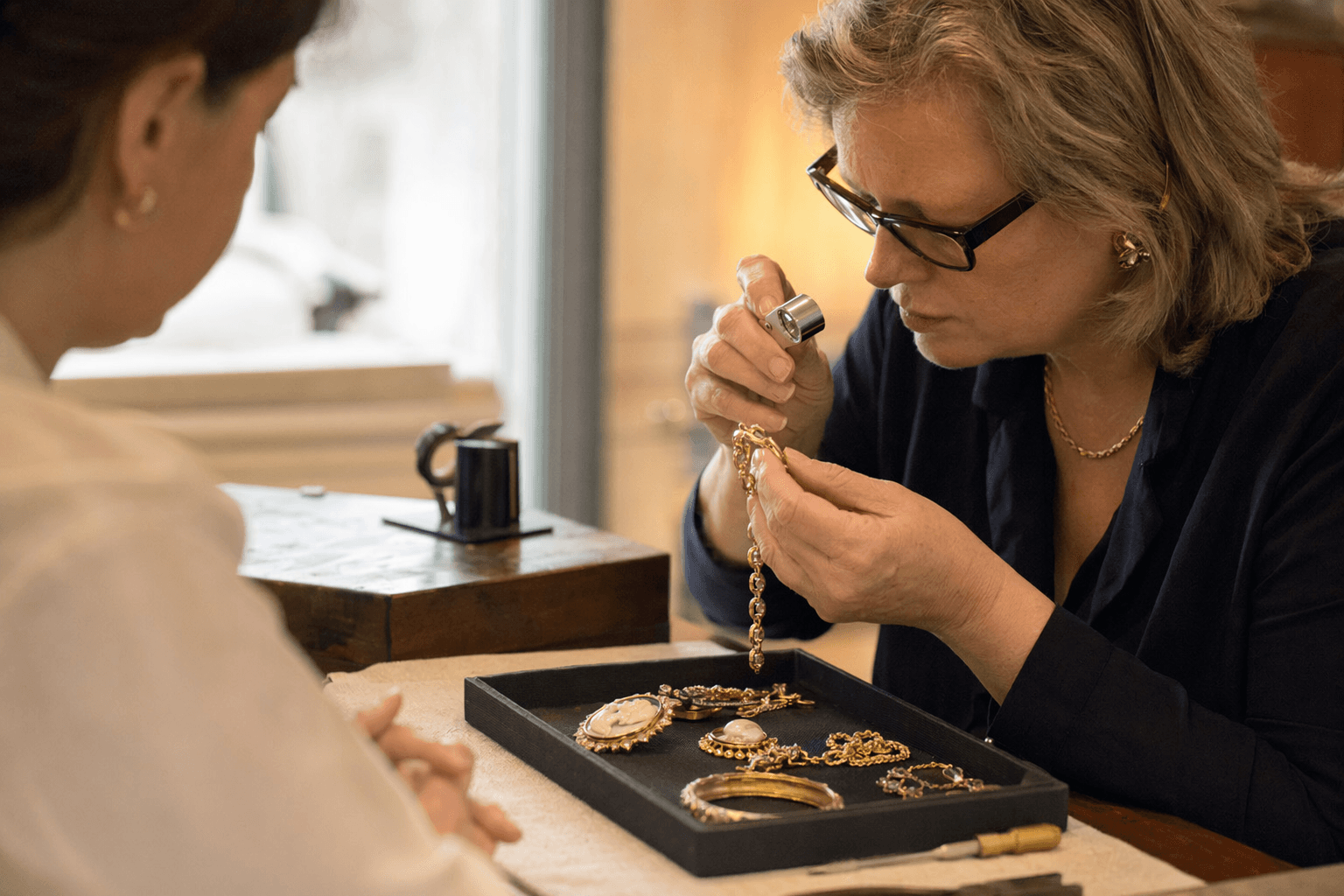
A solid jewelry appraisal is built from close observation, not broad estimates. Gemological documentation is a useful benchmark here: GIA jewelry reports include metal testing, item weight, markings, a photo of the jewelry, and stone analysis where the mounting permits. That level of detail shows why a qualified appraiser should be looking at the piece, not just reading a description.
- Metal type and testing, especially if the piece looks older than it is
- Item weight, which can help distinguish light construction from substantial fabrication
- Marks and hallmarks, including maker’s marks, country marks, and purity marks
- Stone identification, cut, and any visible treatment or replacement work
- Settings, clasps, hinges, and repairs that affect originality and wearability
In practice, the inspection should account for:
This is where vintage jewelry becomes readable. A late-19th-century clasp may tell a different story than a modern safety catch. A hand-finished gallery and old-cut stones can point to an earlier period than a mass-produced mount. Even when a piece is not signed, its construction can still place it accurately within a historical range.
Signed jewelry can change the story
Maker signatures are not the only sign of quality, but they can transform how a piece is interpreted. Christie’s notes that jewelry makers began signing their work during the Arts and Crafts and Art Nouveau periods, from about 1860 onward. That means an intact signature on an early piece can be a significant clue, not a decorative extra.
A specialist should know where such marks tend to hide. Inside a ring shank, on the back of a brooch, near a clasp, or along an edge of a pendant are common places for stamps and signatures. If those marks are worn, partial, or obscured by repair, the appraiser should say so and explain what can still be concluded.
Questions worth asking before you book
The best appointments begin with practical questions, not a polished sales pitch. Ask how the appraiser handles antique and vintage jewelry specifically, whether they have GIA and USPAP training, and what kind of value they will provide for your purpose. If the answer sounds generic, the report probably will too.
- Whether the appraiser specializes in antique, vintage, signed, or period jewelry
- Whether the report will suit insurance, estate settlement, donation, or resale
- What documentation they want you to bring
- Whether they will photograph the piece and note marks, metal, weight, and stone details
- How they handle provenance, prior repairs, and later modifications
A useful conversation usually covers:
You are looking for someone who understands that a brooch with an original clasp is not the same as one converted to a pendant, or that a ring with a replaced center stone may have a different market story than the setting alone suggests.
Watch for the red flags of a generic valuation
The biggest warning sign is speed without scrutiny. If the appraiser barely looks at the clasp, ignores the underside of the setting, or does not ask about provenance, they may be giving you a broad personal-property estimate rather than a true antique-jewelry appraisal. That can be costly if you need the report for tax, insurance, or estate purposes.
- The appraiser will not explain the intended use of the value
- There is no mention of hallmarks, photos, metal testing, or stone analysis
- Vintage period, maker, and construction details are brushed aside
- The report sounds interchangeable with one for furniture, watches, or general household goods
- No documentation is requested beyond a quick glance at the front of the piece
Be wary when:
A qualified appraisal should leave a trail you can follow. It should explain what the piece is, how it was examined, what marks were visible, what was tested, and why the assigned value fits the purpose you named.
A vintage jewel holds more than sparkle. In the right hands, it becomes legible, and that legibility is what protects its story, its value, and the decisions that follow it.
This article was produced by Prism’s automated news system from verified source data, official records, and press releases, then run through automated quality and moderation checks before publishing. The system is built and supervised by the people who set the standards it runs under. Read our full AI policy.
Did this article answer your question?