How to identify hairwork and mourning jewelry in vintage pieces
Hair jewelry is not automatically mourning jewelry. Look for inscriptions, enamel, symbols, and how the hair is built into the piece to tell a love token from a memorial.
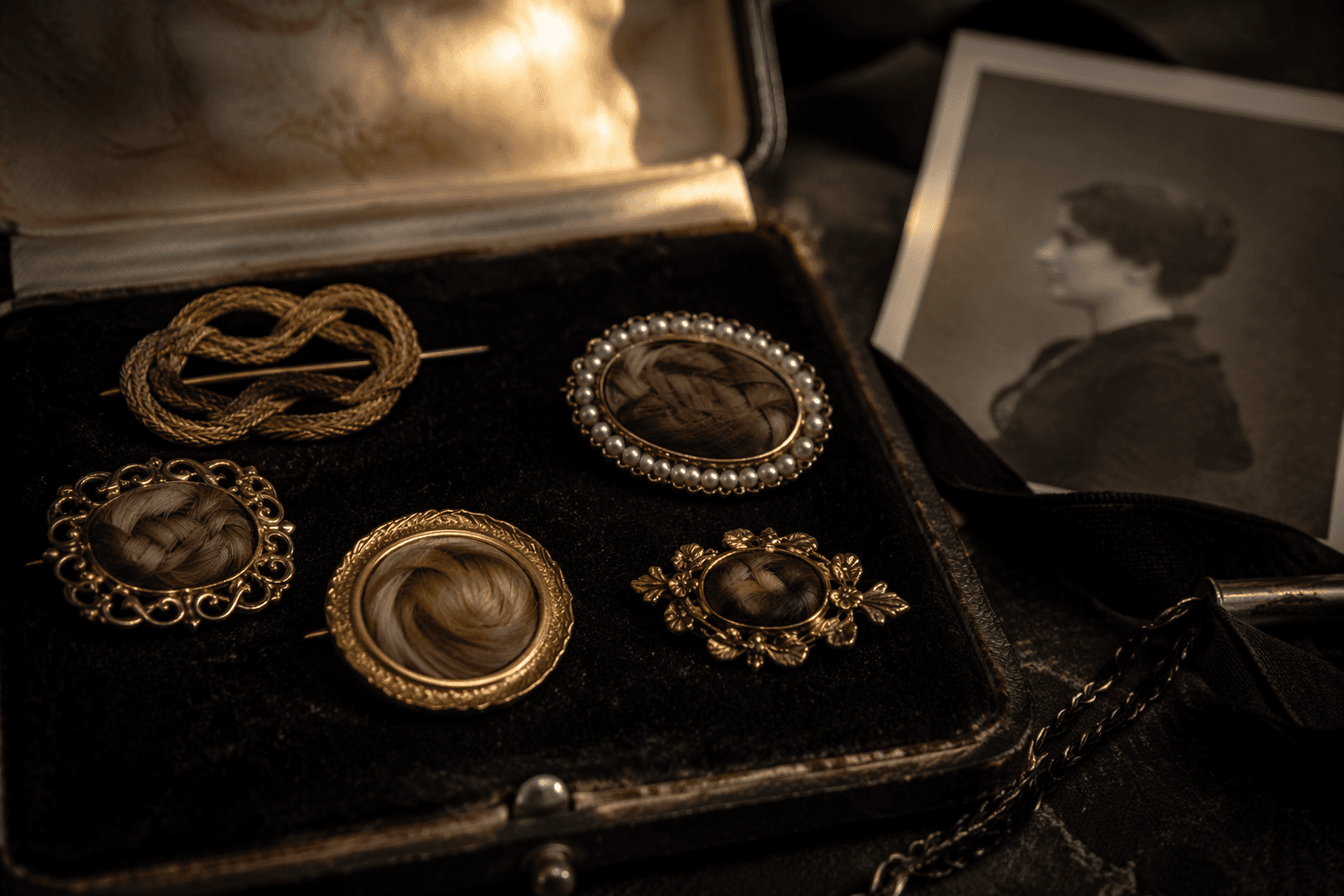
Hair jewelry can be deeply personal without being mournful, and that is the first myth to clear away. A lock of human hair might sit in a locket, ring, bracelet, or brooch as a love token, a family keepsake, or a memorial piece, so the presence of hair alone does not tell the whole story. The real clues are in the inscriptions, symbols, materials, silhouette, and construction, the details that reveal whether a piece was made to remember the dead or to keep someone beloved close.
The longer history behind mourning jewelry
Mourning jewelry reaches far beyond the Victorian period. The Victoria and Albert Museum traces it back to ancient Rome, and from the sixteenth century onward wills sometimes set aside money specifically so mourners could buy mourning rings. That long arc matters because it explains why these pieces were never just fashion accessories; they were objects tied to grief, inheritance, and ritual long before Queen Victoria made mourning culture especially visible in Britain.
By the Victorian era, death was present in public life in a way modern collectors often underestimate. Specialized hair artists turned locks of hair into memorial pieces, and printed catalogues offered designs while promising that the hair would not be mixed up or substituted. Those guarantees tell you something important: authenticity and identity were central to the appeal. In the same period, the Metropolitan Museum of Art notes that mourning jewelry was also commonly commissioned by early American colonists after the loss of friends or loved ones, so this is not a narrowly British story.
What hairwork looks like in hand
The easiest mistake is to assume every piece that contains hair is a mourning piece. In fact, hairwork could be sentimental, decorative, or commemorative, and the same object types appear in all three categories. Hair can be tucked under crystal, set into compartments at the back of rings, or woven into three-dimensional forms for earrings, charms, and watch chains by the mid-nineteenth century. That range of techniques is part of the field guide: the more deliberately the hair is arranged and protected, the more likely the piece was intended to be kept as a treasured object rather than worn casually.
Construction details matter. A mourning brooch dated 1868 in the Met’s collection holds a lock of plaited hair beneath crystal, a classic arrangement that protects the hair while keeping it visible. A mourning ring from 1733 includes a piece of human hair and black enamel lettering, which shows how text and material can work together to identify the purpose of the jewel. A V&A hair-work brooch dated circa 1842 provides another useful benchmark: by the early Victorian period, hair jewelry was already sophisticated enough to become an art form, not just an intimate keepsake.
Symbols that signal mourning
Symbolism is one of the clearest ways to separate memorial jewelry from love tokens. The Metropolitan Museum of Art points to engraved inscriptions as especially useful, because names, dates, initials, and memorial phrases usually lean toward mourning, while sweeter or more private messages can suggest a token of affection. When you are examining a piece, the engraving is often the first place to look.
The imagery can be equally revealing. Black or white enamel appears often in mourning jewelry, and the Victoria and Albert Museum notes that white enamel was commonly associated with children and unmarried adults. Urns, broken pillars, and mourning figures are also common motifs, all of them shorthand for loss, mortality, and remembrance. A piece with these symbols is much more likely to belong to the memorial tradition than to the category of romantic hairwork.
Materials and finishes that help with dating
Color and finish can help you place a piece in the right emotional register and time period. Black enamel is the strongest visual cue for mourning, especially when paired with a somber silhouette or memorial inscription. White enamel, by contrast, often points to mourning for a child or unmarried adult, a distinction that collectors sometimes miss when they assume all mourning jewelry must be black.
Look closely at the way the hair is protected. Crystal covers, glazed compartments, and back-of-ring settings all suggest that the hair was meant to be preserved intact, not simply used as a decorative flourish. That is where catalog descriptions and museum examples become useful: they show that the work was carefully made, not improvised. If the piece combines hair with a formal memorial design, it is likely closer to mourning jewelry than a casual sentimental souvenir.
How to tell a love token from a memorial piece
A practical examination begins with three questions. First, is there an inscription? If the piece names a person, gives a date, or uses memorial language, it is probably mourning jewelry. Second, are there symbols of death or remembrance, such as urns, broken pillars, or mourning figures? Third, how is the hair used? Hair tightly sealed under crystal or woven into a structured memorial form points more strongly to grief than to romance.
Love tokens may also contain hair, but they often feel more intimate than solemn. They can appear in lockets, rings, bracelets, or brooches without the black enamel, white enamel, or funerary imagery that anchors mourning jewelry. The difference is not always absolute, but the overall language of the object usually gives itself away. A piece built around remembrance will look ceremonial; a piece built around affection will usually look personal.
Dating clues collectors should not ignore
Hairwork stayed fashionable for centuries before fading, and Smithsonian Magazine places its decline around 1925. That long life means you will encounter examples from many eras, but the Victorian period remains the richest field for collectors. If a piece has the classic combination of hair, crystal, enamel, and memorial imagery, the nineteenth century is often the most likely place to start.
Specific examples can sharpen the eye. The Met’s 1733 mourning ring shows that hair memorials were already established well before Victoria. The circa 1842 V&A brooch shows the early Victorian refinement of the form. The 1868 mourning brooch at the Met demonstrates the fully developed language of the period, with plaited hair under crystal. And the ring containing Charlotte Brontë’s hair, reported in 2019, reminds collectors that these objects can carry literary and historical significance well beyond their material value.
Why provenance and condition matter
These pieces are valuable not only because they are old, but because they preserve identity. A named person, a documented maker, or a clear memorial purpose can lift a jewel from curiosity to artifact. That is why museum examples matter so much: they provide a framework for judging whether a piece is plausibly mourning jewelry, a sentimental hairwork object, or something in between.
Condition also changes what survives of the story. Hair sealed beneath crystal or preserved in a back compartment often remains legible when the rest of the jewel has worn down. In that sense, hair jewelry is fragile and durable at once: delicate enough to record a private loss, strong enough to carry that loss across centuries. For collectors and inheritors alike, the task is not just to admire the hair, but to read the whole object with care.
This article was produced by Prism’s automated news system from verified source data, official records, and press releases, then run through automated quality and moderation checks before publishing. The system is built and supervised by the people who set the standards it runs under. Read our full AI policy.
Did this article answer your question?