How to Identify Vintage Jewelry Hallmarks, Purity Stamps, and Provenance
Before you ask what a vintage jewel is worth, read its stamps, settings, and wear. Ten minutes of careful triage can separate solid evidence from expensive guesswork.
Start with the object, not the asking price
Flip the ring over. Turn the brooch to the back. Look inside the band, along the clasp, under the bail, and across every hidden surface where a maker left evidence. A vintage jewel is a small archive: its marks, metal, stones, repairs, and wear patterns can point to origin, purity, and whether the piece is ready for appraisal or needs more research first.
That first look should be slow and systematic. Hallmarks and purity stamps matter, but so do maker’s marks, stone settings, condition, and any trace of ownership history. The point is not to guess the price in the first minute. The point is to gather enough facts to know whether the piece is likely compliant, under-described, over-described, or simply not ready for a reliable value opinion.
Photograph before you clean, polish, or test
The best first step is documentation. Use natural light and take clear photos of the full front, full back, and every close-up stamp or engraving you can find. A ruler or coin in frame helps later when you compare size, wear, and proportions.
1. Photograph the piece as found, before any cleaning.
2. Capture every mark from several angles, especially inside bands and on clasps.
3. Photograph the stones, prongs, settings, hinges, and solder points.
4. Record visible damage, replacements, missing stones, and areas that look repaired.
This matters because tiny details disappear fast once a piece is polished or handled too much. A worn stamp, a replaced clasp, or an altered mounting can change how a jeweler reads the object. Good photos preserve the evidence even if the piece is later sold, appraised, or sent out for testing.
Read the metal marks in the right order
In the United Kingdom, hallmarking has legal force. The Hallmarking Act 1973 governs precious-metal hallmarking, and official guidance says that items sold as gold, silver, platinum, or palladium above certain minimum weights must carry a legally recognized hallmark. That hallmark shows the piece has been independently tested and verified against legal purity or fineness standards.
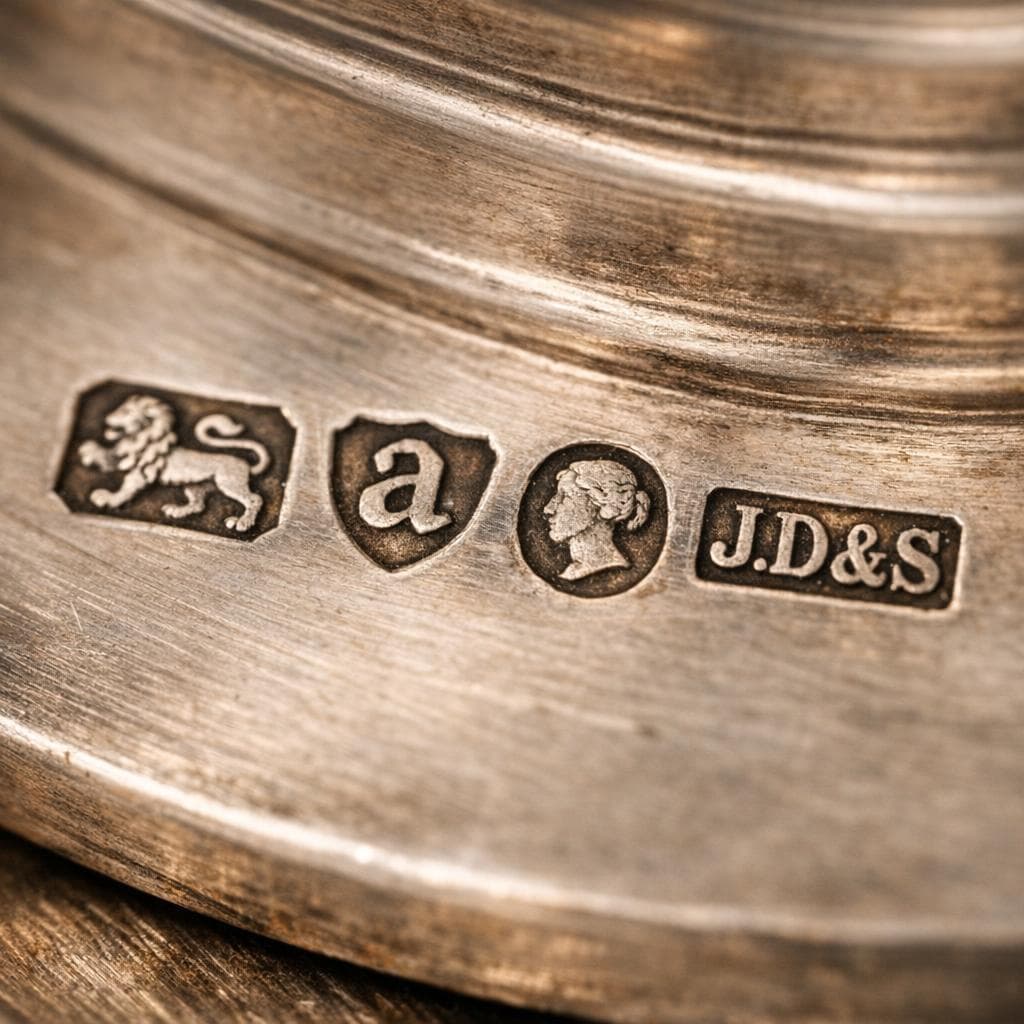
A full hallmark is more than a decorative stamp. Official guidance identifies its main components as the sponsor’s mark or maker’s mark, the assay office mark, and the fineness mark. Items below the legal weight exemptions may not need hallmarking, so the absence of a hallmark does not automatically mean a piece is false, but it does mean the story is incomplete.
How to think about purity stamps and karat language
Purity language is where many owners get misled. The Federal Trade Commission’s jewelry guidance exists to help consumers understand the words and symbols used for gemstones, pearls, and precious metals, because inaccurate purity claims can mislead buyers. In practical terms, that means a stamp should be read as evidence, not as a promise you never question.
Karat is one of the simplest places to start. Britannica defines a karat as one twenty-fourth of the whole, which means 24-karat gold is pure gold. Lower karats contain proportionally less gold, and that is not a flaw in itself. Precious metals are commonly alloyed with other metals to improve durability, so a 14-karat or 18-karat marking often reflects a working balance between purity and strength rather than a downgrade.
That is also why “gold” by itself is not enough. You want the exact fineness, the exact mark, and any accompanying symbols that show who submitted the piece for testing. If the wording is vague, abbreviated oddly, or looks inconsistent with the style and wear of the jewel, the piece deserves a closer look before anyone assigns value.
Maker’s marks tell you who made it, but not everything about what it is
A maker’s mark can be one of the most useful clues on a vintage jewel. It can connect a ring, bracelet, or brooch to a workshop, a region, or a known design era, especially when paired with the assay office mark and the fineness mark. But a maker’s mark is not a guarantee of value on its own, and a missing maker’s mark is not proof that a jewel has no history.
This is where misreadings happen. People often mistake decorative symbols, style numbers, or worn surface scratches for proof of quality. Others assume any small stamp means a piece is solid metal, when the real answer may depend on whether the item falls under a legal exemption, whether the mark has been altered, or whether the piece needs professional testing to confirm what the stamp only suggests.
Look at stones, settings, and condition as part of the evidence
A jewel’s stones tell their own story. Note the shape of each stone, whether the setting looks original, and whether prongs, bezels, or channels appear worn, bent, or replaced. A piece with a strong hallmark but damaged settings, missing stones, or mismatched repairs may still be desirable, but its condition will shape how a specialist values it.
Condition matters because it affects both authenticity and usefulness. A heavily polished band can soften a hallmark. A replaced clasp can interrupt the maker’s trail. A stone that looks newer than the mounting can point to repair, replacement, or later alteration, all of which are crucial before you decide whether the piece is ready for sale or should be researched further.
Provenance turns a jewel from an object into a documented possession
Keep every scrap of history that came with the piece. Original boxes, receipts, old insurance descriptions, family notes, and previous appraisal papers can all help establish provenance and support a later opinion of value. Even a single handwritten note from a previous owner can help a specialist place the jewel in time or distinguish an inherited piece from one that was altered later.
Provenance also protects you from false confidence. A story about a grandmother’s ring is meaningful, but it is not the same as a document trail. The strongest file combines the object itself with whatever paper history survives around it, and that combination is often what tells a jeweler whether a piece belongs in a formal appraisal, a sale conversation, or a deeper research queue.
When the evidence is thin, stop and test
If the marks conflict, the fineness looks doubtful, the stamp is worn beyond reading, or the stones and mounting seem inconsistent with the claimed period, do not rush to a value opinion. That is the point at which professional testing, a closer metal analysis, or a specialist appraisal becomes the sensible next step. The most useful first ten minutes are not about certainty; they are about collecting enough evidence to avoid being fooled by a stamp, a story, or a guess.
A well-read hallmark can confirm a jewel’s legal purity story. A weak one can expose missing context. Either way, the small marks hidden inside a vintage piece are often the difference between a decorative object and a properly understood artifact, and that is where a serious appraisal begins.
This article was produced by Prism’s automated news system from verified source data, official records, and press releases, then run through automated quality and moderation checks before publishing. The system is built and supervised by the people who set the standards it runs under. Read our full AI policy.
Did this article answer your question?