How to spot vintage jewelry fakes by marks, materials, provenance
A fake can copy a hallmark, but not the full life of a jewel. The safest vintage buy is one whose marks, construction, wear, and papers all tell the same story.
The jewel as a small archive
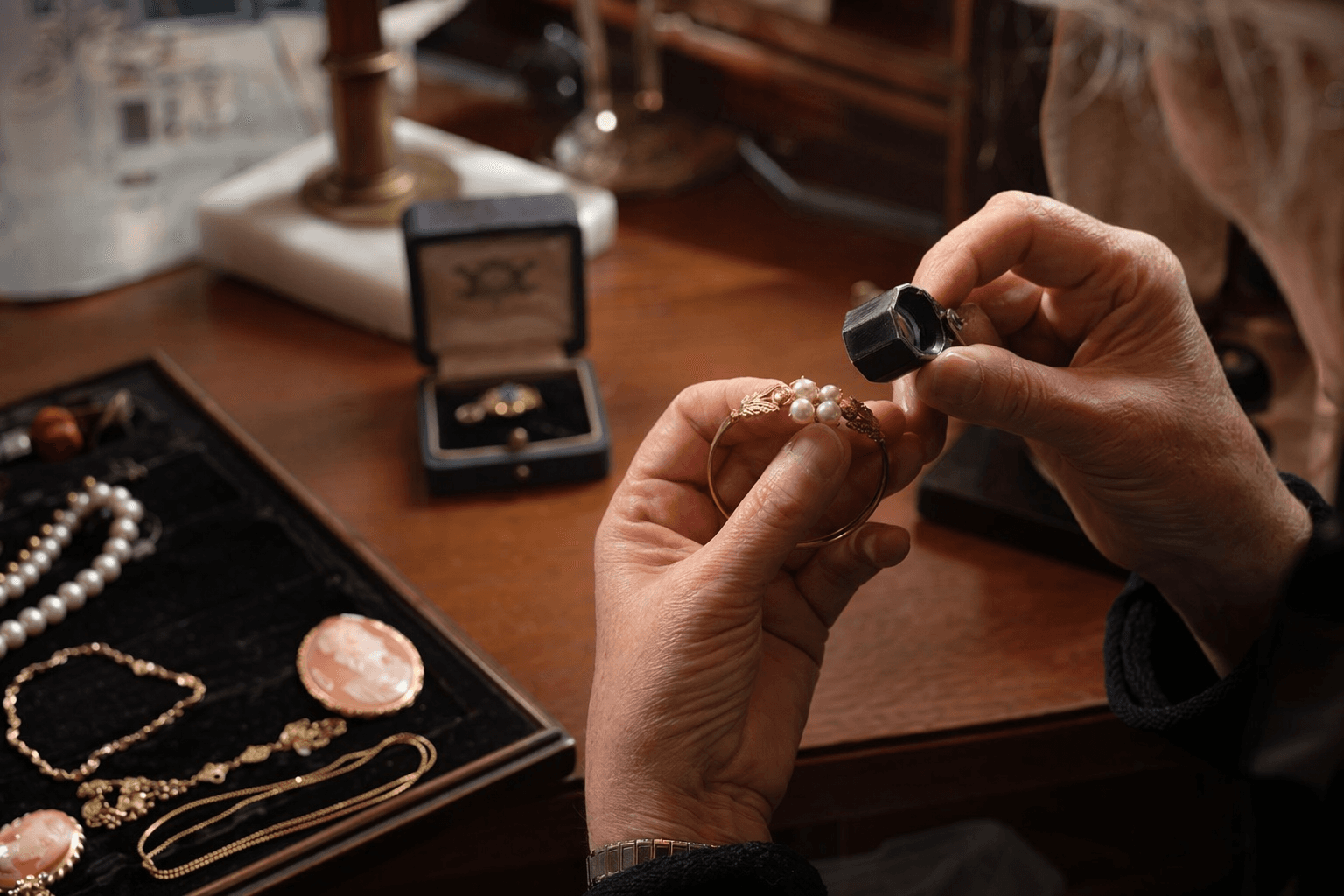
Vintage jewelry rarely gives itself away in a single glance. A ring, brooch, or bracelet is more like a small archive: its clues are tucked into the band, the clasp, the underside of a setting, and the soft abrasion of years of wear. The point of authentication is not to be dazzled by a stamp, but to test whether every part of the object agrees with every other part.
That is why the best buying strategy starts with method, not mystique. A real vintage piece should make sense as a whole, from metal content and workmanship to marks, provenance, and the way time has touched it. When any one of those elements looks out of step, the burden of proof rises fast.
Start with the marks, then distrust them a little
Hallmarks and maker’s marks are the first language to read, but they are not the whole conversation. In jewelry, these marks can identify the maker, confirm metal content, and sometimes suggest a place of origin or date of manufacture. The United States formalized part of that system with the National Gold and Silver Stamping Act of 1906, better known as the Jewelers’ Liability Act, yet later Federal Trade Commission guidance made clear that quality marks can still mislead if they suggest a metallic composition the item does not have.
That is the modern trap: a stamp can be true, partially true, or counterfeit. A mark that looks crisp and official is not enough if the surrounding object feels wrong, if the alloy does not test as claimed, or if the style of the setting does not match the purported era. Treat the mark as a clue, not a verdict.
A practical authentication sequence
Before you buy from a dealer, estate sale, or online listing, move through the piece in a fixed order.
1. Read the marks. Look for maker’s marks, purity stamps, serial numbers, cartouches, and country-of-origin indications.
Compare them against verified examples, not just casual internet images.
2. Study the construction. Examine how the piece is assembled.
The way a bezel is formed, how prongs are shaped, whether solder seams are neat or careless, and how the clasp is finished often reveals more than the front of the jewel.
3. Check wear patterns. Genuine age leaves uneven softness on edges, thinning where a ring rubs, and delicate smoothing on the underside of a pendant or clasp.
A piece that looks newly polished on top but untouched in places that should show handling can be a warning.
4. Test the materials. If the seller is confident, the metal should stand up to verification.
A stamp that says gold or silver means little if the composition does not match.
5. Ask for provenance. Request receipts, old appraisals, family records, estate paperwork, or prior auction records.
The best stories are not sentimental, they are documented.
6. Compare side by side. Place the object next to authenticated examples of the same maker, period, or model.
Counterfeits often get one detail right and another wrong, especially in proportions, font, fastening systems, or stone settings.
Construction tells the truth under pressure
The body of the jewel often exposes what the mark tries to hide. In vintage pieces, the method of construction should fit the claimed period and maker. A clasp that feels too modern, a mounting that looks machine-perfect in a way the rest of the piece does not, or a setting that uses materials inconsistent with the era can all point to a later copy or a heavily altered original.
This is especially important because modern replicas can imitate hallmarks, serial numbers, and even packaging with alarming precision. A counterfeit brooch may wear a convincing signature, yet still fail when you look at how the pin stem meets the back, how the stones are seated, or how the piece balances in the hand. Authenticity lives in those practical details, not only in the glamour of the face-up view.
Wear patterns are part of the evidence
Time leaves a different signature than a forgery does. Authentic vintage jewelry usually carries wear where human contact naturally occurs: the lower curve of a ring shank, the edge of a brooch catch, the back of a pendant, the corners of a bracelet clasp. When wear is selective in an unnatural way, or when the surfaces look artificially distressed to simulate age, caution is warranted.
Look, too, for consistency between wear and value. A stone that appears to have a century of handling but sits in a mounting that looks freshly manufactured should raise questions. The same is true for a chain that seems old in one section and suspiciously new in another. In vintage buying, age must read as cumulative, not staged.
Provenance is not decoration, it is evidence
Documentation matters because it anchors an object to a history beyond the seller’s description. Museum and collection standards commonly require a full identification and description of each object, along with its associations, provenance, condition, treatment, and present location. That framework is useful to private buyers because it shows what a serious paper trail should contain.
Provenance marks can include stamps, labels, and other markings that reveal prior ownership, and sometimes even confiscation or theft history. A boxed jewel with an old retailer’s label, a family inscription, or a recorded auction appearance may be far more persuasive than a polished sales pitch. When the paperwork and the object’s physical evidence agree, the piece becomes easier to trust and easier to insure, resell, or pass on.
Why old rules still matter now
The concern over misleading metal claims is not new. A 1977 bill in the U.S. House of Representatives sought to amend the 1906 stamping law to require better disclosure in representations of gold and silver jewelry, which shows how long this problem has shadowed the trade. The legal and consumer-protection stakes remain real because misrepresentation affects not only collector confidence, but also the value and marketability of precious-metal jewelry.
That is why careful authentication is more than an aesthetic exercise. A misread stamp can distort an appraisal, inflate a purchase price, and complicate resale. In the vintage market, the difference between “signed” and “sound” is often the difference between a jewel that is merely marked and one that can actually be defended.
The cleanest rule is still the simplest
A trustworthy vintage jewel should survive comparison on every front: marks, materials, construction, wear, and provenance. If one of those pillars fails, the object may still be attractive, but it is not yet authenticated. The finest pieces do not just look old; they can prove they are.
This article was produced by Prism’s automated news system from verified source data, official records, and press releases, then run through automated quality and moderation checks before publishing. The system is built and supervised by the people who set the standards it runs under. Read our full AI policy.
Did this article answer your question?