Isabel Delgado's Sofia ring turns lapis and gold into old-world elegance
Isabel Delgado’s Sofia ring pairs hand-cut lapis and 14k gold with Córdoba-inspired arches, giving a modern jewel the depth and authority of a vintage find.
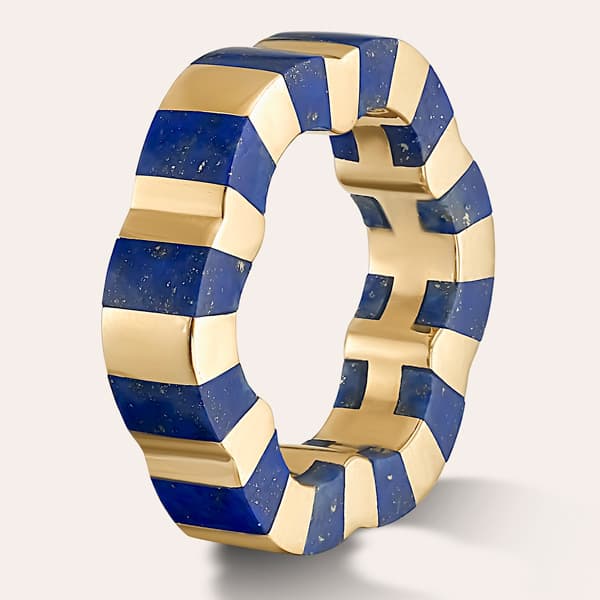
Isabel Delgado’s Sofia ring has the kind of visual authority that makes a case for jewelry as architecture in miniature. In Brittany Siminitz’s June 11, 2026 JCK pick, the design is built from hand-cut lapis lazuli and 14k gold, then shaped by references to the arches of southern Spain’s Mosque-Cathedral of Córdoba and the blue-and-white light of the Côte d’Azur. The result feels less like a trend piece than a jewel with lineage, one that understands how color, structure, and material can carry history without becoming costume.
Architecture translated into ornament
The strongest contemporary rings often borrow from buildings because architecture gives jewelry something collectors instantly recognize: proportion, rhythm, and a sense of permanence. The Sofia ring leans into that logic through repeated arch-like forms, a visual language tied to Córdoba’s famous mosque-cathedral and its layered cultural identity. That reference gives the ring more than surface beauty. It suggests movement, span, and repetition, the kind of structural elegance that vintage collectors often seek in jewels with Mediterranean or European roots.
The blue-and-white palette adds another layer of specificity. Lapis has long been prized for its saturated, almost nocturnal blue, and paired with warm gold it reads as both classical and graphic. The palette recalls the sun-struck contrast of the French Riviera, but the design never drifts into clichés of seaside luxury. Instead, it lands closer to the bold clarity of great mid-century and 1970s color jewelry, where one saturated stone could carry an entire composition.
Why lapis changes the conversation
What makes the Sofia ring especially compelling is the way lapis is treated not merely as a gemstone, but as a design material. That distinction matters. In traditional fine jewelry, lapis is often valued for its color and history, but here it does more than sparkle or decorate, it helps define the architecture of the piece. Hand-cut lapis gives the ring a slightly more tactile, artisanal presence than machine-perfect calibration would allow, which deepens its appeal to anyone who values evidence of the maker’s hand.
That material-led approach is especially persuasive in a market where gold itself has become conspicuously expensive. When a designer chooses lapis and 14k gold, the message is not just about visual richness. It is about making the most of strong materials without relying on excessive weight or gem size to create impact. The ring feels considered rather than inflated, which is exactly the kind of restraint that often distinguishes enduring jewelry from merely expensive jewelry.
A ring designed for real wear
JCK described the Sofia ring as versatile enough to wear alone or stacked, and that flexibility is part of its modern appeal. Vintage collectors understand that some rings are made to command the hand by themselves, while others work best as part of a layered story. The Sofia ring seems to straddle both worlds, with enough presence to stand alone and enough architectural clarity to hold its own beside other bands.
That versatility also reflects a broader shift in fine jewelry toward pieces that can live in a wardrobe, not just in a vault. Delgado’s work has a startup-informed practicality beneath the romance, and that matters in a category where ornament must now justify itself across occasions. A ring with strong lines, durable materials, and a clear visual identity can move from daytime wear to evening polish without losing its sense of purpose.
Delgado’s business instinct is part of the design language
Delgado’s jewelry reads as personal, but it is also disciplined. In her February 25, 2026 JCK profile, she described carrying forward a lesson from college: businesses must adapt or become obsolete. That idea helps explain why the Sofia ring feels so tuned to the present moment. It is rooted in old-world references, yet it is built with the adaptability that contemporary luxury demands.
This is where Delgado separates herself from designers who mine historical styles as surface decoration. Her rings are not trying to reproduce the past. They are translating it into a language that can survive changing markets, changing tastes, and changing assumptions about value. For vintage-minded buyers, that is often the crucial difference between a jewel that looks nostalgic and one that feels legitimately collectible.
Why the market backdrop makes this ring resonate
The timing of the Sofia ring’s attention is no accident. The World Gold Council reported that global gold-jewelry demand in Q1 2026 fell 23 percent year over year to 299.7 tonnes, the lowest level since Q2 2020, even as spending on gold jewelry climbed 31 percent to a record US$47 billion. That split tells the story of the moment: buyers are purchasing less weight, but paying more for it, because gold prices remain elevated.
The same data showed total gold demand in Q1 2026 reached 1,231 tonnes, while value surged to a record US$193 billion. The Council also noted that gold supply rose 2 percent year over year in the quarter, but that higher supply did not ease the pressure felt by jewelry buyers. In the United States, jewelry demand volumes fell to a record low in Q1 2026, while value declined only slightly, a sign that affordability is shaping purchasing decisions as much as aesthetics.
That backdrop helps explain why independent fine jewelers have become more inventive. WWD reported in November 2025 that they were responding to gold’s new highs with more creativity in both design and business strategy, and that observation still feels apt. When metal is costly, design has to work harder. Pieces like the Sofia ring answer that challenge with color, structure, and a clear point of view rather than sheer heft.
Why vintage collectors will notice
Vintage collectors tend to respond to jewelry that feels culturally grounded, materially honest, and visually distinct. The Sofia ring checks all three boxes. Its Córdoba-inspired arches give it provenance in spirit, its hand-cut lapis gives it texture and depth, and its 14k gold setting anchors the design in a precious-metal tradition that still reads as substantial without appearing ostentatious.
There is also something satisfyingly old-fashioned about the ring’s confidence in color. The great jewelry decades, from the Mediterranean-inflected glamour of earlier European pieces to the bolder color stories of the 1970s, understood that richness does not need to shout. It needs structure, contrast, and a memorable silhouette. Delgado’s Sofia ring has all three, which is why it feels less like a seasonal novelty than a jewel that could earn a place in a serious collection.
This article was produced by Prism’s automated news system from verified source data, official records, and press releases, then run through automated quality and moderation checks before publishing. The system is built and supervised by the people who set the standards it runs under. Read our full AI policy.
Did this article answer your question?