M.S. Rau displays 507-carat diamond soccer ball for World Cup
M.S. Rau paired the World Cup with a 5.5-inch soccer ball in 18k white gold, set with 507.5 carats of black and white diamonds.
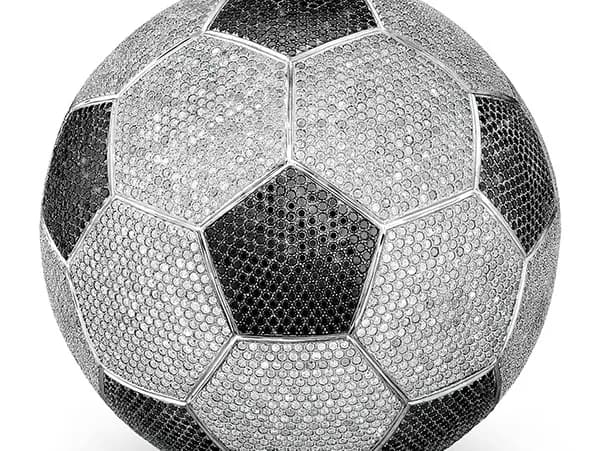
M.S. Rau turned a familiar sports emblem into a collector’s object with a 5.5-inch soccer ball crafted from more than 523 grams of 18k white gold and set with 507.5 carats of black and white natural diamonds. The New Orleans dealer priced the piece at $348,500 and placed it in the path of the 2026 FIFA World Cup, using the tournament’s global spotlight to elevate a gleaming curiosity into a serious showpiece.
The timing was intentional. The 2026 World Cup opened June 11 and runs through July 19, marking the 23rd edition of the tournament, the first with 48 teams, and the first staged across three host countries, Canada, Mexico and the United States. M.S. Rau’s ball, with its pentagonal pattern arranged like a traditional soccer ball, fits neatly into that moment of spectacle, but its appeal reaches beyond sports branding. It is a jewel object first, a novelty only in the sense that it transforms an instantly recognizable form into a densely worked luxury artifact.
That distinction matters in a house like M.S. Rau, which was founded in 1912 and describes itself as a 40,000-square-foot gallery in New Orleans’ French Quarter. Under third-generation owner Bill Rau, the business has built its reputation on objects that sit at the intersection of decorative art, antiques and high jewelry, where craftsmanship and conversation value often matter as much as function. In that context, a diamond soccer ball is less a merchandise play than a continuation of the old tradition of jeweled curiosities, pieces made to stop a room and reward close looking.

The setting choice reinforces that reading. White gold gives the sphere a cool, sculptural frame, while the black and white natural diamonds preserve the look of the familiar ball pattern instead of burying it under color or ornament. At 5.5 inches in diameter, it is compact enough to read as a luxury object and large enough to announce itself immediately, the kind of piece that belongs in a cabinet, not on a pitch. Bill Rau said he was thrilled to acquire it and described it as one of the more unique objects he had seen recently, a remark that matches M.S. Rau’s broader habit of pairing rarity with display.
For vintage-jewelry buyers, the question is not whether the piece is playful. It clearly is. The sharper question is whether it should be read as genuine craftsmanship with historical precedent or as high-end spectacle sharpened for attention. In this case, the answer may be both, and that tension is exactly what gives the object its force.
This article was produced by Prism’s automated news system from verified source data, official records, and press releases, then run through automated quality and moderation checks before publishing. The system is built and supervised by the people who set the standards it runs under. Read our full AI policy.
Did this article answer your question?