Pittsburgh's Vintage Festival Draws 50 Vendors, Rare Brooches and Estate Jewelry
Pittsburgh's 12th Vintage Pittsburgh Festival packed 50-plus vendors and rare brooch specialists across five floors of the Heinz History Center on April 4.
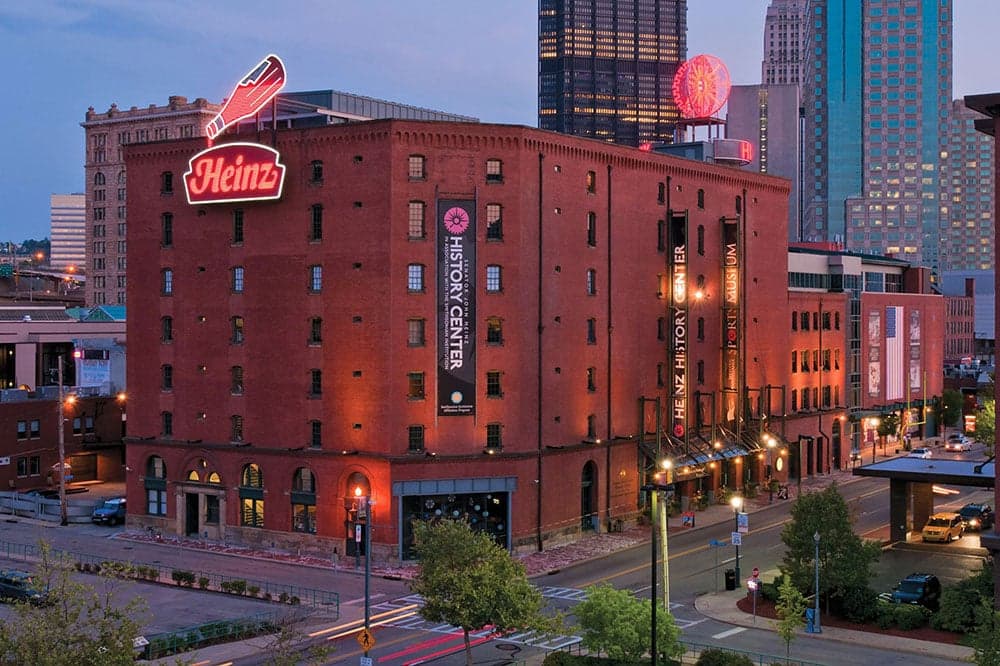
Pick up a brooch from a vendor's velvet tray at the Senator John Heinz History Center, and you're holding a small archive. The pin might be a 1950s rhinestone trembler, its hand-set stones catching the museum light in a way no modern casting can replicate, or it could be a signed Eisenberg sterling figural from the wartime years, worth several hundred dollars to the collector who recognizes it. The difficulty, at any vintage market, is knowing the difference before your wallet opens.
The Neighborhood Flea's 12th annual Vintage Pittsburgh Festival drew more than 50 vendors to the Strip District museum on Saturday, April 4, spreading across five of the building's six floors from 10 a.m. to 4 p.m. The event, part of a run stretching back to the Neighborhood Flea's founding in July 2014, offered something a scrolling Etsy page cannot: the ability to hold a piece, tip it toward the light, and interrogate the person who sourced it.
For jewelry hunters, the vendor roster made this a morning worth clearing the calendar for. Archaic Allegheny brought goods spanning the 1940s through the 1980s, the precise decades when American costume jewelry reached its commercial and artistic apex, with manufacturers like Trifari, Coro, and Lisner producing signed, hand-finished pieces that now command serious secondary-market prices. The Brooch Bro, a vendor dedicated exclusively to vintage and antique brooches, represented the kind of focused curation that separates a serious flea market from a general estate cleanout. Toysburgh rounded out the specialty vendor list with vintage toys and collectibles, though for collectors interested in wearables, the jewelry and accessory tables were the primary draw.
The single most useful tool to carry to any vintage market is a 10x jeweler's loupe. At that magnification, hallmarks, maker's marks, and surface condition that are invisible to the naked eye become legible. Common stamps to know: "14K" or "18K" for solid gold, "925" for sterling silver, "GF" for gold-filled, "1/20 12K GF" for the 12-karat gold-fill standard found on much mid-century American costume jewelry, and "Plat" or "Pt" for platinum. A small penlight used not overhead but raked at a low angle across a metal surface casts shadows into worn stamps and makes otherwise ghostly marks visible. Photograph anything ambiguous in macro mode before concluding it is illegible.
Construction details tell as much as hallmarks. Prong settings hand-applied in the 1950s and 1960s have a slight irregularity to them: no two prongs are perfectly identical. Modern reproductions are uniformly machine-finished. Bezel-set stones in mid-century pieces typically show fine tool marks under magnification. The clasp is a reliable dating signal: C-catches without a safety mechanism are generally pre-1940s, fold-over box clasps arrived in the 1950s, and a piece with a toggle clasp that a vendor dates to the 1960s warrants a closer look at the whole. Genuine faceted glass from the mid-20th century, including Czech rhinestones and early Swarovski crystal, shows a depth and refraction that most modern replacements cannot match; look for foil backing on older stones, which amplifies their brilliance from behind.
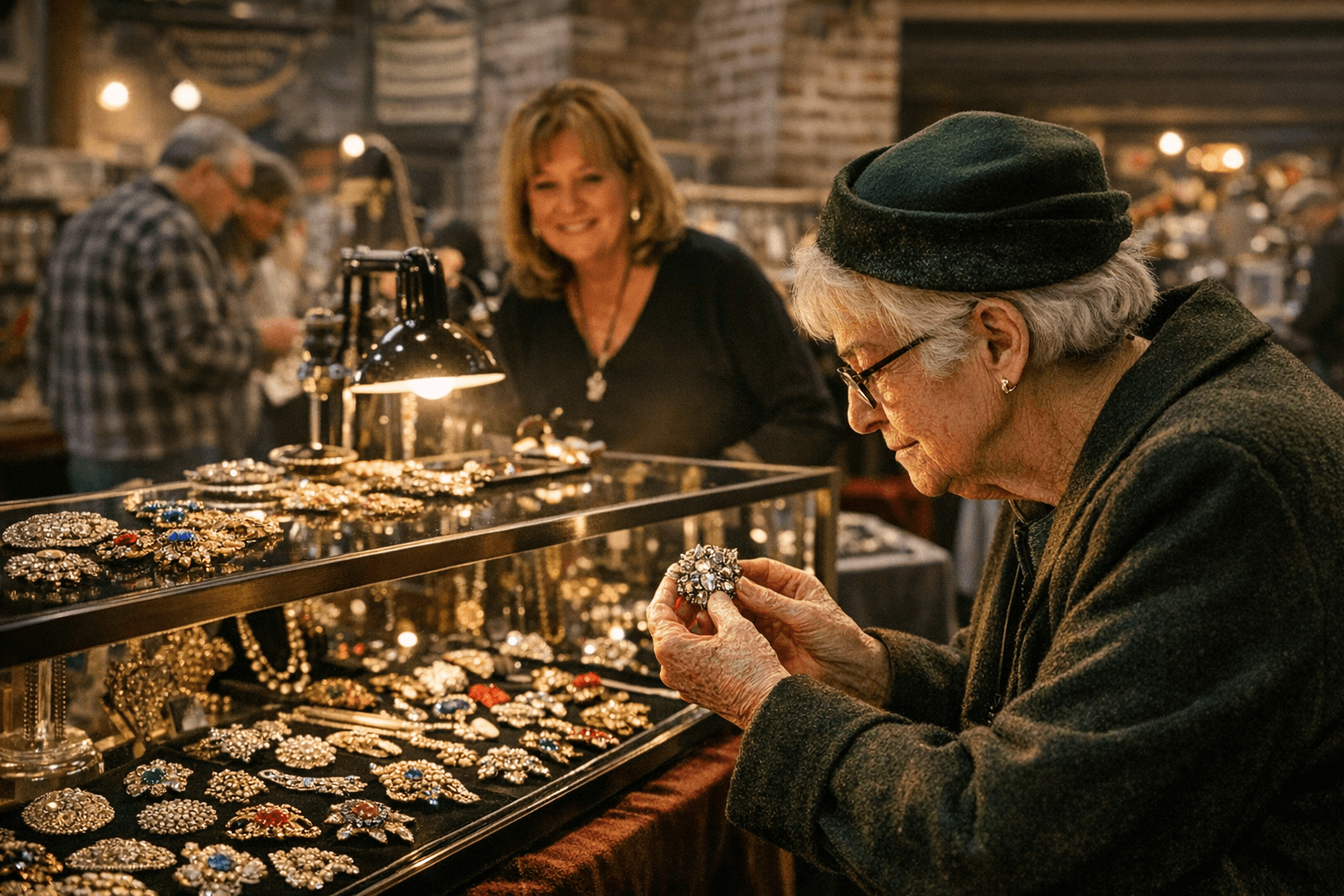
Before committing to any piece of real significance, there are seven questions worth directing at any vendor. Ask first whether the piece is signed and exactly where the mark appears, since the placement and font of a maker's signature is itself a dating tool. Ask what decade the piece dates from and how the vendor arrived at that conclusion: a specialist can explain the rationale; a generalist will approximate. Ask whether anything has been replaced or repaired, because resoldered findings, re-plated surfaces, and replaced stones all affect value and, in the case of signed pieces, originality. Ask where the piece came from, not because every vendor tracks estate provenance to the deed level, but because an unwillingness to discuss sourcing is information in itself. Ask whether the maker is recognized and whether the vendor knows the maker's history. A vendor like The Brooch Bro, whose entire stock centers on brooches, should be able to speak with some fluency to the difference between a Miriam Haskell glass-bead floral and a Joseff of Hollywood gold-washed figural. Ask about the return policy, since reputable vintage vendors typically offer a brief window for pieces that prove to have been misrepresented. And ask whether the price reflects comparable recent sales or the melt market, because understanding which benchmark a vendor is using reveals exactly how much room exists to negotiate.
At a 50-plus-vendor flea anchored in the 1940s through 1980s, certain jewelry categories reliably surface and reward attention. Signed American costume jewelry from roughly 1940 to 1975 represents the strongest intersection of accessibility and genuine value: a Trifari "Crown" piece or a Miriam Haskell multi-strand glass bead necklace can appear at prices far below recognized collector levels when a vendor is not a specialist in the category. Mid-century 10k and 14k yellow gold is consistently underpriced at general markets because dealers often price to melt rather than design, meaning a well-made 1960s gold charm bracelet might trade for $80 when a jewelry collector would price it at $250. Rhinestone and crystal brooches from the 1950s and 1960s, particularly the trembler and floral spray styles that defined the American cocktail-dress aesthetic, remain among the most approachable entry points for new collectors: all-original examples in excellent condition are still widely available and priced below $100 at most regional markets. Estate silver and gold rings travel well from Pennsylvania estate sales and often arrive in mixed lots that have not been individually researched, creating the kind of pricing gaps that reward buyers who do their homework. And Victorian mourning jewelry in jet, black glass, and hairwork turns up with genuine regularity in a region with as many intact 19th-century estates as western Pennsylvania.
The festival's setting inside the Heinz History Center added institutional context to the shopping. The museum's own galleries ran concurrently, including "Pittsburgh's Hidden History," which surfaces archival objects rarely seen from the museum's collections, and "My America: An Illustrated Experience," a contemporary installation framed around the country's approaching 250th anniversary. Admission to the festival was included with regular museum entry, priced at $20 for adults, $18 for seniors, and $11 for students; kids 17 and under were admitted free under the Kamin "Free for Kids" Initiative, a permanent policy funded by an $11.5 million endowment gift.
The Neighborhood Flea has built the Vintage Pittsburgh event into one of the more serious collecting occasions on the regional calendar. For jewelry buyers in particular, it offers something that online platforms have not managed to replicate: a direct line to the person who knows where a piece has been, and the chance to ask before the money changes hands.
This article was produced by Prism’s automated news system from verified source data, official records, and press releases, then run through automated quality and moderation checks before publishing. The system is built and supervised by the people who set the standards it runs under. Read our full AI policy.
Did this article answer your question?