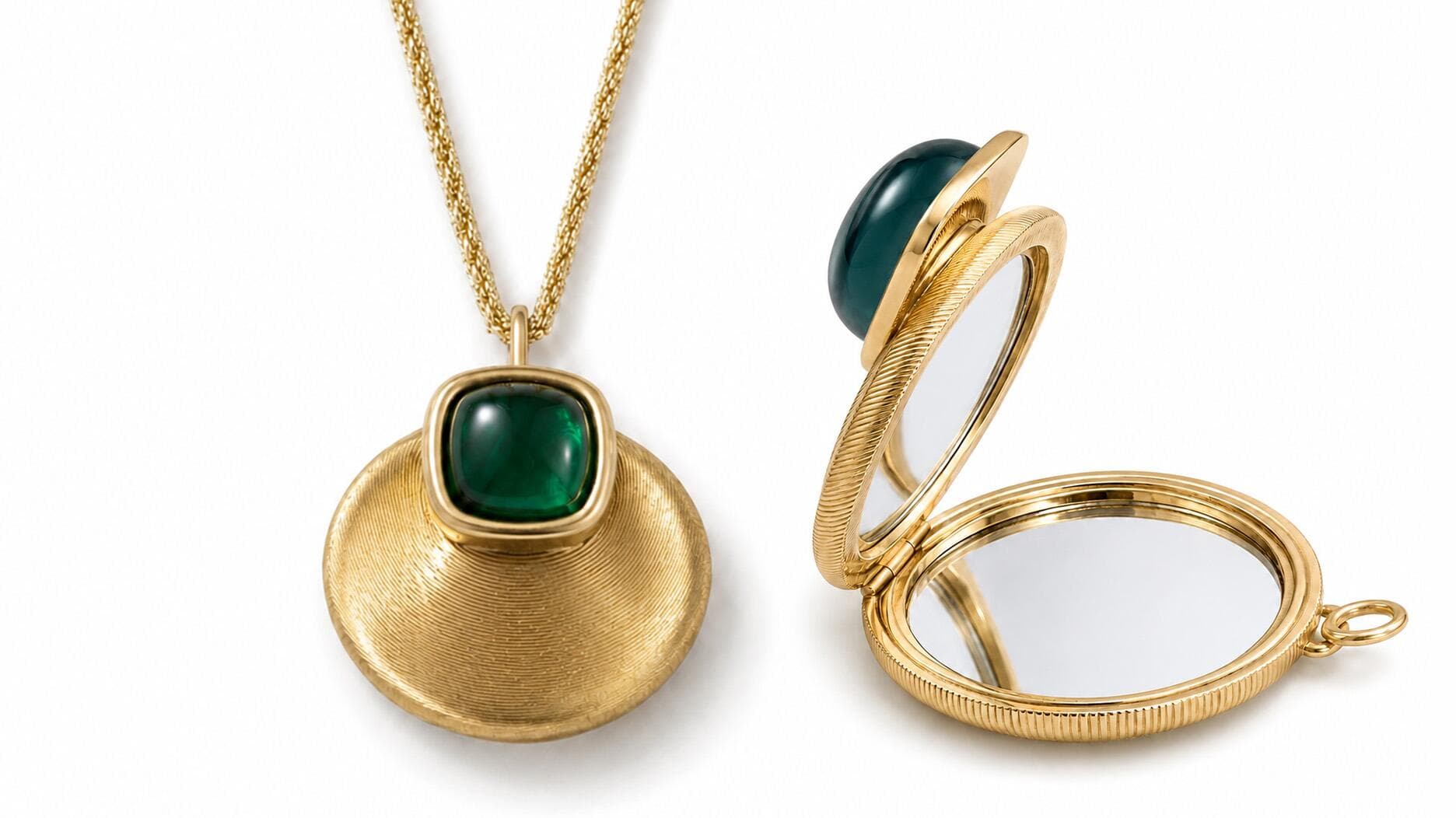
Romantic Antique Jewelry Makes a Quiet Comeback in Spring 2026
Pick up an estate ring and you're holding 18th-century candlelight. Taylor Swift's old mine-cut diamond sparked a quiet surge in demand for genuine romantic-era antiques this spring.

Pick up an inherited ring or a brooch pulled from an estate sale, and you are holding a small archive. The weight of buttery yellow gold, the slight asymmetry of a hand-cut stone, the raised relief of repoussé metalwork pressed by a craftsman who left no other record: these are not design choices. They are evidence. Spring 2026 is the season collectors have been quietly waiting for, a moment when that evidence suddenly feels urgent again.
The clearest signal came not from a runway but from an Instagram carousel. On August 26, 2025, Taylor Swift announced her engagement to Travis Kelce, and the ring that appeared in the third slide of that post stopped jewelers mid-sentence. Designed by Kindred Lubeck of Artifex Fine Jewelry, the ring centers an old mine-cut diamond, an elongated cushion shape with 58 large facets ground by hand in the 18th century for candlelight, not daylight. The stone sits in a yellow gold bezel setting, its band engraved by Lubeck herself. Estimated at between eight and ten carats and valued somewhere between $400,000 and $800,000, the ring was not designed to look antique. It was built around an antique stone, which is an entirely different proposition, and serious collectors noticed the difference immediately.
Industry observers at JCK described the immediate market response as the Taylor Swift effect, a surge of interest in vintage cuts and heirloom-quality construction that has pushed estate dealers and auction houses alike to re-examine their inventories. What Swift's ring made visible, Cynthia Findlay's March 2026 curatorial essay articulates precisely: Spring 2026 marks a quiet resurgence of romantic antique aesthetics in fine jewellery, and shoppers need a vocabulary to navigate it.
The Spring Palette: What to Look For
The material and design cues of "romantic antiquity" cluster around a few specific signatures. The first is the colour of the gold itself. Antique yellow gold, particularly pieces from the Georgian and Victorian periods, tends toward a richer, warmer hue than modern 18-karat alloys. Jewelers sometimes describe it as buttery, and the word is accurate: it has a slightly matte depth rather than the high mirror-polish of contemporary castings.
The second cue is the stone palette. Pastel-toned gems, rose-cut amethysts, pale aquamarines, blush-pink tourmalines, and softly included pearls, were the chromatic language of 19th-century jewellers who designed for gaslight and morning rooms, not LED display cases. These stones absorb rather than reflect light, and they tend to look richer in person than they do in photographs, which is itself a useful authentication signal.
The third cue is repoussé metalwork: the technique of hammering metal from the reverse to create raised, three-dimensional relief on the surface. Floral sprays, foliate scrolls, and naturalistic vine motifs achieved this way have a softness and slight irregularity that casting cannot replicate. Run your fingernail across the back of a repoussé brooch and you will feel the corresponding indentations where the goldsmith worked the metal outward.
Dating Look-Alikes vs. True Antique Pieces: A Checklist
The romantic aesthetic is fashionable enough in 2026 that reproductions are everywhere, from mass-market "Victorian-inspired" rings to well-intentioned vintage-style pieces from contemporary designers. Here is how to distinguish them from the real thing:
- Construction method: Pre-industrial pieces are fabricated, not cast. Look for solder joins at bezels and shanks rather than seamless uniformity. Under magnification, hand-engraving shows slight variation in line depth; machine engraving is perfectly even.
- Prong and setting style: Antique pieces often use collet settings (a band of metal encircling the stone) or old-fashioned claw prongs that are filed and shaped by hand. Modern reproductions use standardised prong heads stamped from sheet metal.
- The stone cut itself: An old mine-cut diamond has a high crown, small table, large culet (the flat facet at the base, visible as a circle when you look straight down through the stone), and hand-cut facets that are not perfectly geometric. Old European cuts, slightly later, have a more circular outline. Neither will look like a modern brilliant, which is mathematically precise.
- Maker's punches: Turn the piece over and look for small stamped marks, typically inside a ring shank, on the reverse of a brooch pin, or at the clasp of a bracelet. A British hallmark from the Victorian period will include a maker's initials, a purity mark, an assay office symbol (the anchor for Birmingham, the lion's head for London, the rose for Sheffield, the castle for Edinburgh), and a date letter. Date letters were first introduced at London's Goldsmith's Hall in 1478, making British pieces among the most precisely datable objects in the decorative arts. If you cannot read the marks, a loupe and a hallmark reference guide will take you further than most dealers expect.
- When to ask for an assay report: For any piece where the metal purity is in question or the marks are worn, request an independent assay. This is a non-destructive acid or X-ray fluorescence test that confirms metal content. Reputable dealers should not hesitate at the request.
- Patina as evidence: Genuine age leaves a warm, slightly uneven surface oxidation on gold that cannot be convincingly faked at scale. A piece that looks artificially antiqued in its recesses but bright everywhere else warrants scrutiny.
Patina, Condition, and the Conservation Question
One of the most common mistakes new collectors make is treating patina as a flaw to be polished away. It is not. The warm surface depth of an unpolished Victorian gold brooch or an Edwardian pearl cluster ring is part of the object's integrity. Aggressive polishing removes material, softens engraved detail, and erases the very evidence that confirms authenticity and age. Patina, assessed correctly, adds rather than detracts from value.
Condition assessment begins with structure, not surface. Check that prongs are intact and not thinned from previous polishing. Look for hairline cracks at solder joins, particularly in repoussé work where the metal has been stressed. Examine stones under magnification for chips at the girdle, which is the thin edge where the upper and lower halves of the stone meet, a vulnerable point in antique cuts. Pearl strands should be knotted between each pearl; restringing is inexpensive and worth doing before wear.
Professional restoration is appropriate when structural integrity is compromised: a broken hinge, a missing prong, a cracked shank. It is not appropriate as a cosmetic intervention. Any conservator worth their credentials will work to stabilise rather than transform.
Layering Antique with Modern for Everyday Wear
The most compelling wearers of antique jewelry in 2026 are not treating their pieces as museum objects. They are stacking a Georgian mourning ring against a plain modern band, pinning a Victorian floral brooch to a contemporary blazer, or wearing a single Edwardian paste earring as a stud alongside a modern gold hoop in the opposite ear. The guiding principle is that antique pieces read as anchors rather than costume: one or two genuine period pieces ground an otherwise contemporary look in something irreplaceable.
Yellow gold is the easiest through-line. Because modern designers have returned to warm gold tones in force, an antique piece no longer reads as jarring against contemporary metalwork. Pastel stones similarly bridge eras: a pale pink tourmaline from 1880 sits comfortably beside a modern hammered gold cuff.
Care and Storage
Antique jewelry was not made for the lifestyle of modern cosmetics, perfumes, and ultrasonic cleaners:
- Do store pieces individually in soft pouches or compartmented boxes lined with acid-free fabric. Pieces that touch scratch each other, and repoussé surfaces are particularly vulnerable.
- Do remove antique jewelry before applying perfume, hand cream, or hairspray. Alcohol-based products accelerate tarnish and can cloud certain stones, including opals, pearls, and foiled-back paste gems.
- Do clean gently with a soft brush and lukewarm water with a drop of mild soap, then pat dry immediately. Never submerge strands of pearls.
- Don't use ultrasonic cleaners on antique pieces. The vibration can loosen old stone settings and fracture fragile engraving.
- Don't store silver or gold pieces in humid environments or in sealed plastic bags, which trap moisture and accelerate tarnish.
- Don't attempt to re-size antique shanks without consulting a specialist. Old gold alloys behave differently from modern ones under heat, and an inexperienced jeweler can crack a shank irreparably.
The pieces that survive to become heirlooms are almost always the ones that were stored with care and worn with knowledge. An old mine-cut diamond held up to spring light carries centuries of accumulated craft in its 58 imperfect facets. Understanding what you are looking at is the beginning of knowing what it is worth.
Now let me format this properly as a full response:
Pick up an inherited ring or a brooch pulled from an estate sale, and you are holding a small archive. The weight of buttery yellow gold, the slight asymmetry of a hand-cut stone, the raised relief of repoussé metalwork pressed by a craftsman who left no other record: these are not design choices. They are evidence. Spring 2026 is the season collectors have been quietly waiting for, a moment when that evidence suddenly feels urgent again.
The clearest signal came not from a runway but from an Instagram carousel. On August 26, 2025, Taylor Swift announced her engagement to Travis Kelce, and the ring that appeared in the close-up slide of that post stopped jewelers mid-sentence. Designed by Kindred Lubeck of Artifex Fine Jewelry, the ring features an old mine-cut diamond set in a bespoke gold mount. Old mine brilliant cuts are often boxy shaped with rounded corners and soft curved edges, and Swift's diamond sits in a yellow gold bezel setting. Such diamonds usually have 58 large facets and the style dates to the 18th century. The ring showcases an elongated, cushion-shaped old mine-cut diamond estimated between 8 and 10 carats, its value pegged somewhere around $400,000 to $800,000.
The ring was not designed to look antique. It was built around an antique stone, which is an entirely different proposition, and serious collectors noticed immediately. Industry observers described the moment as the Taylor Swift effect, noting that the pop singer's vintage-style old mine-cut diamond engagement ring set the internet on fire. Cynthia Findlay's curatorial essay, published in March 2026, captures the broader shift: Spring 2026 marks a quiet resurgence of romantic antique aesthetics in fine jewellery, with the spring palette anchored by soft gold, pastel stones, patina, and floral motifs reimagined.
The Spring Palette: Material and Design Cues
The material signatures of romantic antiquity cluster around a few specific tells. The first is the colour of the gold itself. Antique yellow gold, particularly from Georgian and Victorian periods, tends toward a richer, warmer hue than modern 18-karat alloys: what dealers describe as buttery, meaning it carries a slightly matte depth rather than the high mirror-polish of contemporary castings.
The second cue is the stone palette. Pastel gemstones, in hues of blush pink, sky blue, soft lavender, and mint green, carry a gentleness that echoes blooming flowers and clear seasonal skies. Rose-cut amethysts, pale aquamarines, and softly included pearls were the chromatic language of 19th-century jewellers who designed for gaslight and morning rooms rather than LED display cases. These stones absorb rather than reflect light, and they tend to read richer in person than in photographs, which is itself a useful authentication signal.
The third cue is repoussé metalwork: the technique of hammering metal from the reverse to create raised, three-dimensional relief on the surface. Floral sprays, foliate scrolls, and naturalistic vine motifs achieved this way carry a softness and slight irregularity that casting cannot replicate. Run your fingernail across the back of a repoussé brooch and you will feel the corresponding indentations where the goldsmith worked the metal outward. Botanical and woven details are seeing a resurgence in 2026, offering a refined take on natural motifs, while romantic, vintage-inspired pieces continue to perform strongly with collectors who value visible craftsmanship.
Dating Look-Alikes vs. True Antique Pieces
The romantic aesthetic is fashionable enough that reproductions are everywhere, from mass-market "Victorian-inspired" rings to well-intentioned vintage-style pieces from contemporary designers. Here is how to distinguish them from genuine period work:
- Construction method: Pre-industrial pieces are fabricated, not cast. Look for solder joins at bezels and shanks rather than seamless uniformity. Under magnification, hand-engraving shows slight variation in line depth; machine engraving is perfectly even.
- Prong and setting style: Antique pieces frequently use collet settings (a band of metal encircling the stone) or old-fashioned claw prongs that are filed and shaped individually by hand.
- The stone cut itself: An old mine-cut diamond has a high crown, a small table, and a large culet (the flat facet at the base, visible as a dark circle when you look straight down through the stone). Old mine cuts are antique diamonds dating back to the time that diamonds were hand-cut and polished. Neither old mine nor old European cuts will look like a modern brilliant, which is mathematically precise and optimised for electric light.
- Maker's punches: Hallmarks are official stamps, usually placed by an assay office, that certify the metal content of a piece, whether gold, silver, platinum, or another precious metal. These marks can also include date letters and location stamps, providing key information about when and where the piece was made. Each UK assay office uses a unique symbol: the lion's head for London, the anchor for Birmingham, the rose for Sheffield, and the castle for Edinburgh. Date letters were first introduced in 1478 in London, making British pieces among the most precisely datable objects in the decorative arts.
- When to ask for an assay report: For any piece where the metal purity is in question or the marks are worn, request an independent assay. This is a non-destructive test that confirms metal content. A reputable dealer should not hesitate at the request.
- Patina as evidence: Genuine age leaves a warm, slightly uneven surface oxidation on gold that cannot be convincingly faked at scale. A piece that looks artificially antiqued in its recesses but unnaturally bright everywhere else warrants close scrutiny.
Patina, Condition, and the Conservation Question
One of the most common mistakes new collectors make is treating patina as a flaw to be polished away. It is not. The warm surface depth of an unpolished Victorian brooch or an Edwardian pearl cluster ring is part of the object's integrity. Aggressive polishing removes material, softens engraved detail, and erases the very evidence that confirms authenticity and age. Patina, assessed correctly, adds rather than detracts from value.
Condition assessment begins with structure, not surface. Check that prongs are intact and not thinned from repeated polishing. Look for hairline cracks at solder joins, particularly in repoussé work where the metal has been repeatedly stressed. Examine stones under magnification for chips at the girdle, the thin edge where the upper and lower halves of the stone meet, a point of vulnerability in antique cuts. Pearl strands should be knotted between each pearl; restringing is inexpensive and worth doing before regular wear.
Professional restoration is appropriate when structural integrity is compromised: a broken hinge, a missing prong, a cracked shank. It is not appropriate as a cosmetic intervention. Any conservator worth their credentials will work to stabilise rather than transform.
Layering Antique with Modern for Everyday Wear
The most compelling wearers of antique jewelry in 2026 are not treating their pieces as museum objects. Stacked bands, mixed metals, and statement details are all in play, but the key is that it feels personal: a meaningful antique piece combined with something modern, gold and silver together, texture against texture. A Georgian mourning ring stacked against a plain contemporary band, a Victorian floral brooch pinned to a modern blazer, a single Edwardian paste earring worn as a stud alongside a modern gold hoop in the opposite ear: antique pieces function as anchors rather than costume, grounding an otherwise contemporary look in something irreplaceable.
Yellow gold is the easiest through-line. It feels like just yesterday that yellow gold took a backseat, but in 2026 it is back and making a serious statement, with a definite shift toward warmer tones across both bridal and everyday fine jewelry. Because modern designers have returned to warm gold tones in force, an antique piece no longer reads as jarring against contemporary metalwork. Pastel stones bridge eras with equal ease: a pale pink tourmaline from 1880 sits comfortably beside a modern hammered gold cuff.
Care and Storage
Antique jewelry was not made for the lifestyle of modern cosmetics, perfumes, and ultrasonic cleaners:
- Do store pieces individually in soft pouches or compartmented boxes lined with acid-free fabric. Pieces that touch each other scratch, and repoussé surfaces are particularly vulnerable.
- Do remove antique jewelry before applying perfume, hand cream, or hairspray. Alcohol-based products accelerate tarnish and can cloud certain stones, including opals, pearls, and foiled-back paste gems.
- Do clean gently with a soft brush, lukewarm water, and a single drop of mild soap, then pat dry immediately. Never submerge pearl strands.
- Don't use ultrasonic cleaners on antique pieces. The vibration can loosen old stone settings and fracture fragile engraving work.
- Don't store pieces in humid environments or in sealed plastic bags, which trap moisture and accelerate tarnish.
- Don't attempt to re-size antique ring shanks without consulting a specialist. Old gold alloys behave differently from modern ones under heat, and an inexperienced jeweler can crack a shank irreparably.
The pieces that survive to become heirlooms are almost always the ones that were stored with care and worn with knowledge. An old mine-cut diamond held up to spring light carries centuries of accumulated craft in its 58 imperfect facets. The question for collectors in 2026 is not whether romantic antique jewelry is worth pursuing. It is whether you know enough to recognize the real thing when you hold it.
This article was produced by Prism’s automated news system from verified source data, official records, and press releases, then run through automated quality and moderation checks before publishing. The system is built and supervised by the people who set the standards it runs under. Read our full AI policy.
Did this article answer your question?