Sealed Jewelry Jars Offer Budget Route to Vintage Finds, With Caveats
Sealed "mystery jars" packed with vintage and costume jewelry offer a low-cost entry into estate collecting, but buyers need authentication skills to find real value.
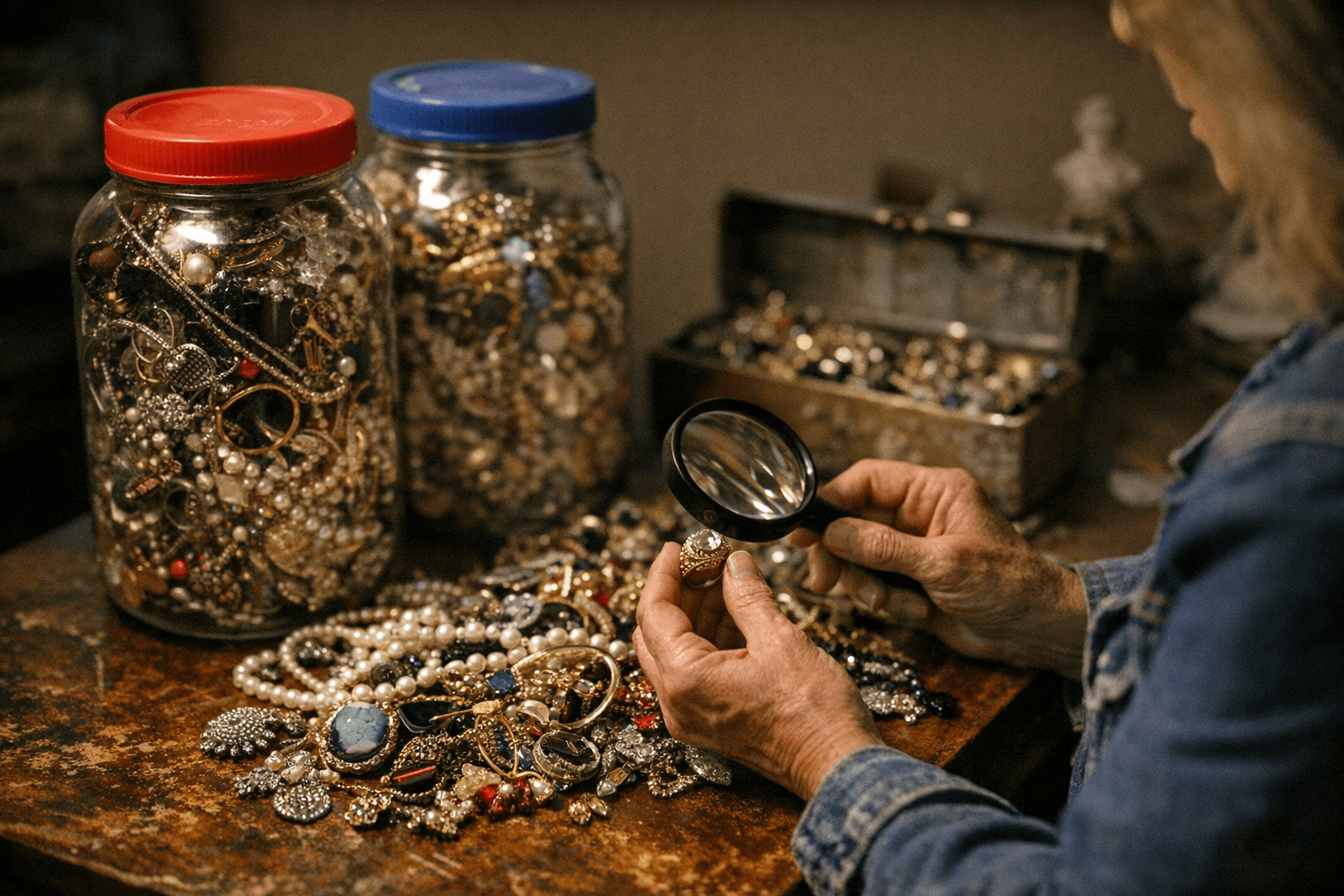
Pick up a sealed mason jar stuffed with tangled necklaces, mismatched earrings, and mystery brooches, and you are holding a small, chaotic archive of someone else's life. That is the appeal of the jewelry jar trend, a format that has migrated from thrift-store back rooms onto TikTok feeds and Etsy storefronts with remarkable speed. The seller known online as "Crazy Lamp Lady," an independent reseller with a devoted following, released a short video feature on April 5, 2026 explaining exactly why she decided to pack and sell jewelry this way, and what she has learned about what buyers actually find inside.
The format is deceptively simple: a glass jar, sealed and sold sight-unseen, filled with an assortment of second-hand and vintage pieces. But the implications for buyers who care about provenance, condition, and value are anything but simple.
What Goes Into a Jewelry Jar
The contents of a typical jar span a wide spectrum. Most are a blend of modern costume jewelry, things produced in volume with base metals and glass stones, and genuine vintage pieces that pre-date the 1980s. Necklaces, earrings, bracelets, and brooches all make regular appearances. Sellers source from estate sales, thrift stores, storage units, and personal collections, which means the mix inside any single jar reflects a genuinely random cross-section of decades.
Jars are typically sold for anywhere between $5 and $50, a price point deliberately kept low enough to feel like a gamble worth taking. Some sellers on Etsy and eBay have begun offering themed variations: a jar labelled "whimsical goth," for instance, signals a curated aesthetic even if the actual contents remain a surprise. At the higher end of the market, buyers are now requesting custom jars from sellers, providing style preferences and paying a premium for a more tailored mix. Chunky necklaces and statement bangles, in particular, generate outsized enthusiasm in unboxing videos, a detail that reflects the Gen Z appetite driving much of this trend.
The Thrill Behind the Trend
The format works because of the same psychology that powers lottery tickets and estate auctions: the possibility, however slim, of finding something extraordinary. It is not theoretical. In one widely shared TikTok, a buyer purchased a jar for $40 and discovered a scarab bracelet later identified as 14-karat gold, a piece worth roughly $14,000. In another, a jar bought from a Goodwill location contained a silver Tiffany and Co. bracelet. These finds are rare, but they are real, and they function as the emotional engine of the entire format.
The unboxing videos themselves have become a genre. Some buyers receive new jars every other week, releasing reveal videos that accumulate thousands of likes and comments. The participatory quality, the shared suspense of watching someone's hands work through a jar of tangled silver chains, has made jewelry jars one of the more durably engaging formats in resale content.
The Caveats Buyers Need to Hear
None of this means the jewelry jar is a reliable investment strategy, and the Crazy Lamp Lady video is candid about that. The probability of finding a high-value signed piece is low. The overwhelming majority of jars contain exactly what their price suggests: costume jewelry with sentimental rather than monetary worth.
Condition is the first reality check. Pieces sold in sealed jars have not been individually inspected for every buyer. Expect tarnish, broken clasps, missing stones, bent prongs, and the occasional piece so tangled it requires patience and fine-nose pliers to separate. Cleaning is almost always necessary before a piece is wearable or assessable. For buyers who have never cleaned vintage jewelry before, the approach matters: ultrasonic cleaners can damage pearls, opals, and foil-backed stones, while harsh chemicals will strip plating from gold-filled and gold-plated pieces. Gentle soap, warm water, and a soft toothbrush will handle most costume pieces safely.
The low probability of a signed find deserves particular emphasis. Pieces by known houses, Miriam Haskell, Trifari, Monet, Napier, or any European maker with a documented hallmark system, occasionally appear in mixed lots. But sellers who are sorting carefully will typically pull recognizable signed pieces and sell them individually, where they command far better returns. What reaches the jar is usually what was not immediately identifiable as high value.
Authentication Steps After Purchase
This is where the real work begins. If a piece inside a jar looks promising, a systematic approach to authentication will tell you whether the excitement is justified.
Start with magnification. A jeweler's loupe at 10x magnification, combined with a strong directional light source, will reveal impressions that are invisible to the naked eye. Hallmarks on gold and silver pieces are often struck in small, shallow stamps inside a ring band, on the back of a brooch, or on the clasp of a necklace. Common marks to look for include metal purity stamps: "925" for sterling silver, "750" for 18-karat gold, "585" for 14-karat gold, and "PT" or "PLAT" for platinum. The absence of a purity mark does not automatically disqualify a piece from being precious metal, particularly on older American jewelry, but it shifts the burden of proof.
Maker's marks are a separate category from purity hallmarks. A maker's mark identifies the jewelry house or manufacturing firm that created the piece. These marks are often composed of initials, symbols, or a combination of both. For costume jewelry from the 1920s through the 1980s, the Costume Jewelry Collectors International database, built around the research of Dotty Stringfield, provides alphabetized listings with mark photographs. For sterling silver specifically, there are dedicated online databases for identifying silver hallmarks from different national assay systems.
If a piece appears to be gold but carries no hallmark, a professional acid test or electronic metal tester can determine actual purity. Do not rely on visual assessment alone: gold-filled and gold-plated pieces are designed to pass casual inspection. A magnet test provides a quick preliminary screen, since genuine gold and silver are non-magnetic, but it is not conclusive because non-precious alloys can also be non-magnetic.
For pieces that appear to carry signatures from known houses, cross-reference against documented examples before drawing conclusions. Counterfeit and tribute pieces exist across virtually every desirable mid-century American and European brand. Missing expected accompanying hallmarks alongside a famous signature is a red flag worth taking seriously.
Practical Guidance for Sellers
The Crazy Lamp Lady video also addresses the seller side of the transaction, where decisions made during sorting and packing determine whether the format is ethical or exploitative. The core principle is honest disclosure.
Before sealing a jar, sellers should:
- Remove any pieces with sharp broken findings that could injure a buyer opening the jar
- Sort broadly so that a jar does not contain exclusively damaged or unusable pieces
- Photograph the exterior of the sealed jar and, where possible, a representative sample of the contents before sealing
- Disclose any known condition issues in the listing, including heavy tarnish, missing stones, or broken clasps
- Note if any pieces carry visible marks or stamps, even if the seller cannot identify them, since this is valuable information for a buyer
- Price according to what is actually inside, not according to the most optimistic possible interpretation of the contents
The temptation to overstate the possibility of high-value finds is real, given how powerfully the format is driven by discovery narratives. Sellers who lean too hard into that narrative without honest disclosure are, in effect, selling a fiction. The format works best as a transparent lottery, not a misleading promise.
Where the Trend Is Headed
The jewelry jar occupies an interesting position in the broader resale landscape. It democratizes access to vintage pieces by lowering the entry price and reducing the expertise required to make a purchase. Someone who would never bid at a Christie's jewelry auction or navigate a specialist vintage dealer will comfortably spend $25 on a jar. That accessibility is genuinely valuable for a new generation of collectors building their eye.
But accessibility without education creates a gap. The buyers who get the most from jewelry jars are the ones who treat each purchase as a starting point rather than an end point: who open the jar with a loupe already on the table, who know how to clean without causing damage, and who understand that the signed Miriam Haskell brooch hiding in the tangle is worth exactly nothing until it has been confirmed as genuine. The thrill of the find is real. The skill to recognize what you have found is what turns a $40 jar into something worth remembering.
This article was produced by Prism’s automated news system from verified source data, official records, and press releases, then run through automated quality and moderation checks before publishing. The system is built and supervised by the people who set the standards it runs under. Read our full AI policy.
Did this article answer your question?