Precious Metal Hallmarks Decoded: What Every Vintage Jewelry
A single stamped symbol on a vintage ring can confirm its maker, metal purity, and era. Here is how to decode every mark you find.
Pick up an inherited brooch or a ring pulled from an estate sale, and you are holding a small archive. The tiny stamps pressed into its shank or clasp are not decorative: they are a legal record, a maker's signature, and a purity certificate compressed into a space smaller than a grain of rice. Learning to read them is the difference between paying collector prices for a genuine Victorian piece and overpaying for a later reproduction.
The Numbers That Confirm Metal Purity
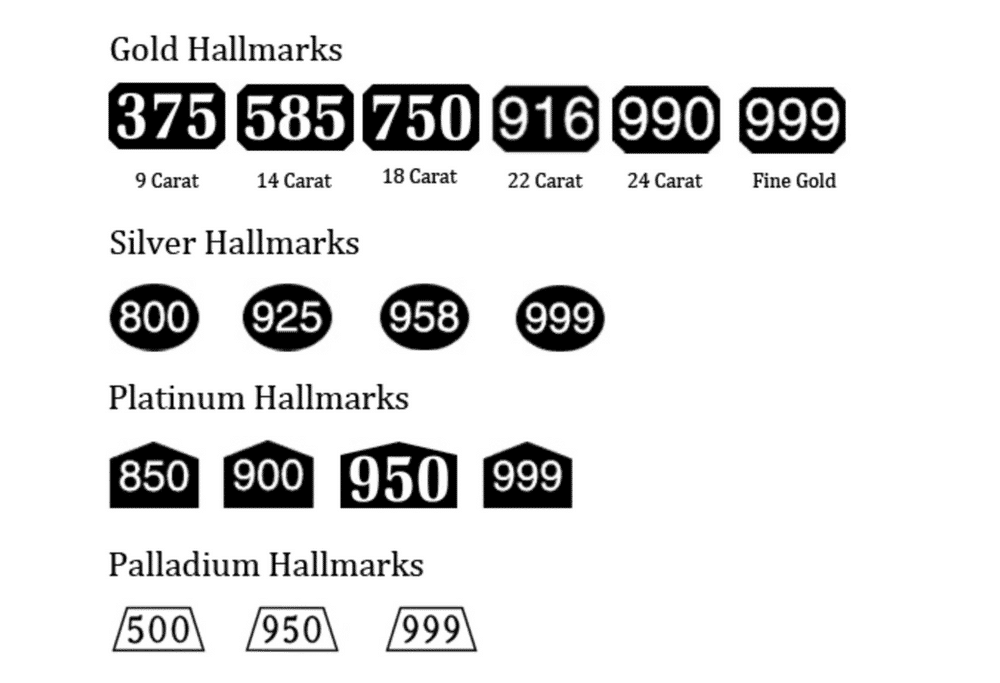
The most legible marks on most vintage jewelry are numeric, and they follow a straightforward logic: millesimal fineness, meaning parts per thousand of pure metal. A "375" hallmark indicates 37.5% pure gold, equivalent to 9-karat gold. Step up the scale and the 750 gold stamp means the item is 18-carat gold, comprising 75% pure gold and 25% alloy for strength, one of the most common stamps used in high-quality jewellery. Between those two, a "585" stamp indicates the jewelry contains 58.3% pure gold, or 14 karats. At the top of the gold purity ladder, 916 denotes 22-karat gold and 999 signals pure or fine gold, effectively 24 karats with no alloying metals added.
Silver follows the same convention. If you see "925" stamped near a clasp or inside a ring band, you are looking at sterling silver, 92.5% pure silver. Regional standards complicate things: some Continental European silver is marked 800, indicating 80% purity, a legal minimum in several countries that produced enormous quantities of jewelry and flatware in the late nineteenth and early twentieth centuries.
Reading the British System: Assay Offices and Date Letters
No country built a more elaborate hallmarking apparatus than Britain, and that detail is now one of the great gifts to the vintage jewelry collector. The four active UK assay offices each carry a distinct symbol: London uses a leopard's head, Birmingham an anchor, Sheffield a rose, and Edinburgh a castle. Each symbol tells you not only where the piece was tested, but also which date-letter charts you need to consult.
Each assay office used a distinct letter font and case, uppercase or lowercase, rotating through the alphabet over 25-year cycles. A lowercase "f" in Gothic font could mean 1843 in London, while a different font "f" might indicate 1903 in Birmingham. Because the letter "i," "j," or "l" is typically omitted to prevent confusion, most date-letter cycles run 25 years rather than 26. The shield shape surrounding the letter also changed with each cycle, giving you a second visual cue to narrow the date range.
The Hallmarking Act of 1973 brought the remaining four British assay offices into alignment, with the date letter changing on 1 January each year from 1975 onward. Before that, offices ran on their own calendars: Birmingham's year changed in July, and Edinburgh's ran from October through September of the following year. A piece hallmarked before 1975 therefore needs office-specific charts to be dated accurately.
London's assay office has been in operation since the 1300s, when a law of Edward I required all silver sold in England to be tested. Birmingham and Sheffield were both established by Act of Parliament in 1773. Edinburgh has regulated hallmarking since the fifteenth century. The depth of those records means a well-marked British piece can often be dated to within a single year.
French Marks: Pictorial, Precise, and Politically Motivated
French hallmarks are a visual language of their own, using animal profiles instead of alphanumeric codes. For 19th-century gold, the eagle's head is the dominant mark; introduced in 1838, it signifies 18-karat gold at 750/1000 purity. Find an eagle's head inside an oval on the back of a ring shank, and you are holding guaranteed 18-karat French gold.
Silver carries a different profile: French assay marks feature a Minerva's head for silver. Platinum gets a dog's head, guaranteeing a minimum fineness of 850 parts per thousand. The owl is a French import mark used on gold; when it was struck, a number on the owl's chest identified at which French assay office the item was tested, but it does not itself show the fineness of the gold. The owl has been used since 1893 and appears on pieces brought to a French assay office in finished condition, meaning a piece bearing the owl could have been manufactured anywhere.
The maker's mark in France is pressed into a lozenge-shaped cartouche and carries the maker's initials and often a small symbol. Even houses like Cartier and Van Cleef & Arpels follow this convention, so the same format that identifies an anonymous provincial goldsmith also appears on signed pieces by the grandes maisons.
Swiss Marks: Optional but Informative
Although hallmarking in the Swiss territories dates back to Geneva in the fifteenth century, there was no uniform system of hallmarking in Switzerland until 1881. Today, only precious metal watch cases must be hallmarked in Switzerland; the hallmarking of jewelry is optional. That means the absence of a Swiss mark on vintage jewelry is not suspicious. When present, Swiss marks indicate the fineness of the precious metal and the assay office location, using the same millesimal numeric system as the rest of Continental Europe.
Maker's Marks: The Initials in the Cartouche
In addition to date letters, most antique pieces carry a maker's mark, also called a sponsor's mark, usually in the form of initials inside a cartouche, a shield-like shape. These marks can be traced to individual goldsmiths through assay-office registers, many of which have been digitized or published. The cartouche shape itself carries information: pointed base shields were common in one period, rectangular ones in another, and the shift in style can help you bracket a date even before you consult a database.
To begin researching a maker's mark, note every character inside the cartouche, the shape of the cartouche itself, and the assay office symbol nearby. A British maker's mark combined with a London leopard's head and a date letter is a highly specific combination, often traceable to a named workshop.
Three Databases Worth Bookmarking
Three online resources stand out for practical identification work:
- The Antique Jewelry University hallmark library operates on a crowdsourced growth model, meaning its coverage expands as users contribute images. It is particularly strong on signed pieces and American marks.
- 925-1000.com is considered the primary destination for identifying sterling silver items, maker's marks, and hallmarks, with deep international coverage organized by country and assay office.
- National assay office websites, particularly the UK assay offices, publish official mark registers and date-letter charts that carry the authority of the certifying bodies themselves.
Cross-reference your findings between at least two sources. A mark that appears in only one database is worth treating with some caution until corroborated.
When the Mark Is Worn or Partial
Decades of wear, polishing, and repair can reduce a crisp hallmark to a ghost of its former self. Before concluding that a mark is illegible, photograph it under raking light: hold a small torch at a low angle to the metal surface and shoot in macro mode. The shadows cast by even shallow stamps become visible in a way they never are under direct overhead light. A jeweler's loupe at 10x magnification will resolve detail that is invisible to the naked eye.
If the mark remains ambiguous after photography, cross-reference what you can see with the style of the piece. Setting type, stone cuts, and construction techniques all carry their own chronological signatures. A collet-set old mine-cut diamond in a closed-back gold mounting points strongly toward the early nineteenth century regardless of what the hallmark shows.
When a hallmark is nearly gone, a jeweler can perform an acid test or XRF scan to confirm metal content. X-ray fluorescence (XRF) analysis is non-destructive: a small handheld device reads the elemental composition of the metal's surface and returns a precise alloy breakdown within seconds. The result will not tell you where the piece was made or when, but it will confirm whether the metal is what the surviving marks suggest, which is often the most pressing question when you are considering a significant purchase. Commission an XRF test through a certified appraiser or a reputable auction house's specialist department rather than through a general jeweler, as calibration and interpretation matter as much as the reading itself.
The hallmark is where a piece of jewelry stops being anonymous. A single small stamp, decoded with patience and the right tools, can return a name, a city, and a year to an object that has been silent for a century.
This article was produced by Prism’s automated news system from verified source data, official records, and press releases, then run through automated quality and moderation checks before publishing. The system is built and supervised by the people who set the standards it runs under. Read our full AI policy.
Did this article answer your question?