Rising Gold Prices Are Linking Jewelry Lovers to Chunky Vintage Chains
Gold nearing $5,000/oz is sending collectors straight to vintage chunky chains, where a maker's mark and original clasp can mean the difference between a bargain and a trophy piece.
Pick up a heavy curb-link chain from an estate sale, feel the substantial weight of it coil into your palm, and you are holding something that no contemporary jeweler can reproduce at anywhere close to the same price. Gold is nearing $5,000 per troy ounce in 2026, a climb of more than 25 percent since early 2025, and that single number is reshaping how collectors, stylists, and first-time buyers think about where to spend their money. The answer, increasingly, is the past.
Why the vintage market is absorbing the shock
When spot gold rises, not all gold jewelry rises equally. Mass-produced modern gold jewelry tends to track metal price closely, leaving little margin for design or long-term appreciation. Vintage and signed gold jewelry, by contrast, often decouples from spot pricing. This is the asymmetry that dealers have understood for decades and that a broader audience is now beginning to grasp.
The chunky chain, specifically, sits at the center of this moment. Heavy-link pieces, whether a wide Figaro, a Byzantine weave, or a thick curb, carry real gram weight, but they also carry the irreplaceable premium of hand-finished surfaces. Engraving, hammering, and millegrain work that cannot be economically replicated today are commonly found in vintage gold jewelry, and it is precisely that labor intensity that justifies pricing a period chain above its simple melt value. The question a sophisticated buyer should ask is not what gold is trading at today, but which objects could not be remade at today's costs.
Reading the marks: authentication fundamentals
Before any discussion of price, there is the matter of provenance. A vintage gold chain without legible marks is a different object from one that carries its history in metal. Hallmarks stamped into the metal confirm both the purity of the metal and, often, the identity of the maker. A mark reading "750," for example, indicates 18-karat gold (18 parts gold per 24, or 75 percent purity), while "585" denotes 14-karat. In the United States, karat weight is abbreviated as "k"; in Great Britain, it appears as "ct," which provides an immediate clue to the piece's likely origin.
Maker's marks work in tandem with these purity stamps. A signed chain from a recognized house, whether a Cartier oval-link or a Tiffany anchor, commands a premium that floats substantially above melt. Victorian, Edwardian, and Art Deco pieces with intact original design features carry distinct collector interest precisely because those markers of era and authorship survive. Dealers treating Rapaport's current editorial analysis of the market are paying close attention to provenance documentation alongside the stamps themselves: original purchase receipts, estate paperwork, and auction provenance all support a stronger asking price.
Clasps as a dating tool
The clasp is among the most underappreciated authentication details on a vintage chain. The design of closures can offer critical insight into the era of a piece, as different closure styles were popular during distinct periods. Identifying the type of clasp can help authenticate vintage jewelry and narrow its date of manufacture. An early 20th-century barrel clasp or a swivel trigger hook behaves and looks nothing like a modern box clasp or spring ring; the machining tolerances, the metal color, and the wear patterns all tell a story.
The fastening should also correspond with the weight of the piece: a large, clunky clasp on a small chain or a flimsy backing on a weighty piece indicates low-quality manufacturing and should raise questions about whether a chain has been altered or assembled from mismatched components. An original clasp that matches the chain's metal color, karat, and period styling is one of the clearest signals that a piece has not been substantially modified.
How repairs affect what you pay
No area creates more disagreement between buyers and sellers than the question of repaired links. Re-soldering is a fact of life for heavy chains: repeated daily wear stresses the links at their joins, and a competent repair, properly disclosed, need not devastate value. Cleaning, stone tightening, and minor soldering are generally considered safe interventions that stabilize a piece without meaningfully altering its character.
What does damage resale value is over-intervention. Over-restoration, such as modern stone replacement or aggressive refinishing, diminishes collector interest. Risks include metal weakening, loss of value, and disputes over authenticity. A chain that has been buffed to a mirror finish with modern polishing equipment loses the micro-surface texture that distinguishes hand-fabricated period work from contemporary production. Ask dealers directly how many links have been resoldered and where. Insist on that transparency before agreeing on a price.
What dealers are charging, and why
The current pricing landscape reflects a genuine tension between buyers who are drawn to vintage chains partly for value and dealers who are recalibrating their asking prices upward as gold climbs. Dealers with well-provenanced, signed pieces are holding firm; those with unsigned or heavily repaired chains are finding buyers more resistant. The principle is straightforward: a chain with a legible maker's mark, an original clasp, and minimal repair history carries a narrative that justifies a premium above melt. A chain without those elements is priced closer to its gold content, which, at today's spot prices, is itself not a trivial number.
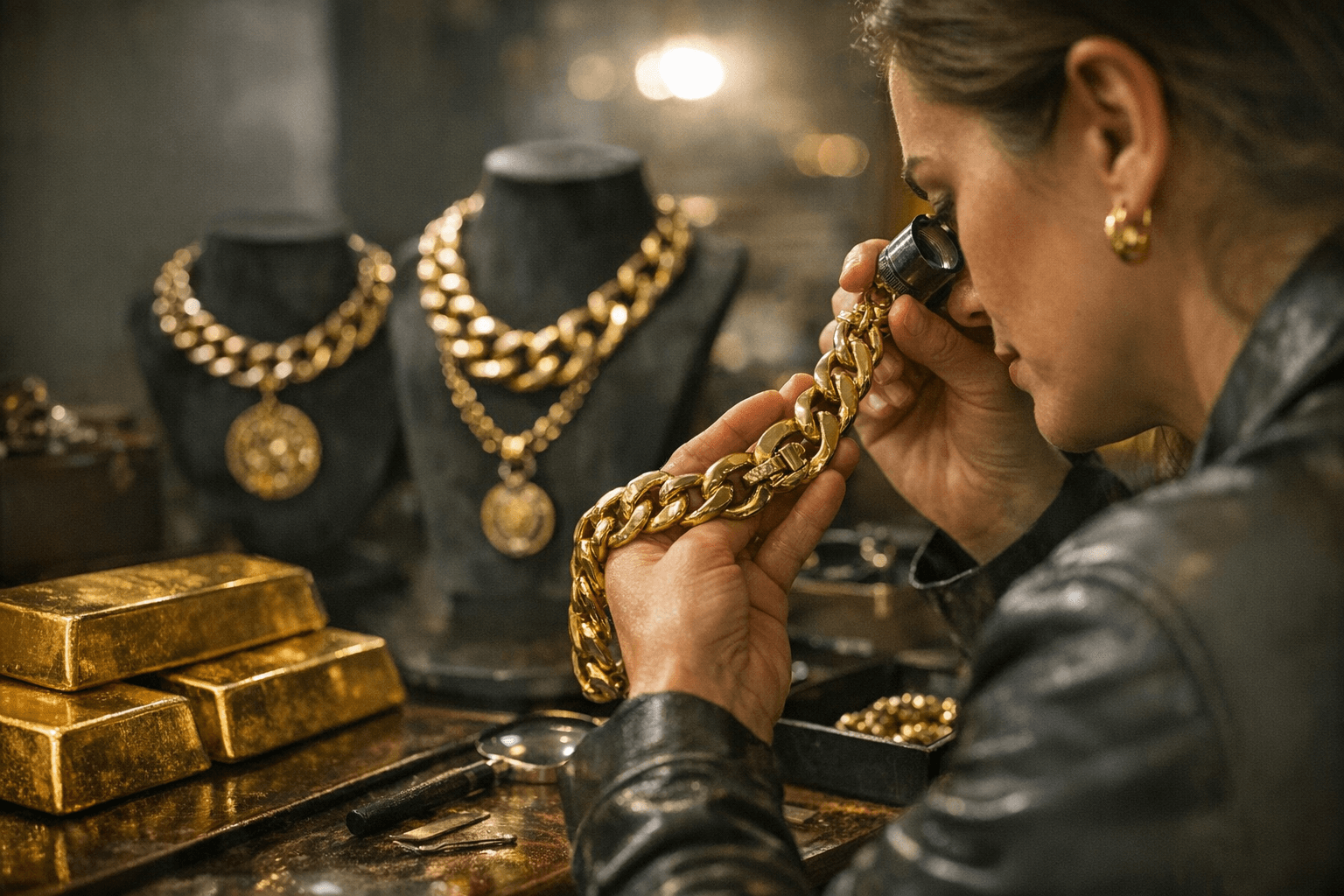
Condition grading for link chains follows a different logic than for set stones. Look at the surface of each link under a loupe: the type of clasps, chains, patina, and surface detail can all assist a buyer in determining both the monetary value and the historic period of a vintage piece. Bright polished wear on the outer faces of curb links is normal and expected; cracked links, stretched sections, or mismatched solder are red flags that warrant a price concession or a pass.
The sustainability argument, and why it holds
The demand surge for vintage chains is not purely economic. Vintage and secondhand pieces, along with professional upcycling, add historic and aesthetic value while reducing demand for new metal extraction, and that argument is resonating with a generation of buyers who scrutinize supply chains as carefully as they scrutinize carats. Roughly seven in ten global consumers report a willingness to pay more for products from companies with a positive environmental impact, and the pre-owned jewelry market is absorbing a significant share of that sentiment. The fine jewelry resale market is projected to reach $5.5 billion by 2033, driven by growing interest in sustainable luxury.
For chunky gold chains specifically, this framing is particularly persuasive. Buying a 1920s curb-link chain means no new mining, no new refining, and no new fabrication energy. The piece already exists, already carries its carbon cost, and already belongs to the material record of a specific moment in jewelry history. That is a meaningful argument, and in the current market it is being made by dealers and estate specialists who understand that sustainability is not a talking point but a genuine differentiator for a growing slice of their clientele.
A buyer's checklist for vintage link chains
Before committing to any chunky vintage chain, work through these points methodically:
- Locate the hallmark and maker's mark. Check the clasp, the last link adjacent to the clasp, and any connecting rings. Use a loupe, not just your eyes.
- Confirm the karat. "750" is 18K, "585" is 14K, "417" is 10K. A missing or illegible mark requires further testing before purchase.
- Date the clasp independently of the chain. The clasp should match the chain in metal color, apparent age, and wear pattern.
- Inspect every link for solder repairs. Ask the dealer to identify all repair points and factor their extent into your offer.
- Weigh the chain on a scale if possible. At spot gold approaching $5,000 per ounce, even a modest weight difference measurably affects melt value and, therefore, a rational floor price.
- Assess the surface. Original hand-finished texture, even with age wear, is preferable to an aggressively polished surface stripped of its period character.
The collision of record gold prices with a generation newly invested in pre-owned luxury has made the vintage chain market more competitive than it has been in years. The pieces worth pursuing are those whose marks, clasps, and surfaces tell a coherent story. At $5,000 gold, that story is also, quietly, a hedge.
This article was produced by Prism’s automated news system from verified source data, official records, and press releases, then run through automated quality and moderation checks before publishing. The system is built and supervised by the people who set the standards it runs under. Read our full AI policy.
Did this article answer your question?