Sotheby’s leads with rare Imperial Fabergé necklace and original box
An Imperial Fabergé necklace in its original box, traced to Empress Alexandra Feodorovna, will anchor Sotheby’s June 17 Artistic Luxury sale.

Sotheby’s is putting a lesson in connoisseurship at the center of its inaugural Artistic Luxury sale: a circa-1911 Imperial Fabergé diamond-and-aquamarine necklace offered with its original fitted box, a detail that can matter as much as the stones themselves. Cataloged as a work by Albert Holmström of St Petersburg, the necklace is estimated at $400,000 to $600,000 and listed as lot 5, with a current bid of $300,000 in the online catalog.
The necklace measures 15 1/4 inches, or 38.9 cm, and is set with eleven graduated round-cut Siberian aquamarines framed by rose-cut diamonds, alternating with openwork laurel motifs centered by eleven old-cut diamond brilliants. It is mounted in platinized settings with a gold clasp, and it carries the scratched inventory number 91288, the kind of internal mark that often helps authenticate an object’s life before it left the workshop.
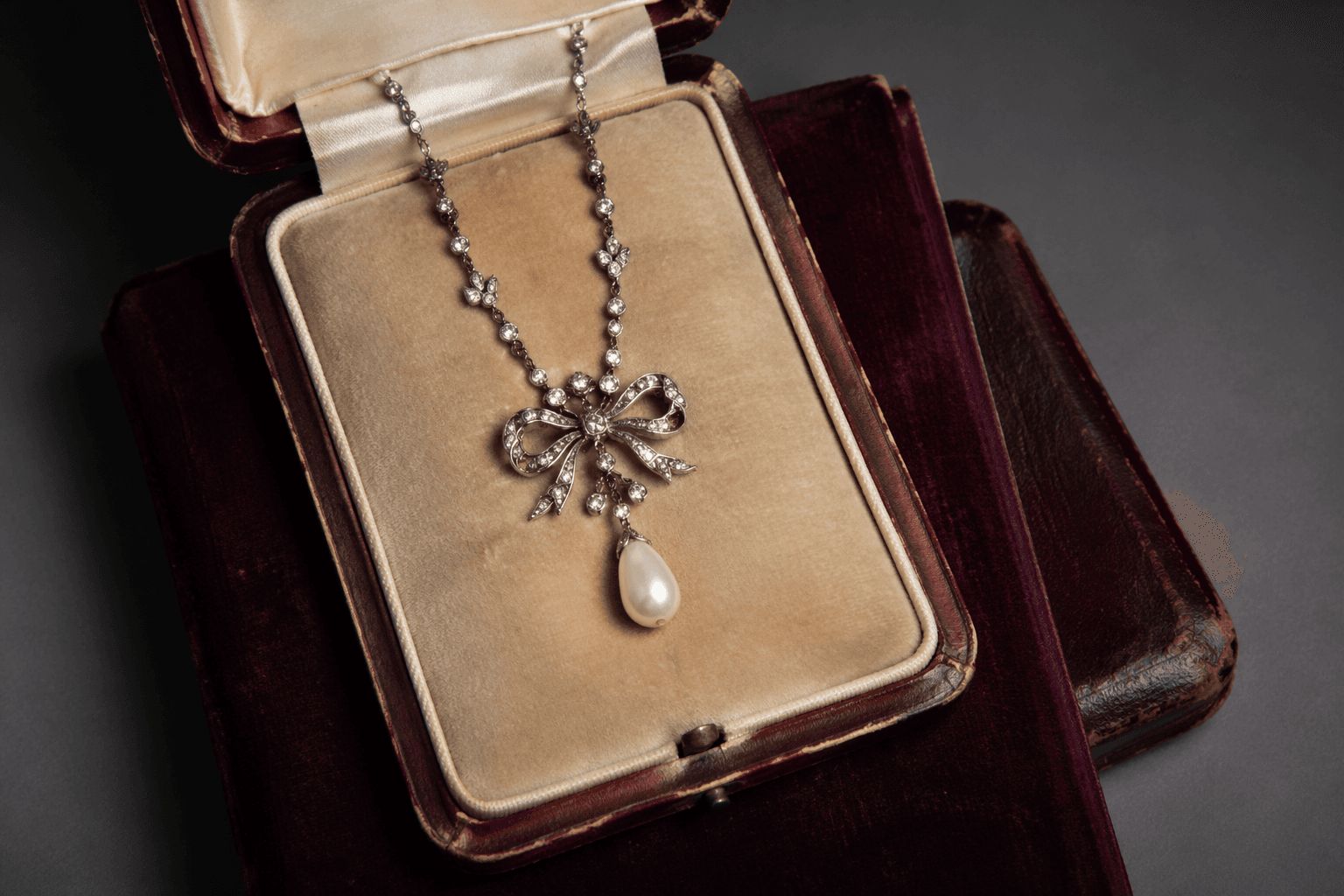
Its provenance is unusually direct. Sotheby’s says the Imperial Cabinet presented the necklace in May 1911 to Empress Alexandra Feodorovna as a suggested gift for the visit of German Crown Prince Wilhelm and Crown Princess Cecilie to St Petersburg. The jewel was not selected and was returned to the Imperial Cabinet, a paper trail that gives the piece the sort of documentary backbone collectors prize when evaluating elite antique jewelry.

That documentation is reinforced by the object’s survival in complete form. Sotheby’s notes that Fabergé necklaces of this caliber, especially with original fitted boxes, are exceedingly rare because the Russian Revolution led to the confiscation and breakup of much of the firm’s precious jewelry. For collectors, the box is not a bonus accessory. It is part of the evidence, binding object, presentation, and survival into a single historical record.
The sale also places the necklace in a broader Fabergé context. Sotheby’s cites a related diamond-and-aquamarine brooch with the scratched inventory number 909171, purchased by Dowager Empress Maria Feodorovna from Fabergé on January 3, 1911, which helps anchor the necklace within the imperial taste of the period. Forbes has described the necklace as among the largest known Fabergé necklaces, a scale that, combined with its imperial provenance and original box, helps explain why it stands apart even in a market accustomed to exceptional objects.
The June 17 sale in New York is Sotheby’s first Artistic Luxury auction, with 168 lots spanning Fabergé, gold boxes, silver and ceramics. That the necklace is joined by Russian imperial objects including dress trimmings associated with Catherine the Great and Empress Elizabeth only heightens the sense that this is not simply a luxury auction, but a study in how history, survival and workmanship translate into value.
This article was produced by Prism’s automated news system from verified source data, official records, and press releases, then run through automated quality and moderation checks before publishing. The system is built and supervised by the people who set the standards it runs under. Read our full AI policy.
Did this article answer your question?