Sotheby’s London sale spotlights Phyllis Frank’s Art Deco Cartier jewels
Phyllis Frank’s seven-piece Cartier group is the sharpest lesson in Art Deco geometry, with clues in the clips, clasps, and stone cuts that separate period work from revival pieces.

The sale at a glance
A hidden Cartier stamp inside a clasp can tell you more than a carat weight ever will. Sotheby’s London Fine Jewellery Sale, running from May 20 to June 3, 2026, closes its 225 lots independently at one-minute intervals, and the Frank Cartier group is the section collectors will want to read like a dossier, not a headline.
Why the Phyllis Frank group matters
Lot numbers 41 through 47 form a seven-piece Cartier collection given to Phyllis Frank, née Francatelli, by her New York financier husband, Jesse Frank, during the 1920s and 1930s. That dating matters because it places the jewels inside Cartier’s Art Deco stride, when the house was refining a language of geometry, contrast, and portable glamour that still anchors collecting today.
Frank herself adds useful context without becoming a distraction. Sotheby’s identifies her as one of the original models for Lucile Ltd., Lady Duff Gordon’s fashion line, a house described as an early global couture brand with salons across three countries. That kind of provenance will always draw attention, but the collector’s real question is sharper: do the jewels themselves read as period Cartier, and do they still carry the construction, proportions, and wear of objects made to be used, not just admired?
How to read the Cartier workmanship
The first thing to examine is the signature language of the metalwork. True Art Deco Cartier is rarely about excess; it is about discipline, balance, and a clean relationship between stone and setting. On these pieces, the hallmarks, signatures, and fittings should feel consistent with one another, with hardware that looks purpose-built rather than retrofitted for later fashion.
Stone cut is the next clue. Cartier’s Art Deco jewels often use step cuts, calibrated shapes, and strong graphic contrasts, which is why diamonds, sapphires, and lapis lazuli work so well together here. A period jewel should show that the stones were chosen to serve the design, not merely to raise the appraised value, and the geometry should remain legible from the front as well as the reverse.
Condition is equally revealing. Collectors should look for softened edges from honest wear, not over-polished surfaces that erase definition; for original fittings that still move cleanly; and for repairs that do not disturb the symmetry of the composition. Later revival work can imitate the silhouette of Art Deco Cartier, but it often lacks the integrated engineering that lets the jewel wear naturally and securely.
The pieces that teach the most
Among the Frank lots, the lapis lazuli and diamond clip is one of the clearest lessons in Cartier’s Art Deco vocabulary. Lapis gives the house a saturated blue plane that reads almost architectural, while the diamonds sharpen the outline and keep the design from drifting into ornament for ornament’s sake. For a collector learning how Cartier used color blocks, this is the kind of object that explains the period at a glance.
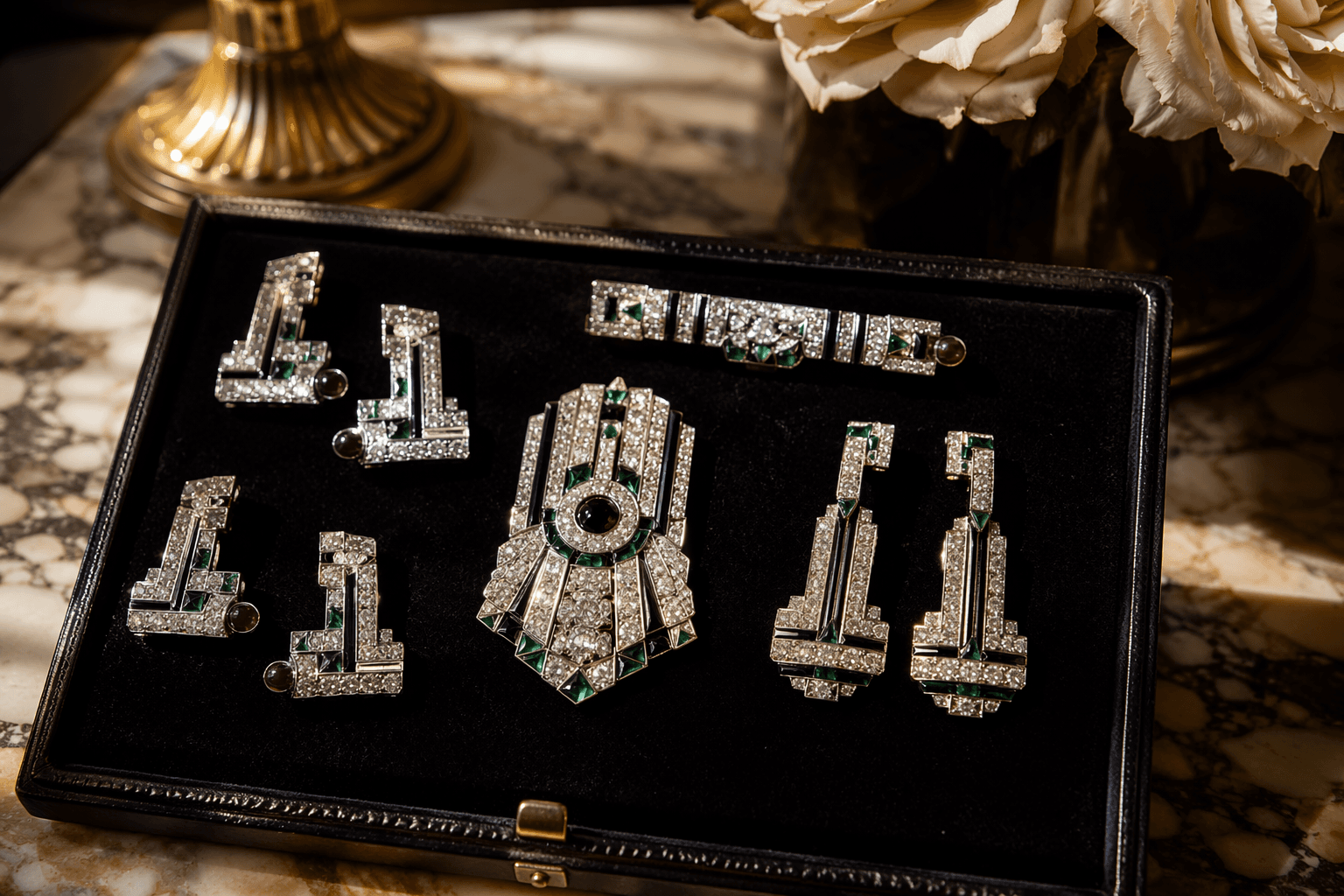
The sapphire and diamond bracelet deserves close reading for a different reason. Sotheby’s notes a similar example sold in New York in 2017, lot 227, which gives this bracelet a useful market reference point and suggests that comparable Cartier bracelets in this idiom have already established auction comparables. When a catalog can point to a closely related sale, collectors gain a better sense of how rarity, condition, and exact configuration influence price.
The sapphire-and-diamond double-clip brooch is especially instructive because the form itself was developed in the 1930s. A true double-clip should function as two matching clips that can be worn separately or joined as one brooch, with no pin penetrating the fabric. That modularity is not a decorative gimmick, it is a hallmark of Cartier engineering, and it is exactly the sort of feature later revival work often simplifies or misunderstands.
The diamond bangle and the lapis bracelet round out the grouping with a quieter kind of value. They may not have the instant graphic force of a double-clip brooch, but they can be excellent study pieces if the signatures, clasps, and stone-setting remain crisp. For vintage Cartier collectors, those are often the lots that offer the cleanest path into a category, because they show how the house balanced wearability, luxury, and structural precision.
Provenance, pricing, and desirability
Phyllis Frank’s name will help, but only if the jewelry itself supports the story. A named private collection can strengthen desirability because it gives the buyer a coherent group with social history and period continuity, yet the pricing question still turns on condition, originality, and how clearly each jewel expresses Cartier’s Art Deco geometry. In other words, provenance is the frame, not the painting.
That is why these seven lots may matter more to collectors than the sale’s most obvious headlines. Sotheby’s top rings, one with a 5.72 ct Kashmir sapphire set within a star-shaped diamond surround and the other with an 8.03 ct brilliant-cut diamond graded G color and VS2 clarity, will attract the biggest bids. The Frank Cartier group, by contrast, offers something rarer for a serious collector: a compact lesson in how to authenticate, compare, and evaluate period Cartier on the merits of design and construction.
The wider sale context
The rest of the London sale stretches from the 19th century through Belle Époque and Art Deco material into bold mid-20th-century design and contemporary jewelry. Andrew Grima, Charles de Temple, Gerda Flockinger, and John Donald bring a British counterpoint to Cartier’s Parisian refinement, and their presence reminds buyers that good collecting is often about seeing design histories side by side.
For anyone building a vintage jewelry wardrobe, that matters. Cartier’s Frank group teaches the language of Art Deco in its most legible form, while the broader catalog shows how that language was echoed, challenged, and reworked in later decades. The best buy-side opportunities here are not the loudest lots, but the ones that let you verify the era from the clasp, the cut, and the line, long before the hammer falls.
This article was produced by Prism’s automated news system from verified source data, official records, and press releases, then run through automated quality and moderation checks before publishing. The system is built and supervised by the people who set the standards it runs under. Read our full AI policy.
Did this article answer your question?