Why antique engagement rings are winning back buyers
Antique engagement rings are winning buyers with visible history, not just sparkle. The smartest purchases come down to provenance, condition, and period detail, not sentiment alone.

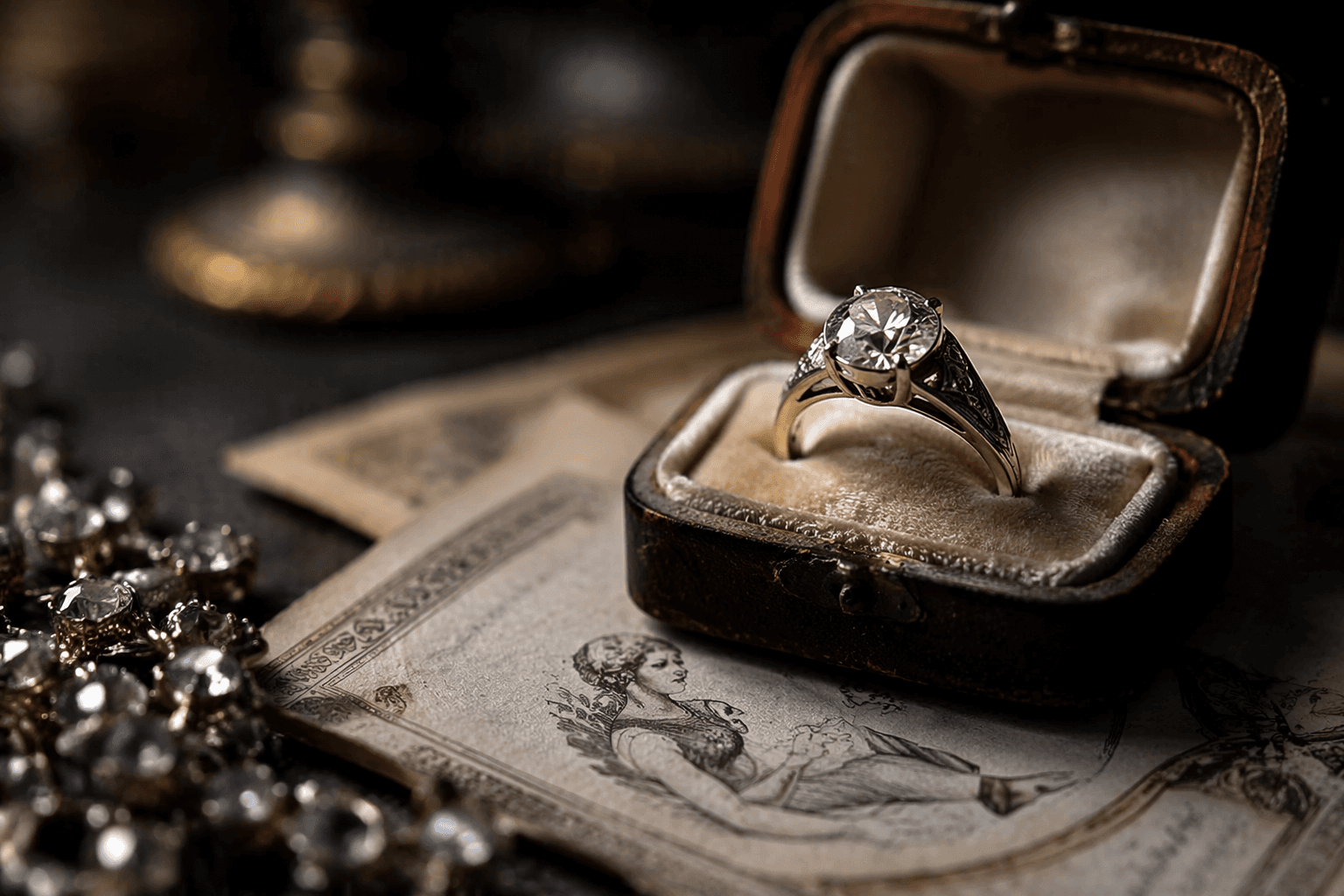
When Taylor Swift and Travis Kelce announced their engagement on August 26, 2025, the ring was an Old Mine Brilliant Cut designed by Kindred Lubeck of Artifex Fine Jewelry. The most persuasive thing about an antique engagement ring is not that it is old. It is that the ring arrives with a silhouette, a setting, and a hand-wrought irregularity that mass-market pieces rarely reproduce. Buyers are responding to that difference now, but the strongest reason to buy antique is still the oldest one: the ring should look like it was made by a human in a specific moment, not stamped out to fit every hand.
Why the antique look feels newly desirable
High-profile engagement coverage has pushed antique cuts back into the conversation, but the appeal runs deeper than celebrity spillover. An old mine cut does not read like a generic modern diamond. It has a softer outline, a warmer personality, and the slight asymmetry that collectors often associate with older hand-finished stones.
That distinction helps explain why antique and antique-inspired rings now feel especially current. The market is full of crisp, uniform rounds and perfectly calibrated cushions, yet older cuts offer a different kind of precision: one rooted in era rather than algorithm.
Start with provenance, not romance
The first question is not whether the ring is beautiful. It is whether the seller can explain where it came from and why it is believed to be what it is. Condition, provenance, and maker attribution repeatedly drive value in antique jewelry, and those details matter because they determine whether you are buying a documented object or a pretty story attached to a diamond.
Trusted sellers treat antique rings as objects with histories that can be traced, not just styled. Heritage Auctions treats estate and vintage jewelry as a collectible category for appraisal and consignment. A ring is not only a jewel, but also a record of ownership, workmanship, and survival. That is why the best sellers can speak clearly about period, construction, and any later alterations, rather than hiding behind vague language about rarity.
A convincing provenance file does not need to be theatrical. It needs to be legible, specific, and consistent with the piece in hand. If the paper trail is thin, the ring can still be worth buying, but the price should reflect the uncertainty.
Read the ring as an object, not an image
Antique rings are commonly organized by era because the design language changes sharply from one period to the next. Georgian rings tend to feel hand-made in the most literal sense. Victorian rings often lean sentimental and ornate. Edwardian pieces move into lace-like lightness, while Art Nouveau favors sinuous, organic lines. Art Deco is the era of geometry and clarity, and Retro jewelry brings bolder proportions and more sculptural forms.
The stone and the setting usually tell the story together. Old mine cuts, with their broad facets and lively, less precise sparkle, are among the most useful clues that a ring belongs to an earlier chapter. Closed-back settings, milgrain edges, and filigree work are equally revealing. A closed-back mount can signal an older stone setting style, while milgrain and filigree often point to hand-finished metalwork that contemporary production rarely bothers to imitate with such care.
Wear is not automatically a flaw. Light thinning on the shank, softened engraving, and tiny abrasions to the facet junctions are the natural fingerprints of age. The concern is not that the ring has lived, but whether it has been altered so aggressively that the original design has been compromised.
Understand repairs before you fall for the silhouette
Repairs can preserve a ring, or they can flatten its character. A sympathetic resize or a discreet re-tipping of prongs may be sensible maintenance, especially on a ring meant to be worn every day. But a replacement head, a rebuilt gallery, or a modern shank added to an older top can change the balance of the piece and, in some cases, reduce collector value.
This is where a buyer’s eye needs to become technical. Look closely at whether the metal color is consistent across the entire ring, whether the setting styles match the purported era, and whether the stone sits in a mount that looks visually coherent with the rest of the design. Antique rings are especially vulnerable to being over-restored into something too clean, too symmetrical, and therefore less honest than the original object.
The best antique engagement rings keep a trace of their age in the way they sit on the hand: a slightly taller profile, a more delicate gallery, or a hand-cut stone with visible personality.
When romantic history adds value, and when it is just marketing
Romantic history has real value when it is tied to a specific object, a documented era, or a maker whose hand can still be recognized. A ring from a clearly defined period, with a cut, setting, and construction that align, offers more than sentiment. It offers evidence.
The phrase becomes thinner when it is used to sell a contemporary ring that merely borrows antique styling. Antique-inspired designs can be lovely, but they are not the same as true vintage or antique pieces. The difference is material, not semantic: an old mine cut is not a modern round brilliant pretending to be one, and a milgrain border on a new ring is not the same as milgrain that has survived decades of wear.
That is why buyers keep coming back to estate and antique jewelry as a distinct category rather than a trend. A commercial market report placed the global vintage engagement ring market at USD 6.2 billion in 2024.
Choose the ring that feels personal, not merely fashionable
A ring should feel personal enough to survive trends, especially when antique pieces already arrive with an aesthetic point of view. The right ring is rarely the flashiest one in the case. It is the one whose era, condition, and workmanship align with the person who will wear it every day.
That may mean a Georgian design with softened edges, a Victorian ring with sentimental detail, an Edwardian piece with fine lace-like metalwork, or an Art Deco ring whose geometry still looks sharp nearly a century later. It may mean choosing a stone with an old mine cut because its facet pattern has warmth, depth, and character that a more standardized modern cut cannot mimic.
This article was produced by Prism’s automated news system from verified source data, official records, and press releases, then run through automated quality and moderation checks before publishing. The system is built and supervised by the people who set the standards it runs under. Read our full AI policy.
Did this article answer your question?