Adams County landowners can cut taxes with CAUV program
Adams County farms can be assessed at CAUV values well below the statewide average, but missing the annual renewal deadline can trigger a tax increase and penalty.
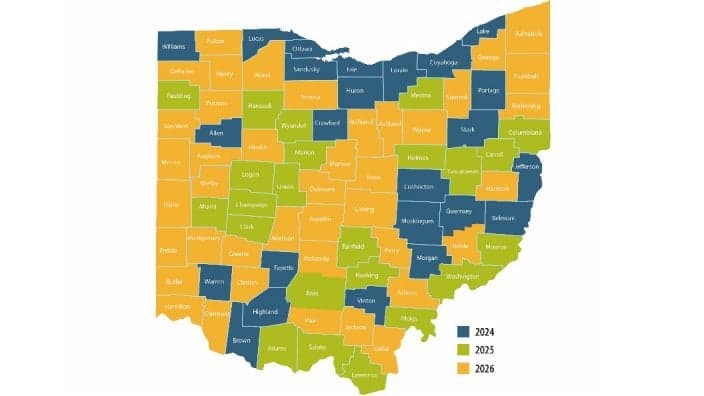
A parcel enrolled in CAUV in Adams County is not taxed like an ordinary piece of rural real estate. The Ohio Department of Agriculture’s 2024 chart lists Adams County’s average CAUV market value at $2,968 per acre, compared with a statewide average of $5,240, which can change the base that a property tax bill is built on before any local levy is applied.
How CAUV lowers the bill
The program provides a substantial reduction in the valuation of land that is exclusively dedicated to agricultural purposes. In Ohio, all real property is generally valued at estimated fair market value or the price it would bring in an arm’s-length sale, except for land in CAUV. In practical terms, that means two parcels that may look similar from the road can land on very different tax rolls if one is being used for agriculture and the other is not.
County auditors sit at the center of this issue. They are determining which land gets the farm-use break, what value attaches to it, and how that value moves through the property tax system.
Who can qualify
The basic eligibility standard used by Ohio county auditors is tied to commercial agriculture. Any Ohio property owner who has engaged in commercial agriculture for the past three years may qualify, and the land has to be exclusively dedicated to agricultural purposes. That is the key distinction: CAUV is built for land genuinely in production, not for vacant acreage held on the hope that it might someday become something else.
That rule matters for owners who farm their own ground, families trying to keep inherited acreage in production, and landowners leasing land to an active operator. If the property is part of a working farm, the program can keep the tax value aligned with agricultural use rather than speculative market pressure. If it is not being used that way, the break is not meant to follow it.
Deadlines and paperwork
The filing calendar is not complicated, but it is strict. Initial and renewal applications may be filed after January 1, and the initial application fee is $25. Renewal applications must be filed with the county auditor before the first Monday in March each year.
That annual filing requirement is the detail that trips up many property owners. Failure to renew may result in a tax increase and a penalty, so the savings that CAUV delivers can disappear quickly if the paperwork lapses. Enrollment is not a one-time box to check. It is an annual obligation, and the county auditor is the office that keeps the program alive for each parcel.
A practical way to think about the process is this:
- File initial or renewal paperwork after January 1.
- Pay the $25 initial application fee if you are enrolling for the first time.
- Renew every year before the first Monday in March.
- Keep the land in agricultural use, because the tax break depends on it.
What happens if the land leaves agriculture
CAUV is designed as a benefit for active farm use, and the backstop is a recoupment penalty if that use changes. The penalty is equal to the tax savings for the past three years if the land use changes to non-agricultural use or if the owner fails to reapply.
For Adams County landowners, that means a later decision to build, subdivide, or otherwise shift the land away from agriculture can trigger a bill tied to the years when the property benefited from reduced valuation. The program is built so land that received a farm-use tax break does not simply convert to a new use without settling the advantage it received.
Why non-farm residents should care
CAUV shapes land values, the cost of holding open ground, and the pressure on farmland at the edge of growth. When agricultural land is taxed on use rather than full market value, it can be more realistic for families to keep land in production instead of selling early to cover rising tax bills driven by development pressure.
The debate also reaches beyond farm gates because it feeds local arguments about fairness. Neighbors who do not farm still live with the consequences of how land is assessed: what vacant acreage sells for, how quickly fields become development sites, and whether tax policy favors speculative value or working production.
A program with deep roots
CAUV has been part of Ohio property tax law for decades. Ohio voters approved the idea in a November 1973 referendum, and the General Assembly enacted implementing legislation in 1974.
The program is also not static. Ohio State University Extension warned in September 2024 that significant CAUV increases in 2024 would affect farmland property taxes in 2025. On June 24, 2025, the Ohio Farm Bureau said 23 counties on the revaluation cycle would see updated values and tax bills and forecast a 50% increase, while on Sept. 3, 2024 it said it was continuing to work multiple channels to address concerns around CAUV, especially values spiking.
This article was produced by Prism’s automated news system from verified source data, official records, and press releases, then run through automated quality and moderation checks before publishing. The system is built and supervised by the people who set the standards it runs under. Read our full AI policy.
Did this article answer your question?