Adams County unclaimed funds list could help residents recover money
A Bentonville name, a Blue Creek business, and other Adams County entries could point to money residents can still claim through Ohio’s free state search.
A name on the 2026 Adams County unclaimed funds list could mean money is sitting with the state under an old address, closed business, or estate file. For families, churches, and business owners across Bentonville, Blue Creek, Peebles, and West Union, the fastest next step is a free search that can lead to a claim.
What this Adams County list is
The county list is an official public record of people, businesses, estates, and organizations tied to Adams County money that has gone unclaimed. Ohio’s unclaimed-funds system is run by the Ohio Department of Commerce, and county guidance says the accounts or deposits are typically inactive for five years or more before holders are required to turn them over to the state.
That makes the list more than paperwork. It is a practical road map back to money that may have been forgotten after a move, a name change, a business closure, or a death in the family. The money can come from dormant bank accounts, insurance proceeds, payroll checks, refunds, rebates, uncashed checks, or deposits that were never collected.
The local names that stand out
What makes the Adams County version useful is its local detail. The entries are tied to familiar places and former residences, not just a generic statewide pool, and the 2026 list includes Adams County locations such as Blue Creek as well as other county communities. One clear example is Harry Davenport, listed with Bentonville as the city, and another is American Rehab & Electrodiagnostics, shown at 1010 Cassel Run Rd in Blue Creek.
The broader list also includes names such as David Gifford, Jessica Applegate, Ethel Baker, Franklin G. Bauman, Lisa Bevens, Susan Birmingham, Philip Blevins, Michelle Brewer, Joseph Campbell, and Randy Chamblin. That spread matters because unclaimed property is not confined to one neighborhood, one surname, or one kind of owner. It can sit under an individual’s name, a business name, or an estate designation, which is why families and executors should scan the list carefully.
For Adams County readers, that variety is the real point. A person may not recognize every entry, but a familiar last name, a former address, or a business that once operated in the county can be enough to justify a closer look.
Why money ends up unclaimed
Most unclaimed funds are not large windfalls that disappeared overnight. They usually start as ordinary money that never reached the right person, then sat untouched long enough for Ohio law to step in. The state’s system is designed to protect that money until the rightful owner, or someone legally acting for that owner, comes forward.
In a rural county, the reasons are often simple and familiar: households move, mail forwarding ends, parents die and leave old accounts behind, or a small business closes before every last deposit or check is cleared. Estate matters can be especially important, because money may be listed under a deceased person’s name instead of the current family name.
How to check the list and file a claim
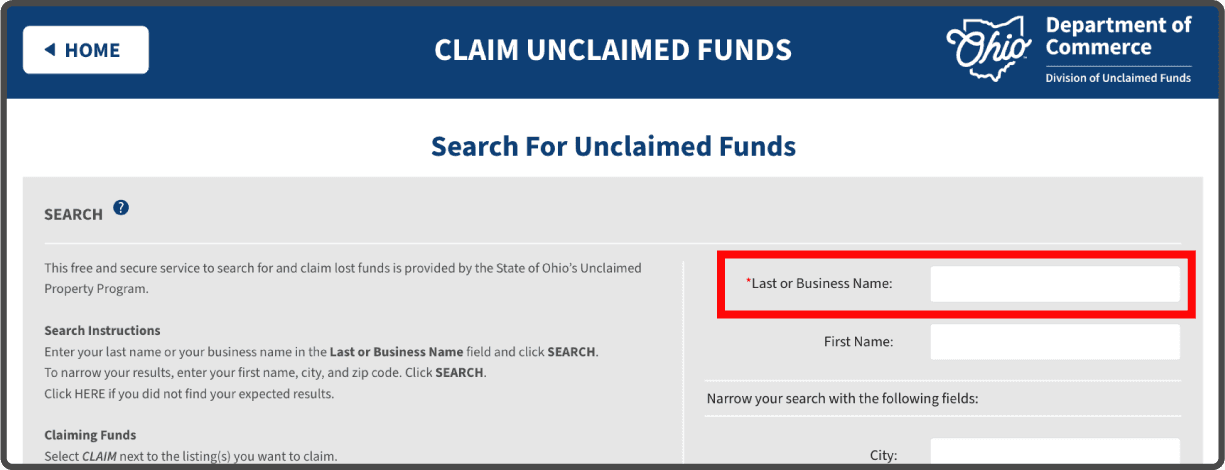
Ohio’s claim search allows you to look for funds by last name or business name, and the state says the service is free and secure. The site also lets you upload documents and check claim status, so the process does not stop at the first search result.
1. Search the state’s unclaimed-funds site using a last name or a business name.
2. If a match appears, review the listing closely and confirm that the address, city, or owner name fits your records.
3. Submit the documents the claim form requires and upload them through the state system.
4. Check claim status after filing, because the state says processing may take 120 days or more.
The state also offers a separate resource for recovering unclaimed funds for deceased property owners, which is important for heirs, executors, and estate representatives. If the money belongs to someone who has died, the claim may need to be handled through the estate rather than by a current household member.
Do not confuse this with tax-sale surplus funds
Adams County also maintains a separate surplus-funds page through the county auditor, and that money is not the same thing as state-held unclaimed property. Surplus funds are overages from tax sales, and the county’s instructions say those funds are held for three years before any unclaimed balance is dispersed to the Adams County Land Reutilization Corporation under state law.
That county process is handled through David Gifford’s office at the Adams County Auditor, 110 West Main Street, Room 104, West Union, with office hours Monday through Friday, 8:00 a.m. to 4:00 p.m. Residents looking for tax-sale overages should use that county channel; residents looking for old checks, dormant accounts, or other forgotten property should use the state unclaimed-funds system.
Why the list matters now
The Adams County list turns a routine government record into a usable recovery tool. A match on the page does not guarantee payment, but it does give residents, churches, families, and business owners a place to start, with a clear state process and a path for both living owners and estates. In a county where old addresses and changing records can leave money behind for years, that is often enough to recover funds that would otherwise keep sitting in Columbus.
This article was produced by Prism’s automated news system from verified source data, official records, and press releases, then run through automated quality and moderation checks before publishing. The system is built and supervised by the people who set the standards it runs under. Read our full AI policy.
Did this article answer your question?