Adams County Quilt Barn Trail turns back roads into outdoor museum
Adams County’s quilt barns began as one daughter’s tribute in 2001 and grew into the nation’s first Quilt Barn Trail, a back-roads route that still defines local tourism.
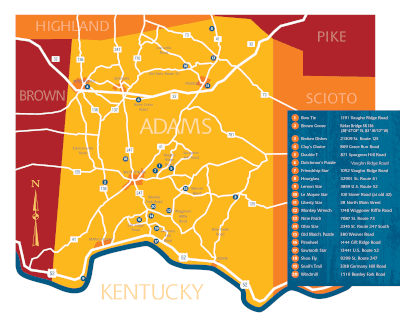
Drive U.S. 52 or State Route 247 through Adams County and the barns start telling their own story. The Quilt Barn Trail began with Donna Sue Groves’ wish to honor her mother, Maxine Groves, a quilter, and grew into the nation’s first Quilt Barn Trail, a countywide route of painted blocks that still pulls travelers onto back roads between Manchester, West Union and Rome.
From one barn wall to a countywide brand
What started as a family tribute in 2001 became a public asset because several local forces lined up behind it. Groves first imagined a painted quilt square on the family barn as a way to honor her mother, and Pete Whan of The Nature Conservancy and Elaine Collins, then Adams County’s economic development director, encouraged the idea. P.A.C.T., short for Planning Adams County’s Tomorrow, helped move the project forward with an Ohio Arts Council grant, and local businesses and residents added support as the trail moved from one barn to a wider county network.
The Adams County trail was dedicated on October 12, 2001, with 20 quilt blocks in the original lineup. Adams County Travel & Visitors Bureau still calls it the nation’s first Quilt Barn Trail, and the trail later expanded beyond the planned 20 quilt squares to reach across the county and beyond. That expansion is part of the story: the trail did not stay a single art installation, but became a visual identity for a rural county that had the patience to build it one barn at a time.
Where to look on the road
The trail works best as a self-guided drive. One of the easiest ways to approach it is to think in landmarks and road names, not just in county lines. The Lemon Star sits west of Manchester on U.S. 52, the Ohio Star is south of West Union on State Route 247 at Lewis Mountain, the Sawtooth Star is near Rome on U.S. 52, and the Pinwheel is on Gift Ridge Road south of West Union.
That geographic spread is the point. Instead of clustering in a single downtown block, the quilts are woven through working roads and small communities, so the route rewards a slow drive and a second pass. You can photograph one block, then compare it with the next turn a few miles away, turning the county into a map of pattern and place.
The patterns carry their own history
The trail is not only scenic; it is a lesson in quilt vocabulary. The historic blocks include Windmill, and the broader pattern language reaches into designs such as Variable Star, Lone Star or Texas Star, and older four-patch forms. That mix matters because the art on the barns is not decorative wallpaper. It connects Adams County to the craft traditions that shaped Appalachian homes, where quilts were both practical and expressive.

Seen that way, the Quilt Barn Trail works like an outdoor museum without walls. Each barn square marks a stop in a larger conversation about geometry, family memory and handwork, and the county’s roads become the gallery space. The result is a route that invites repeat visits because the eye catches different details in daylight, at different speeds, and from different angles of the road.
Why Adams County embraced it
The quilt blocks took root in a county that already had a strong heritage landscape to build on. Adams County Travel & Visitors Bureau points to the Great Serpent Mound National Historic Landmark, the 20,000-plus-acre Edge of Appalachia Preserve, Shawnee State Forest, and seven state nature preserves as part of the county’s draw. The Quilt Barn Trail fit neatly into that mix, adding a man-made landmark that complemented the county’s natural and historic attractions.
That fit helps explain why the trail became more than a local art project. For Adams County, it gave visitors one more reason to leave the main highway, slow down, and stay on the back roads that tie Manchester, West Union and the surrounding countryside together. The trail’s visual consistency also gave the county a recognizable brand, something rural places often try to create and rarely manage to do with this much authenticity.
How the idea spread beyond Adams County
The model moved quickly once the first trail took hold. Neighboring Brown County created its own barn quilt trail soon after Adams County, and the idea went on to spread to nearly all 50 states and parts of Canada. That spread matters because it shows Adams County did not just create a local attraction; it helped launch a format that other places could adapt for tourism, preservation and community identity.
Donna Sue Groves has said in a Quilt Alliance interview, “Friends of mine, Pete Whan with the Nature Conservancy and Elaine Collins, the Economic Development Director in Adams County approached me.” That connection is useful because it shows how the trail took shape as both a personal tribute and a community development effort. Groves has also been identified as the creator of the barn quilt trail movement, and later retellings of her story note the personal hardships behind that persistence, including job loss and breast cancer.
Seen in full, the Quilt Barn Trail is one of Adams County’s clearest examples of homegrown economic development. A daughter’s tribute to her mother became a countywide visual signature, and that signature still draws people off the main roads and into the places that define Adams County best.
This article was produced by Prism’s automated news system from verified source data, official records, and press releases, then run through automated quality and moderation checks before publishing. The system is built and supervised by the people who set the standards it runs under. Read our full AI policy.
Did this article answer your question?